Ministry targets early achievement of 30 million foreign visitors
Plans include converting regional non-apartment buildings into hotels, introducing tourism pass
![Foreign tourists walk through the Myeong-dong shopping district in Jung-gu, Seoul. [Yonhap]](https://wimg.heraldcorp.com/news/cms/2026/07/02/rcv.YNA.20260624.PYH2026062416630001300_P1.jpg)
The Ministry of Land, Infrastructure and Transport is pushing to establish a new tourism-transport bureau as part of efforts to achieve the Lee Jae Myung administration's national policy goal of attracting 30 million foreign tourists ahead of schedule. The ministry is also pursuing plans to convert non-apartment buildings in regional areas into hotels to address an accommodation shortage, while working to improve transportation access for foreign visitors traveling outside Seoul.
According to a government official Wednesday, the ministry is currently preparing to set up the new bureau. After taking office, the Lee Jae Myung administration set a target of attracting 30 million foreign tourists by 2030, riding the wave of the K-culture boom. Earlier this year, the president personally attended the National Tourism Strategy Council and announced the target would be moved up by one year to 2029. Following that, the Ministry of Land, Infrastructure and Transport and the Ministry of Culture, Sports and Tourism jointly launched a "tourism-transport policy council." The land ministry now plans to strengthen that council into a dedicated permanent organization focused on drawing foreign visitors.
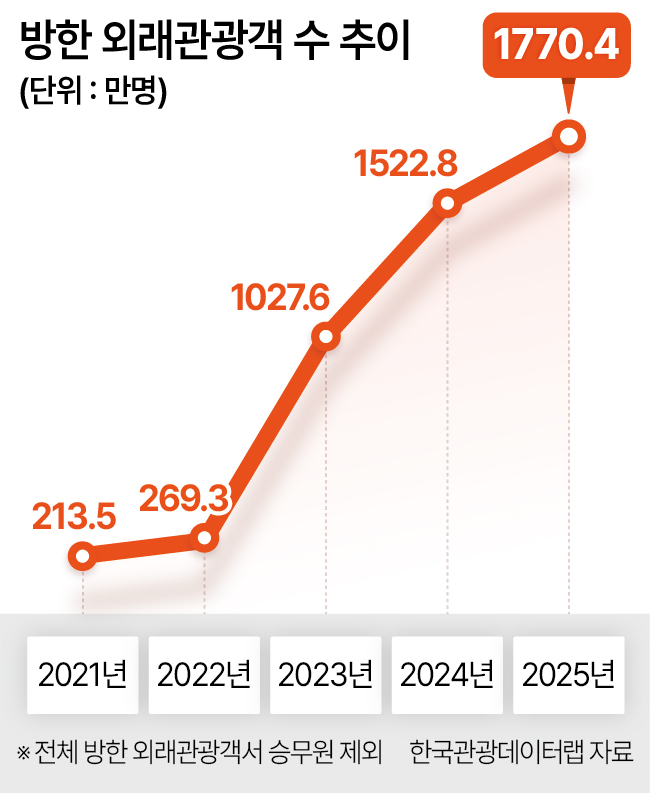
According to the Korea Tourism Organization, the number of foreign tourists who visited Korea last year — excluding crew members — stood at approximately 17.704 million. As recently as 2021, that figure had been just 2.135 million due to the COVID-19 pandemic, meaning arrivals surged 729 percent in roughly four years. In the first half of this year, the number of foreign visitors to Korea exceeded 10 million for the first time on a half-year basis.
The government believes that attracting additional foreign visitors requires activating regional tourism, not just tourism concentrated in Seoul. With 80 percent of inbound tourists gravitating toward the capital, Seoul is showing signs of overheating, including an accommodation shortage.
Once the tourism-transport bureau is established, it is expected to pursue a range of transportation improvements discussed in the earlier policy council. Those include the introduction of a tourism integrated pass, expansion of demand-responsive transport and bus services, launch of late-night airport limousine bus routes, an extended advance booking window for KTX high-speed rail, and installation of dedicated pickup and drop-off zones for platform taxis.
The ministry is also expected to tackle the accommodation supply problem to attract more foreign visitors. A senior Ministry of Land, Infrastructure and Transport official said, "There are not enough hotels in key locations, leaving foreign tourists with nowhere to stay," adding that the ministry "is pursuing a plan to convert well-situated non-apartment buildings in regional areas into hotels."
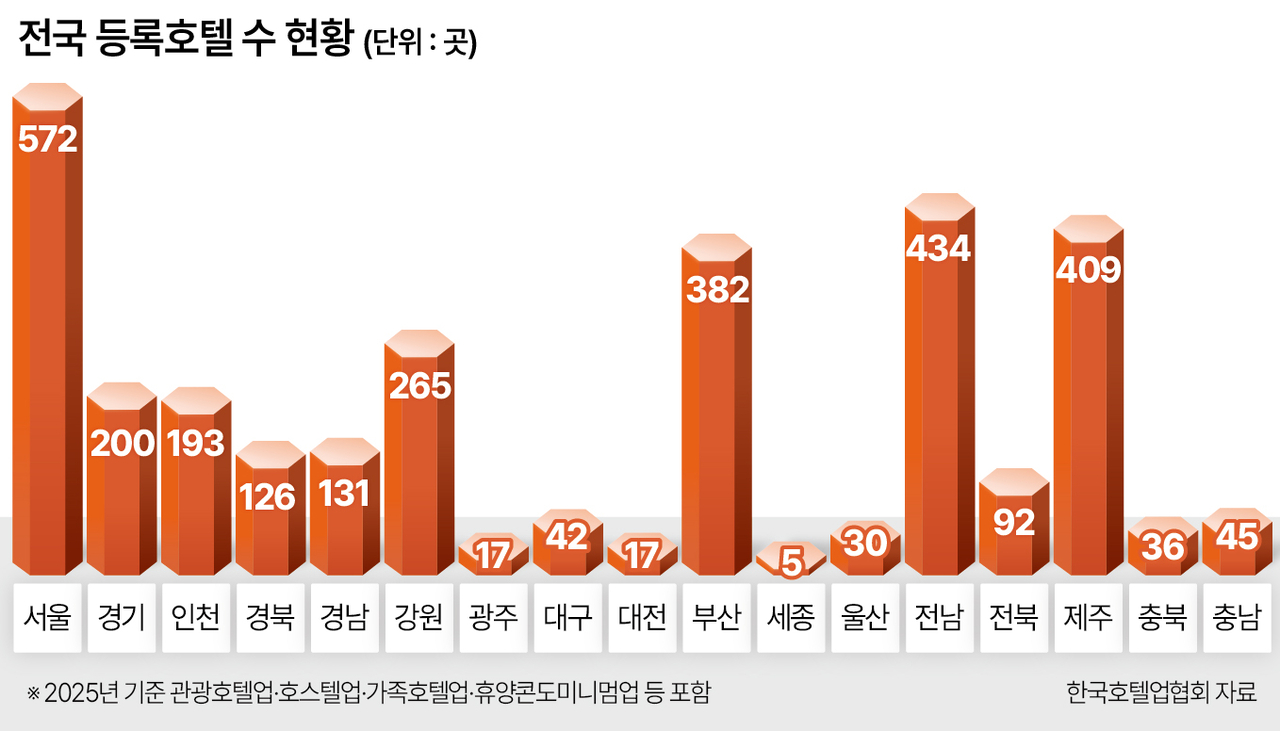
According to the Korea Hotel Association, the number of registered hotels nationwide last year — including tourist hotels, hostels, family hotels and resort condominiums — stood at 2,996. Of those, more than 32 percent, or 965 properties, were concentrated in the Greater Seoul metropolitan area of Seoul, Gyeonggi Province and Incheon.
Regional areas in particular suffer from a chronic hotel shortage that leaves them ill-equipped to handle foreign tourists. Outside of South Jeolla Province (434), Jeju (409) and Busan (382), cities such as Gwangju (17), Daejeon (17) and Ulsan (30) have far fewer properties.
With the land ministry holding authority over building-use conversions, analysts expect that establishing the tourism-transport bureau and launching a large-scale push to increase hotel supply in regional areas could accelerate the drive to attract foreign visitors. The ministry is expected to hold a comprehensive briefing as early as next month covering the current state of inbound tourism and the case for a dedicated organization.
hss@heraldcorp.com
smh@heraldcorp.com