Temporary office lease costs 13.9 billion won; second-half essential expenses short by 15.2 billion won
Basic resident services at risk without government, Incheon city support
Financial burden on newly established districts sparks wider debate
Critics say administrative reform costs were passed down without preparation
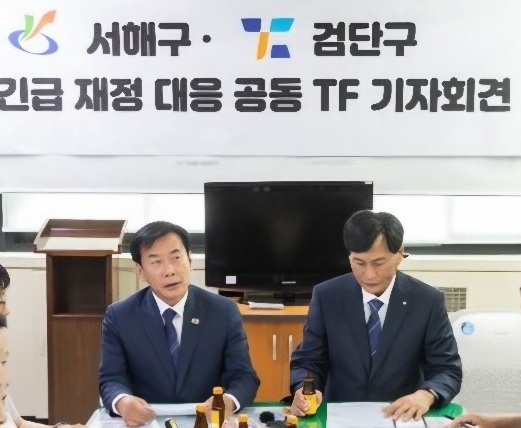
Geomdan-gu, a newly established district carved out of Incheon's Seo-gu, has joined forces with neighboring Sohae-gu after running into serious fiscal difficulties almost immediately after its launch.
The two districts, both created through a recent administrative reorganization, say they cannot independently cover the enormous costs of setting up offices and building administrative infrastructure, and have formally requested financial support from Incheon city and the central government.
Geomdan-gu and Sohae-gu announced Wednesday a joint plan to stabilize the finances of the reorganized districts.
"The administrative restructuring was pushed forward without sufficient fiscal support or advance preparation, leaving us with a heavy financial burden from the very start," Geomdan-gu District Mayor Kim Jin-gyu said. "Active support from the government and Incheon city is absolutely essential to operate the new administrative system in a stable manner."
The biggest strain on Geomdan-gu is the cost of securing office space and building its administrative foundation.
The lease alone for its temporary district office has reached about 13.9 billion won ($8.94 million), and additional costs continue to mount as the district sets up its organizational structure and administrative systems.
Securing budget for essential projects directly tied to residents' daily lives in the second half of this year has also proved difficult.
Geomdan-gu has been unable to secure 15.2 billion won needed for critical administrative services, including waste disposal and snow-removal equipment operations.
Officials warn that if the fiscal gap persists, basic services such as household waste collection, winter road clearing and public safety management could be disrupted.
In response, Geomdan-gu and Sohae-gu agreed to operate a joint emergency fiscal task force — co-led by both district mayors — through December.
The task force will assess the fiscal situation and essential budget shortfalls in both districts and make the case to Incheon city and the central government for financial support.
The crisis has also reignited criticism that the administrative reorganization process failed to adequately examine the fiscal burden it would place on newly created districts.
Administrative boundary reforms are expected to improve residents' access to services and tailor governance to local needs. But voices have consistently argued that stable funding must be secured in advance, given the costs of building offices, staffing and systems for new organizations.
Geomdan-gu is particularly in need of early investment in administrative infrastructure, as the area is undergoing large-scale urban development and rapid population growth.
With fiscal difficulties emerging at the district's launch, debate is expected to intensify over the districts' ability to function and the overall effectiveness of the administrative overhaul.
"Whether the administrative restructuring succeeds depends on whether residents feel a stable improvement in services after the launch," Kim said. "We will work closely with Sohae-gu to keep pressing Incheon city and the central government for the support we need, and do everything we can to prevent any gap in services."
gilbert@heraldcorp.com