Paper use cut 9.07%, greenhouse gas emissions down 1.57%
Full 5-year institutional accreditation secured
Integrated ESG management framework established
President Yuk Dong-in vows to lead ESG practice across education, campus, student welfare and community
Gyeongin Women's University has been embedding ESG principles across its education, campus operations, student welfare and university management, and is now reporting measurable results.
The university has sharply reduced paper consumption and greenhouse gas emissions — including a campus-wide ban on disposable paper cups — while expanding student welfare programs and community service, and has institutionalized ESG practice and monitoring through a performance management system.
The university announced Monday that a review of its ESG education management performance for the first semester of the 2026 academic year showed gains across its "KIWU ESG Education Management" framework, which combines the environmental, social and governance pillars with higher education management.
The university established ESG guidelines and designated responsible departments for 64 diagnostic items spanning education, research, administration, finance, human resources, facilities and organizational management.
The university built a performance management system that tracks each department's progress in real time and feeds annual analysis results back into institutional policy and operations.
The integrated management framework has strengthened overall quality control. In the fourth-cycle junior college institutional evaluation announced in July, the university met all five assessment areas, 30 evaluation criteria and 90 evaluation elements, earning full five-year accreditation.
In the environmental area, the university recorded gains in resource reduction and energy efficiency. Paper use from March through July this year totaled 689,395 sheets, down 68,798 sheets — a 9.07% decrease — from the same period last year.
Greenhouse gas emissions in the first half of this year came to approximately 840.5 tCO₂eq, a reduction of about 13.4 tCO₂eq, or 1.57%, compared with the same period a year earlier.
Gas consumption fell 13.19% and electricity use dropped 3.58%, driven in part by a switch to alternative energy sources for heating and cooling systems.
The university is also working toward a greener campus. A 157.4-kilowatt-peak solar power system installed at the newly built student dormitory supplies renewable energy to the building, and the facility received a preliminary green building certification in June.
A food waste processing system handled approximately 16,000 liters of waste, of which 1,600 liters were converted into eco-friendly compost for use on campus, as part of a broader resource-circulation program.
Efforts to cut single-use plastic have also expanded. The university has provided free personal tumblers to incoming students for seven consecutive years. Starting in September, all departments and academic divisions were in principle barred from purchasing or stocking new paper cups.
Reusable items are now prioritized at on-campus meetings, briefings and events, and the university is digitizing administrative workflows to create a paperless work environment.
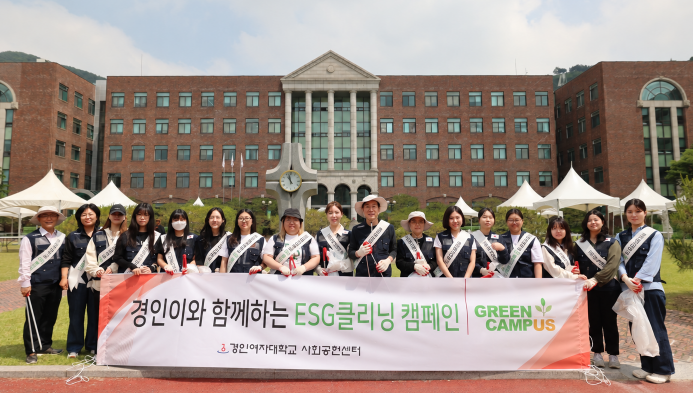
In education, the university offered four ESG-related regular courses in the first semester of this year, enrolling 175 students, and ran four extracurricular programs alongside 22 ESG-themed student clubs. Sixty-nine students took part in plogging activities, and satisfaction scores averaged 99.3 out of 100.
On student welfare and social responsibility, the university strengthened support across the board. It provided welfare scholarships totaling about 148 million won ($110,000) to 533 students facing financial hardship, and pursued tailored support for students with disabilities, international students and others with diverse needs.
Safety and human rights protections were also reinforced. The university completed corrective action on all 21 improvement items identified through risk assessments and recorded zero safety incidents in the first semester.
It overhauled its human rights protection framework through violence-prevention education and the establishment of procedures for handling rights-violation cases, expanded student participation in key committees, and improved operational transparency through external audits and integrity monitoring.
Community engagement continued as well. The university conducted 86 community service activities in the first semester, mobilizing 596 students to provide services and pro bono contributions to 4,507 local residents and others.
Beyond campus, the university is developing an ESG-specialized AI chatbot to help local businesses, small and medium-sized enterprises and students access ESG information, and is providing ESG technical guidance and consulting to companies in the region.
"ESG must not end as a slogan or a campaign — it has to change the daily lives of university members, the way education is delivered and the way the university is managed," President Yuk Dong-in said. "We will continue to lead ESG practice across education, campus life, student welfare and community partnership."
Meanwhile, the university plans to continuously advance its ESG education management framework around the four core strategies of its mid- to long-term development plan, Vision 2028: AI, ESG, K-Care and K-Culture.
The university said it will reinforce sustainable operations through a virtuous cycle in which ESG performance is regularly measured and analyzed, with findings fed back into institutional policy.
gilbert@heraldcorp.com