Ministry of Health and Welfare holds inaugural meeting of establishment preparatory committee
First class to enroll in 2030; details on admissions and other matters still to be worked out
Medical community pushes back as site selection and other key issues remain unresolved
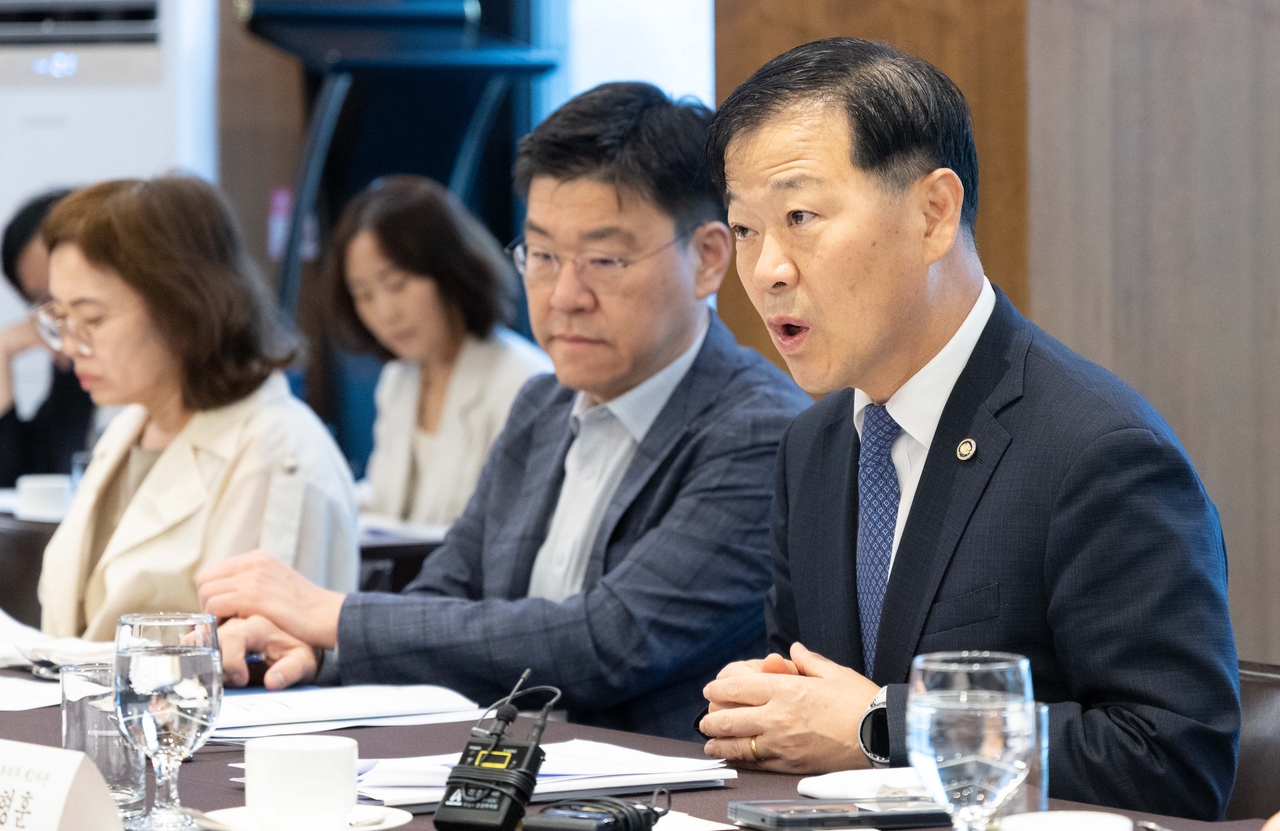
The government has formally launched efforts to establish a national medical graduate school aimed at expanding the public healthcare workforce. It inaugurated a preparatory committee Thursday, targeting a 2029 opening and the enrollment of the first class in 2030.
The Ministry of Health and Welfare held the inaugural meeting of the National Medical Graduate School Establishment Preparatory Committee on Thursday at the Korea Press Center in Jung-gu, Seoul.
The government had designated the establishment of the school as a state policy priority in August last year, citing a chronic shortage of doctors in regional, essential and public healthcare. The National Assembly enacted the Law on the Establishment and Operation of the National Medical Graduate School in May.
The preparatory committee is chaired by the second vice minister of the Ministry of Health and Welfare and comprises 10 members in total — two specialists in public healthcare policy, three in medical education, two in clinical practice at public medical institutions, and officials from the Ministry of Health and Welfare and the Ministry of Education. The committee will deliberate on key matters related to the school's establishment and operation, including infrastructure, organizational structure, curriculum, student support and mandatory service requirements.
Separate expert subcommittees will be formed to cover infrastructure, operational systems, education and mandatory service. Both the preparatory committee and the subcommittees will remain in operation until the school's governing body completes its incorporation registration and the preparatory committee hands over its responsibilities to the school president, at which point the members' terms will end.
The school will operate as a four-year graduate program and plans to admit 100 students per year. Admissions will largely follow the existing medical school selection framework, with a student affairs committee overseeing the process and no regional restrictions on applicants.
The government will cover all study-related expenses, including tuition, enrollment fees and dormitory costs. Students will receive specialized training in public healthcare fields that conventional medical schools rarely address — such as infectious disease, psychiatry, addiction medicine and forensic medicine — through partnerships with key national public health institutions, including the National Medical Center and the National Cancer Center.
Upon graduation and licensure, doctors will be required to serve for 15 years at public medical institutions designated by the minister of health and welfare.
Those who fail to complete their mandatory service or drop out of the program will be required to repay all expenses covered by the state. Non-compliance with corrective orders could result in the suspension or revocation of their medical licenses.
"The establishment of the National Medical Graduate School is highly significant as it introduces a state-led system for training public healthcare professionals," second Vice Minister Lee Hyeong-hun said. "We will do our utmost through the committee to deliberate in detail on the key matters needed to build a top-tier medical education institution."
While the government has laid out its blueprint for strengthening public healthcare through the new school, a number of contentious issues remain to be resolved.
The Korean Medical Association and other medical groups have voiced opposition, arguing that mandatory placement policies undermine the autonomy of the medical profession and do not constitute a fundamental solution to the shortage of public healthcare workers.
"We share the view that strengthening public healthcare is necessary, but treating medical professionals as subjects of compulsory service can never be a sustainable solution," the association said. "The problems in public healthcare must be addressed through rational compensation, improved working conditions and policies that encourage voluntary participation — not through punishment and coercion."
Critics have also raised concerns that requiring graduates to serve for 15 years at state-designated public medical institutions after licensure — excluding military service — and threatening license suspension or revocation for non-compliance constitutes an excessive infringement on freedom of occupational choice.
The government, which has already reviewed similar legal questions in connection with a separate regional doctor service program, maintains that the public doctor system does not violate constitutional rights. The issue, however, is likely to remain a point of ongoing contention.
Because the legislation does not specify a campus site, competition among local governments is expected to intensify. Namwon in North Jeolla Province — home to the former campus of Seonam University's medical school — is among several cities vying to host the institution.
The preparatory committee is expected to select the final site in the second half of this year. Namwon is asserting a strong claim to priority, citing prior consultations among the ruling party, the government and the presidential office that had pointed to using the former Seonam University medical school's enrollment quota of 49 students as the basis for establishing the school there. Several other local governments — including those in South Jeolla Province, North Gyeongsang Province and Incheon, which either lack medical schools or have weak essential healthcare infrastructure — have also entered the competition, citing the need to address regional healthcare disparities.
thlee@heraldcorp.com