Emergency Economic Headquarters meeting unveils high exchange rate SME support plan
Eligibility requirements for raw material importers significantly eased
Trade insurance, currency fluctuation coverage expanded; tax deadlines extended
![Deputy Prime Minister and Finance Minister Koo Yun-cheol presides over the Emergency Economic Headquarters Meeting and Economic Ministers' Meeting at the Government Sejong Building on Friday. [Ministry of Economy and Finance]](https://wimg.heraldcorp.com/news/cms/2026/07/03/news-p.v1.20260703.f9b4ac1db400461086d0661586df9d43_P1.jpg)
The government will provide about 15 trillion won ($9.65 billion) in emergency operating funds — including loans and guarantees — to small and medium-sized enterprises and mid-sized companies hurt by the won's prolonged weakness, as the won-dollar exchange rate hovers in the mid-1,500 won range.
Related ministries jointly announced the plan Friday at the Emergency Economic Headquarters Meeting and Economic Ministers' Meeting chaired by Deputy Prime Minister and Finance Minister Koo Yun-cheol.
The package will channel a total of 14.9 trillion won in emergency operating funds to small, medium-sized and mid-sized companies struggling amid the high exchange rate environment. The government plans to add 1.1 trillion won in new funds to the remaining 13.8 trillion won from the 23.7 trillion won in policy financing originally set aside to address Middle East tensions, bringing the total to 14.9 trillion won. Officials said they would also consider expanding the support if policy funds are depleted quickly.
The Korea SMEs and Startups Agency will create a dedicated track within its emergency business stabilization fund for companies hit by the high exchange rate. Small and medium-sized enterprises whose imports of raw and subsidiary materials account for 20 percent or more of sales will now be eligible for the fund without having to meet the existing requirement of a 10 percent or greater decline in sales or operating profit. The emergency business stabilization fund will also be doubled from 250 billion won to 500 billion won, and the government will offer repayment deferrals and maturity extensions on policy fund loans.
The Export-Import Bank of Korea will expand its special crisis-response program for small and medium-sized enterprises from 7 trillion won to 8 trillion won and widen its preferential interest rate margin by 0.2 percentage points. The bank will also introduce a new ultra-low-interest co-prosperity loan to help companies overcome the high exchange rate, offered at rates equivalent to the bank's own funding cost.
The Korea Technology Finance Corporation will raise the guarantee coverage ratio under its emergency business stabilization guarantee from 95 percent to 100 percent and increase the guarantee fee reduction from 0.3 to 0.4 percentage points.
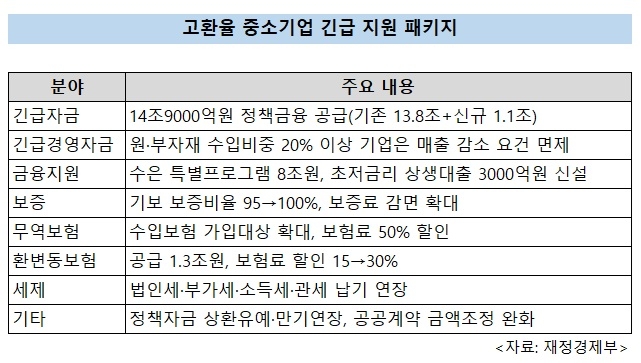
The government will also strengthen trade finance support to ease the exchange rate burden on importing companies. Eligibility requirements for import insurance will be relaxed to allow small, medium-sized and mid-sized companies with no export track record to enroll, and import insurance premiums will be discounted by 50 percent through April next year. Companies facing higher import costs for key raw materials will receive preferential treatment, with the Korea Trade Insurance Corporation doubling the ceiling on its import financing guarantee.
To reduce currency fluctuation risk, the government will expand the supply of currency fluctuation insurance from 1.2 trillion won to 1.3 trillion won and raise the premium discount rate from 15 percent to 30 percent. Eligibility will also be broadened from select raw material importers to all importing companies, excluding those dealing in luxury goods.
For exporters, the government will create a dedicated high-exchange-rate track within the export voucher program, providing 10 billion won in support, and temporarily raise the trade insurance premium subsidy ceiling from 10 million won to 20 million won. The government will also pursue regulatory changes to allow trade insurance premiums — currently paid out after a policy expires — to be disbursed in advance.
Small and medium-sized enterprises using Export-Import Bank loans will be given a free option to switch the currency of their loans, between foreign currency and won or between foreign currencies.
Tax relief measures will accompany the financial support. Companies struggling due to the high exchange rate will receive extensions on deadlines for corporate tax, value-added tax, income tax and tariff payments. The government will also provide consulting to help firms incorporate exchange rate movements into their supplier payment-linkage arrangements. When raw material price surges require adjustments to public contract values, companies will be able to seek contract price revisions regardless of the existing 90-day restriction period.
The measures come as the prolonged high exchange rate — the won-dollar rate surged to 1,549.4 won at end of June — has pushed small and medium-sized enterprises to a breaking point. A survey by the Korea Federation of Small and Medium Business found that 62.7 percent of respondents rated the damage from the high exchange rate as "serious" or "very serious," while every importing company surveyed reported severe harm. Some 71.2 percent of respondents said rising raw and subsidiary material prices had increased their production costs.
"Swiftly relieving the operational burden on small and medium-sized enterprises struggling with the high exchange rate is our top priority," Koo said. "We will closely monitor the difficulties companies face and continue to develop additional support measures as needed."
fact0514@heraldcorp.com