2nm process, advanced packaging facilities under consideration
Taylor fab in Texas set to begin mass production next year
Samsung named 'strategic infrastructure partner' in May
Tesla, Nvidia among growing big-tech customer base
Foundry division's return to profit seen within reach
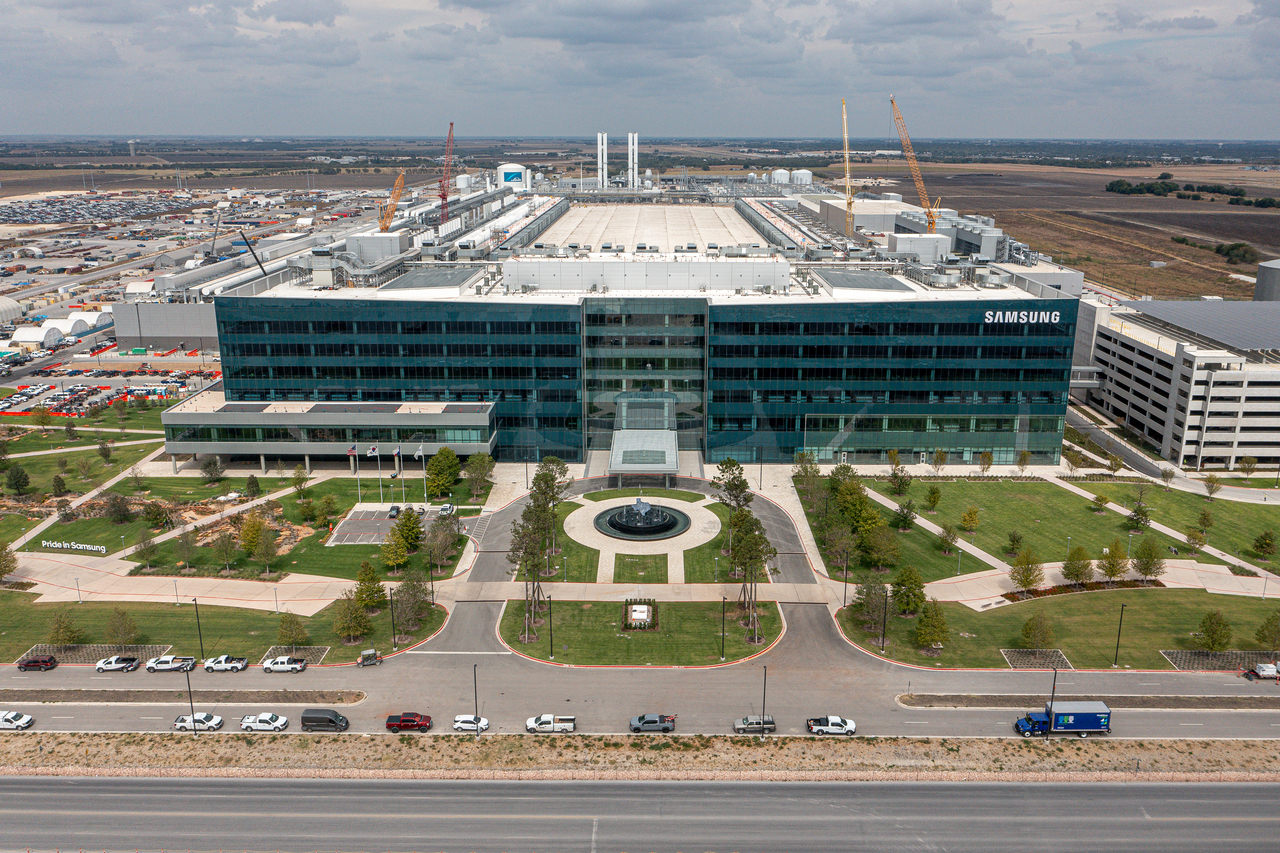
![An aerial rendering of Samsung Electronics' Taylor fab in Taylor, Texas [Samsung Electronics]](https://wimg.heraldcorp.com/news/cms/2026/07/03/news-p.v1.20260130.3ba032e6029a4309acb37d53f365bd7e_P1.png)
Samsung Electronics is in discussions with Anthropic, the developer of the AI model Claude, about producing the company's proprietary AI chips, with the foundry division's 2-nanometer manufacturing process under consideration.
Industry analysts say a contract win could mark the beginning of a turnaround for Samsung's foundry business, which has been steadily adding big-tech clients and is increasingly well-positioned to return to profitability.
Foreign media reported Thursday that Samsung Electronics had held production-related talks with Anthropic, which has begun developing its own AI chips. The discussions involve the possible use of Samsung's foundry division's 2nm process and advanced packaging facilities.
Samsung is preparing to produce 2nm semiconductors at its Taylor fab, built at its Austin, Texas campus. Construction on the Taylor fab began in 2022, and the facility is currently in a trial-operation phase, with full-scale mass production scheduled to begin next year. The next-generation 2nm process raises chip density, delivering superior data processing speeds and power efficiency.
The partnership between the two companies began taking shape in May, when Samsung Electronics was introduced alongside SK hynix and Micron as a "strategic infrastructure partner" during Anthropic's Series H fundraising round.
Anthropic said at the time that the three companies "play a key role in supplying memory, storage and logic chips — semiconductors for computation and control — around the world," adding that they "will be of great help in reliably scaling our computing capacity to meet customer needs."
Industry observers had interpreted Anthropic's mention of a logic chip partner as an implicit reference to Samsung's foundry division. The talks have now progressed into concrete chip production discussions.

The development has fueled optimism about a broader rebound for Samsung's foundry business. With major tech companies racing to develop their own specialized AI chips, TSMC alone cannot absorb all of that production demand. Amid this bottleneck, Samsung — with its advanced manufacturing capabilities — is emerging as a leading alternative. The company is currently pursuing an aggressive order campaign centered on its 2nm process.
Samsung has in fact been landing contracts with prominent players in the global AI market in quick succession. Last year it signed a deal with Tesla worth 23 trillion won ($14.8 billion) to produce the next-generation autonomous driving chip "AI6," and this year it officially confirmed an order for Nvidia's inference language processing unit, the "Groq3." Last month, reports also emerged of a possible order for key components of Google's next-generation tensor processing unit, further filling out the company's pipeline.
The string of wins is expected to heighten expectations for the foundry division's return to profitability. Samsung's foundry strategy centers on phasing out older 8-inch processes and concentrating its technological edge on leading-edge 2nm-to-4nm nodes to accelerate earnings improvement. With recent orders increasingly concentrated in high-margin products, analysts say a return to the black is now only a matter of time.
jeongwan@heraldcorp.com