![[123rf]](https://wimg.heraldcorp.com/news/cms/2026/07/03/news-p.v1.20260703.51dc4028a6e540bf99ebea4d9a6ae23f_P1.png)
The rapid growth of leveraged exchange-traded funds in South Korea's stock market is intensifying a "wag the dog" dynamic in which the derivatives tail wags the underlying asset, analysts say.
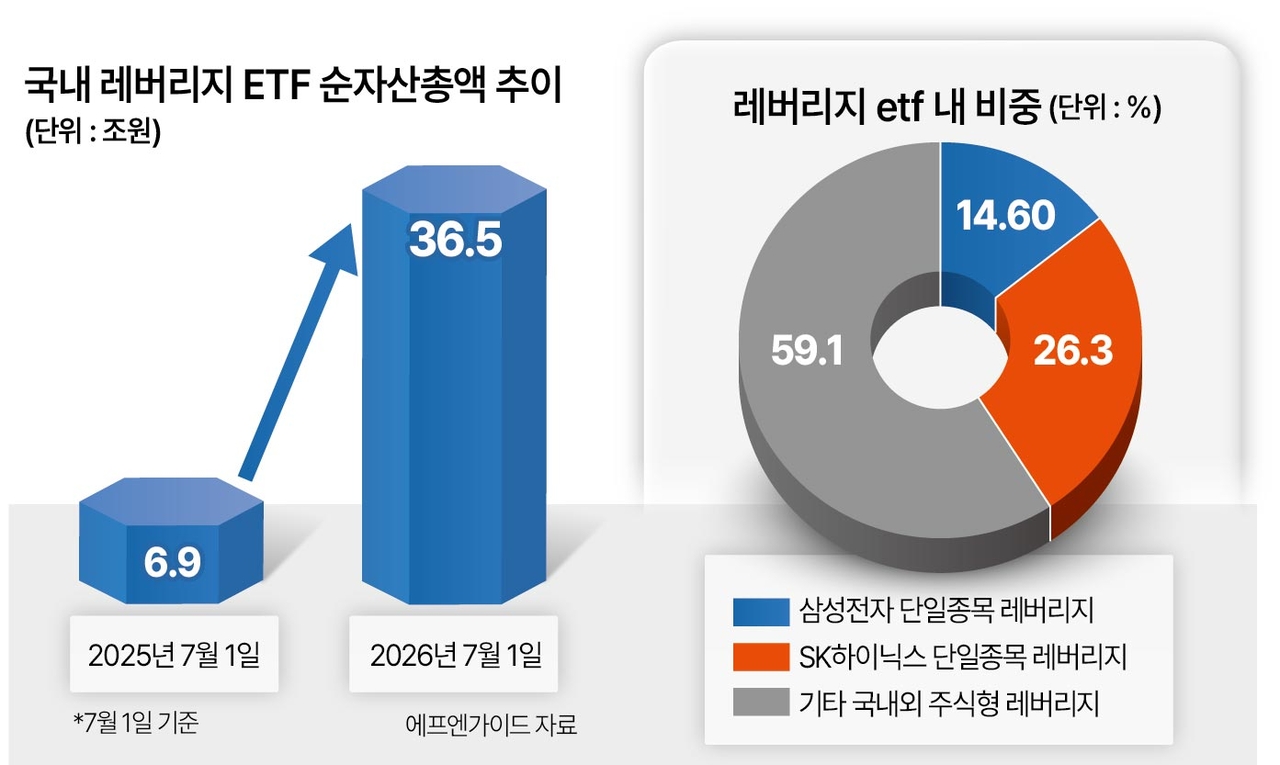
The total assets under management of domestically listed leveraged ETFs reached 36.52 trillion won ($23.5 billion) as of Wednesday, up 431% from 6.88 trillion won a year earlier, according to financial data provider FnGuide.
Their footprint within the broader ETF market has grown sharply as well. Leveraged ETFs accounted for 7.1% of total domestic ETF assets under management as of Wednesday, more than double the 3.4% share recorded a year ago — and more than four times the 1.6% share that Samsung Securities estimates for the US ETF market.
Securities industry analysts agree that the expansion of leveraged ETFs is amplifying market volatility. Yang Il-woo, a researcher at Samsung Securities, said "traditional margin financing expansion is not a factor driving volatility," adding that "the growing share of leveraged ETFs is a supply-and-demand factor amplifying volatility." Leveraged ETFs, the analysis suggests, are emerging as a new variable, replacing margin financing as the primary driver of market swings.
Yu Myung-gan, a researcher at Mirae Asset Securities, echoed that view. "Volatility in the stock market has structurally increased," he said, "because the rapid growth of domestic and overseas ETF markets has expanded the influence of leveraged ETFs."
Last month's domestic stock market saw an unusual bout of extreme volatility. Sidecar trading halts were triggered 10 times on the main bourse, and circuit breakers were activated three times.
The KOSPI 200 Volatility Index, known as VKOSPI, surged to an intraday high of 97.78 on June 24, its highest level since the 2008 global financial crisis. The average VKOSPI for the first half of this year reached 57.3.
Analysts say the domestic market has entered a phase of structural volatility driven by concentration in a handful of leading stocks. Jo Chang-min, a researcher at Hyundai Motor Securities, said "the source of volatility is the concentration in a small number of leading stocks," noting that semiconductors account for 60% of total market capitalization, meaning volatility in a single sector drives the entire index. "On top of that, the activation of the derivatives market and the daily rebalancing of single-stock leveraged ETFs are mechanically amplifying two-way volatility," he said.
In particular, the launch of single-stock leveraged ETFs on Samsung Electronics and SK hynix in May has strengthened what analysts describe as a "wag the dog" effect, where derivatives shake the underlying asset.
The structural characteristics of leveraged ETFs lie at the root of this volatility. To maintain their target return, leveraged ETFs rebalance their exposure to the underlying asset daily before the market close. When share prices rise, they buy more of the underlying asset to maintain target exposure; when prices fall, they sell. This creates a so-called "short gamma" structure in which buying begets more buying in a rising market and selling begets more selling in a falling one.
South Korea's stock market is particularly vulnerable to single-stock leveraged ETFs, given the outsized weight that Samsung Electronics and SK hynix carry in the index.
As of Wednesday, the combined assets under management of 14 single-stock leveraged ETFs tracking Samsung Electronics and SK hynix stood at 14.95 trillion won, accounting for 40.9% of total leveraged ETF assets.
Park Woo-yeol, a researcher at Shinhan Investment, noted that when leveraged ETFs on Nvidia — the stock with the largest market capitalization weighting — were launched, its index weighting was only 2 to 3 percent, and currently stands at around 8 percent. "By contrast, Samsung Electronics and SK hynix together account for about 65% of the KOSPI 200 weighting, so the impact of single-stock volatility on the broader index is that much greater," he said.

moon@heraldcorp.com