New 'high-risk offender cooperative response' protocol takes effect Saturday
Ministry of Justice and police to share data on ankle-bracelet wearers barred from approaching victims
Officers from both agencies to respond simultaneously when offender nears victim
By Yang Geun-hyuk, The Herald Business
South Korea's Ministry of Justice and police have agreed to strengthen surveillance of ankle-bracelet wearers and better protect victims through enhanced information sharing — a response to the Namyangju stalking murder case in March, in which a man wearing an electronic monitoring device stalked and killed his former girlfriend in an act of retaliation, a crime authorities say they failed to prevent because the two agencies were not sharing data.
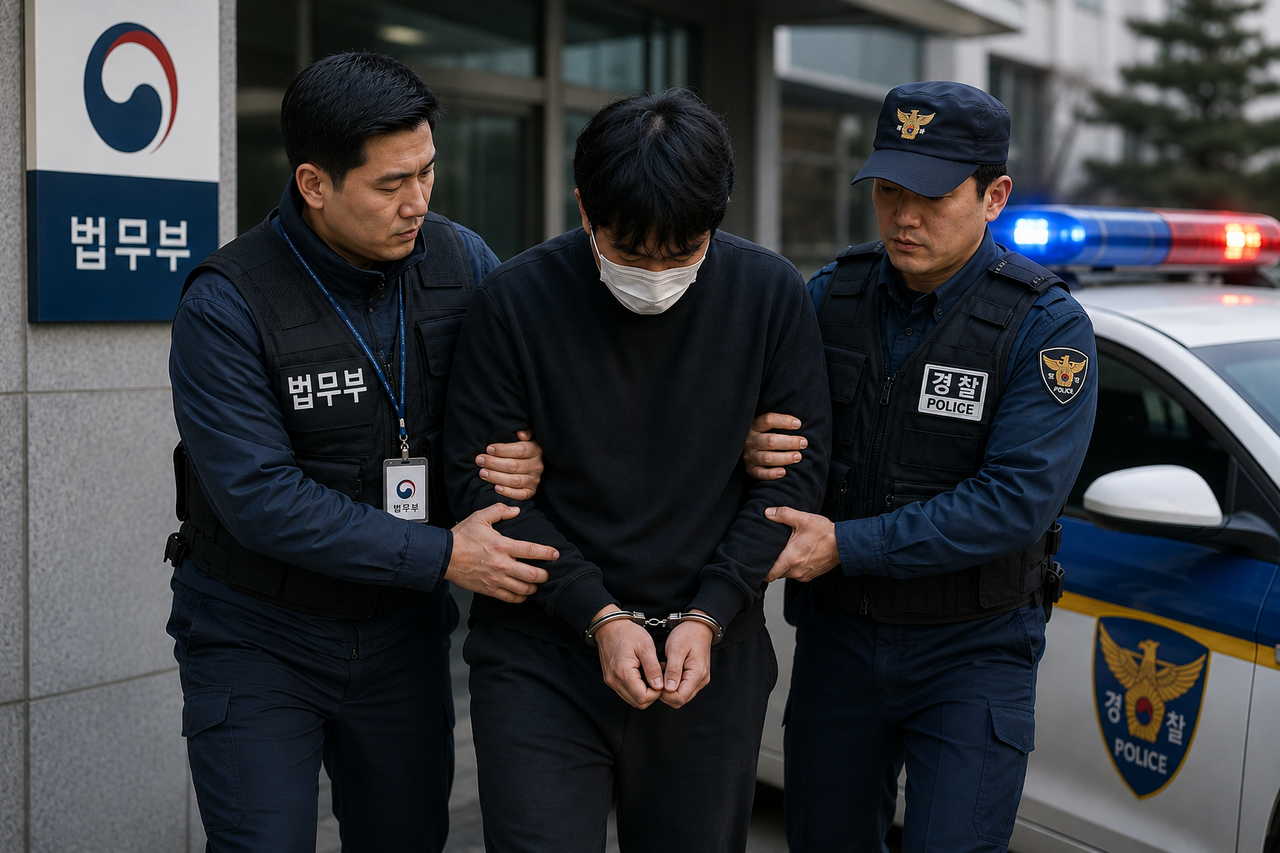
The Ministry of Justice said Thursday that a "Ministry of Justice–Police High-Risk Offender Cooperative Response Protocol" will take effect Saturday. Under the new system, when a person wearing an ankle bracelet for a designated serious offense — sexual assault, murder, kidnapping of a minor, robbery or stalking — commits stalking or domestic violence and receives a court-ordered no-contact order, the two agencies will share that information. When victim protection is needed, a probation officer and a police officer will respond together.
The protocol was designed to prevent a repeat of the so-called Namyangju stalking murder case. In March, Kim Hun, who was wearing an ankle bracelet for a sex crime conviction, committed stalking offenses and had been issued a no-contact order — but that fact was never shared between the Ministry of Justice and police. As a result, neither agency knew he was approaching the victim before he killed her.
The First Criminal Division of the Namyangju Branch of the Uijeongbu District Prosecutors Office indicted Kim in custody on April 8 on charges including retaliatory murder under the Act on the Aggravated Punishment of Specific Crimes, aggravated property destruction, fraudulent use of official marks, use of fraudulently obtained official marks, violation of the Automobile Management Act, and violation of the Act on the Attachment of Electronic Monitoring Devices.
According to prosecutors, Kim broke the driver's-side window of victim A's vehicle with a power drill at around 8:57 a.m. on March 14, dragged her out and stabbed her to death — motivated by revenge against the former girlfriend who had filed a complaint against him. Investigators found that Kim had tracked down A's workplace using a location-tracking device before carrying out the attack.
After the killing, Kim cut off his ankle bracelet while fleeing at around 9 a.m., adding a charge of violating the Act on the Attachment of Electronic Monitoring Devices. He also faces charges of fraudulent use of official marks, use of fraudulently obtained official marks, and violation of the Automobile Management Act for affixing a temporary license plate to a rental car he had obtained and driving it around the Namyangju and Guri areas of Gyeonggi Province from March 12 to 14 — two days before the attack.
Kim and A had been in a relationship. In May last year, when A asked to break up, Kim injured her badly enough to require four weeks of treatment; he was indicted without detention in November last year and was standing trial in the first instance. A again sought to end the relationship in January, and in February filed a complaint against Kim for stalking and violation of the Location Information Act. The court issued provisional measures against Kim under the Stalking Punishment Act — a written warning, a ban on approaching within 100 meters, and a ban on contact via telecommunications. Before all of this, Kim had been sentenced to three years in prison in 2014 on charges including aggravated rape, and was wearing an ankle bracelet under a court order.
![Kim Hun, the Namyangju stalking murderer. [Gyeonggi Northern Police Agency]](https://wimg.heraldcorp.com/news/cms/2026/07/03/news-p.v1.20260319.db53f2119f0a406c91565426ddcf778e_P1.jpg)
Once it emerged that the failure to stop Kim — despite his ankle bracelet and the provisional measures against him — stemmed from a lack of communication between the Ministry of Justice and police, calls grew to improve the effectiveness of the electronic monitoring system.
The Ministry of Justice, which had been supervising Kim because of his past sex crime conviction, failed to recognize that his movements signaled a threat to victim A. Police, for their part, saw no need to share information with the ministry because the reason Kim was wearing an ankle bracelet was not directly connected to the stalking case.
Under the Stalking Punishment Act and the Electronic Device Attachment Act, both enacted in January 2024, information on people subject to provisional measures requiring them to wear a location-tracking electronic device was already being shared. But there was no procedure for sharing information or coordinating a response when someone already wearing an ankle bracelet for a designated serious offense received a no-contact order for stalking or domestic violence. Kim's provisional measures for stalking, it turned out, did not trigger mandatory information sharing.
To close that gap, the Ministry of Justice and police completed a system link on June 23 so that when a person wearing an ankle bracelet for a designated serious offense commits an additional stalking or domestic violence offense and receives a no-contact order, that information is shared swiftly between the two agencies.
The protocol also establishes an immediate joint response for when an ankle-bracelet wearer attempts to approach a victim. When that happens, a probation officer will simultaneously deploy toward the offender while a police officer heads to the victim; if the no-contact order is violated, the two agencies will work together to apprehend the offender and secure the victim's safety.
Justice Minister Jeong Seong-ho said the two ministries had "boldly torn down the information barrier by putting their heads together, laying the groundwork to protect stalking and domestic violence victims far more robustly than before." He added that the government would "continue to fill every institutional blind spot and concentrate all available resources so that the public can live safely and peacefully, free from crime — including stalking and domestic violence."
Yoo Jae-seong, acting commissioner general of the Korean National Police Agency, said the Namyangju murder case had served as a cautionary lesson, prompting the agencies to build a response framework focused on "present and future warning signs rather than an offender's past crimes." He pledged to "thoroughly isolate offenders from the moment they attempt to approach a victim through close information cooperation with the Ministry of Justice, and to build a practical safety net that gives victims genuine peace of mind against the threat of relationship-based crime."
yg@heraldcorp.com