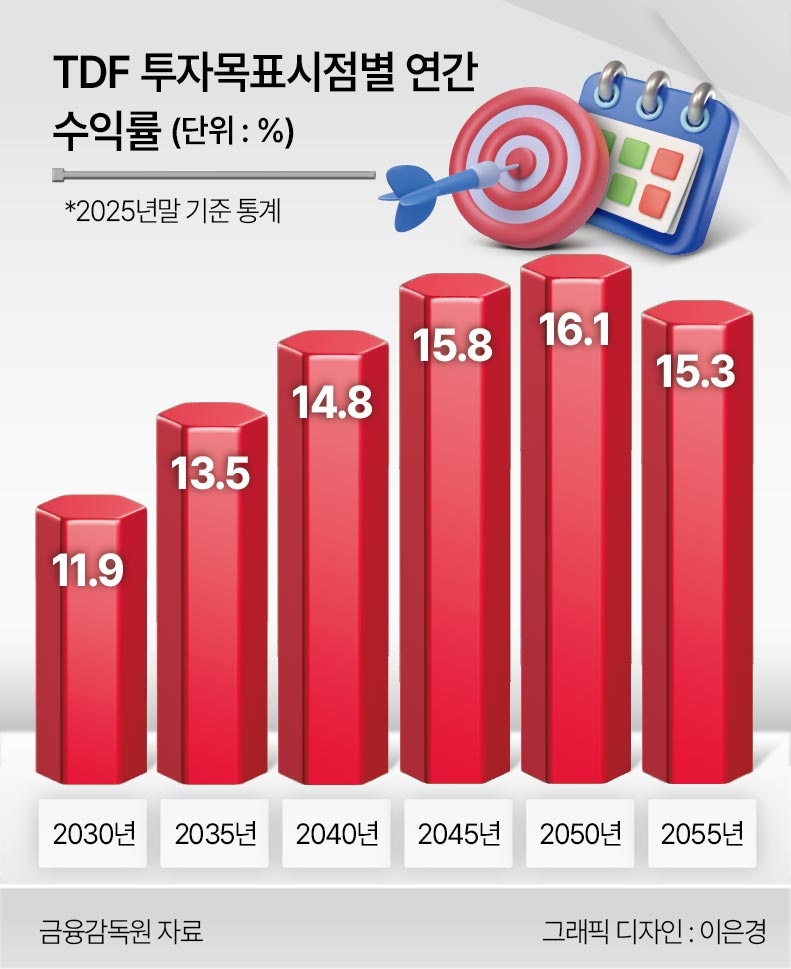
TDF automatically rebalances your portfolio based on your expected retirement date
Simply pick the fund matching your target retirement year and you're set
'Passive' funds track the market; 'active' funds pursue above-market returns
TIF funds, which generate consistent dividend income after retirement, are also worth considering
The Herald Business is launching "Yeongeumbuja" (Pension Rich), a practical personal-finance series on growing wealth through pension accounts. Everyone knows a pension is the most reliable asset for retirement — but the rules and investment options can be so complex that many people don't know where to begin. This series will walk readers through a systematic pension strategy covering goal-setting, growth and withdrawal planning. The journey to becoming pension-rich starts now.
![[Image created using Gemini]](https://wimg.heraldcorp.com/news/cms/2026/07/03/news-p.v1.20260702.ff669c391ced428abf1be18955a6fb45_P1.png)
A manager in his 40s — call him Lee — had always preferred steady saving over active investing, quietly accumulating his salary and severance pay. Diligent as he was, he had done almost nothing to prepare for life after retirement. His occupational pension had sat entirely in principal-guaranteed products earning around 2 to 3 percent a year.
That changed when a bank representative visited his company to run a retirement pension seminar. There, Lee heard about a colleague who had achieved a cumulative return of 80 percent — roughly 13 percent annually — through active asset allocation. The revelation shook him. He realized he had been managing his retirement nest egg in a way that could not even keep pace with inflation.
After the seminar, Lee went straight to the bank for a consultation and learned that his colleague's investment vehicle was a TDF, or Target Date Fund.
When Lee expressed regret at having started so late, the bank adviser told him it was not too late and recommended TDF 2045. Lee wondered whether he could really stay in the workforce for another 20 years, but the adviser explained that the "2045" in the fund's name does not mean he must retire that year. It simply means the fund applies an investment strategy designed for someone retiring around 2045, and therefore carries a relatively higher allocation to growth assets.
Lee shifted a portion of his retirement pension assets into TDF 2045 and, a year later, recorded a return of about 18 percent on that holding. Having experienced firsthand how dramatically outcomes can differ depending on how a pension is managed, he subsequently opened an individual retirement pension (IRP) account and has since been managing his retirement assets far more actively.
Q. What is a TDF?
A. A TDF is a lifecycle fund that automatically adjusts its asset allocation to match an investor's expected retirement date. The younger the investor, the higher the weighting toward riskier assets such as equities; as retirement approaches, the fund gradually shifts toward safer assets such as bonds. The key advantage is that it handles long-term asset management automatically.
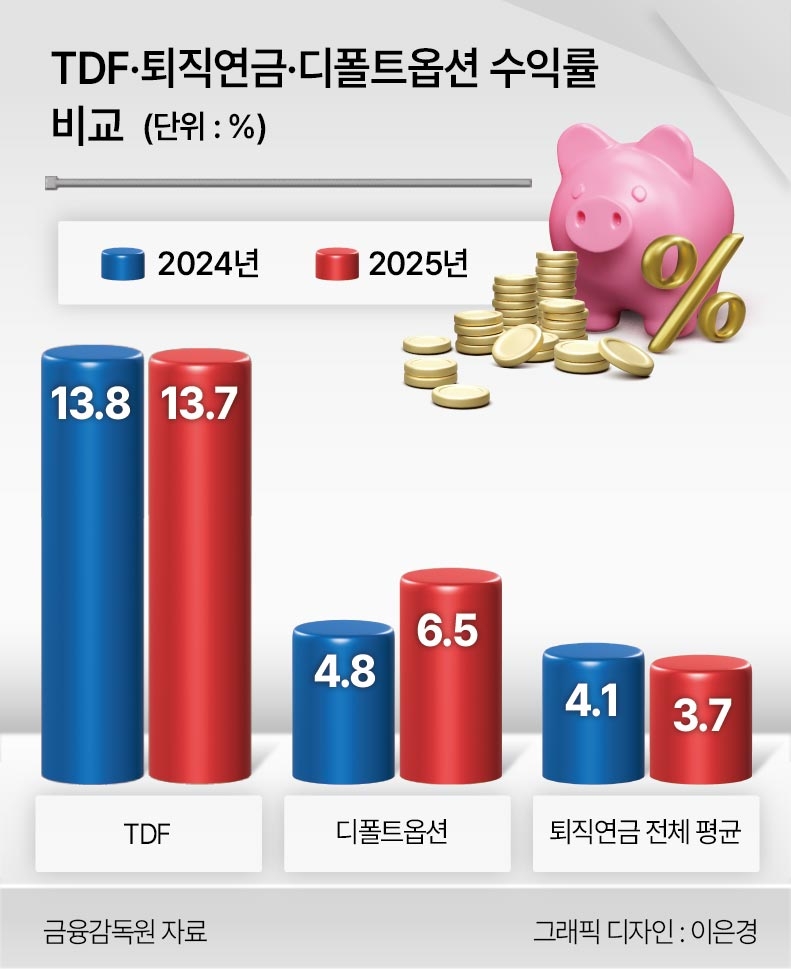
TDF net assets reached 25.6 trillion won ($16.5 billion) at the end of 2025, a 55 percent surge from the previous year, cementing the product's status as a core retirement investment tool. The overall TDF return for the period was 13.7 percent — roughly double the 6.5 percent average return on retirement pensions (a preliminary figure) — and about four times the 3.7 percent return on default options, which tend to be concentrated in principal-guaranteed products. The gap underscores the importance of diversified asset allocation.
Q. How do I choose the right TDF for me?
A. One straightforward approach is to match the fund's target year to your expected retirement date. If you plan to retire around 2040, you would choose TDF 2040. You do not have to pick a fund that precisely matches your current age. The number in a TDF's name is simply an indicator of how aggressively the fund is managed. Even someone planning to retire in 2030 could choose TDF 2050, 2060 or 2080 if they want a higher allocation to risk assets and a greater expected return.
You should also compare the glide paths — the asset-allocation curves — of different fund managers. Two TDF 2050 products from different managers can carry very different weightings in risk assets, and the final equity allocation at the target retirement date also varies. If you can tolerate market volatility well, a fund with a higher initial risk-asset weighting that declines gradually tends to be more advantageous for long-term returns.
It is also worth understanding whether a fund is primarily passive — tracking a market index — or primarily active, pursuing above-market returns. Most TDFs are structured as fund-of-funds, investing in a portfolio of globally diversified quality funds rather than buying individual securities directly.
Q. What is the difference between a passive and an active TDF?
A. A passive TDF invests so that its underlying assets — equities, bonds and others — track average market returns. Country and sector weightings are maintained in line with the market regardless of conditions, which makes performance relatively predictable. An active TDF, by contrast, gives fund managers the flexibility to adjust country and sector weightings in pursuit of returns above the market average. Managers can also selectively include globally promising funds or innovative growth-theme funds depending on market conditions.
If your preference is to track the market steadily and reliably, a passive TDF is the better fit. If you trust professional managers to deliver above-market performance, an active TDF is the way to go.
Q. Some TDF products are labeled 'qualified' — what does that mean?
A. A "qualified" TDF is one that complies with regulatory operating guidelines designed to prevent excessive concentration in any single asset class or country and to encourage long-term diversified investing. Under Financial Supervisory Service rule changes that took effect in April this year, a qualified TDF must hold at least 20 percent of its assets in safe instruments such as bonds and cash, and may not allocate more than 80 percent to any single country. Because a qualified TDF already has built-in safe-asset requirements, it is exempt from the separate safe-asset rule that normally applies to retirement pension investments — the rule capping risk-asset exposure at 70 percent. In practical terms, if you have 1 million won in retirement pension assets, you can put up to 700,000 won into a standard TDF, but you can invest the full 1 million won in a qualified TDF.
Q. Has TDF been proven in overseas markets?
A. TDF has long been a mainstream retirement investment vehicle in leading pension markets such as the United States and Australia. In the US, the Pension Protection Act introduced a default option regime that designated TDF as a core qualified default investment alternative, ensuring that even participants who do not actively choose their own investments have their contributions managed according to a long-term asset-allocation strategy.
Australia's superannuation system has grown on the foundation of long-term diversified investing across equities, bonds, real estate, infrastructure and other asset classes. The fact that the system and its products handle asset allocation on behalf of members — even those without financial expertise — reflects the same investment philosophy that TDF embodies.
Q. Is choosing a TDF enough to manage pension assets across all life stages?
A. For younger investors in the asset-accumulation phase, or those seeking higher returns, combining TDF with direct equity investments to raise the overall risk-asset weighting is a good way to boost expected returns. For those in or approaching the drawdown phase after retirement, however, reducing volatility and building assets steadily becomes the priority. In that case, constructing a portfolio centered on income-generating assets that deliver consistent dividends — or using a TIF — is also worth considering.
Q. What is a TIF?
A. A TIF, or Target Income Fund, is a pension drawdown fund designed to preserve accumulated assets while generating regular cash flow for withdrawal. It invests primarily in assets that produce steady income streams — bonds, high-dividend equities, real estate investment trusts and other alternative investments. Unlike a TDF, which grows assets through capital gains from rising share prices, a TIF provides retirees with stable, regular pension income by drawing on the returns generated by the underlying assets themselves. The ultimate goal is to defend against inflation and longevity risk after retirement, slow the depletion of accumulated pension assets as much as possible, and ensure the income stream does not run dry.
Q. Investing in TDF during a market downturn feels risky.
A. A falling market can actually be a good opportunity to grow pension assets. Asset prices inevitably go through downturns as economic conditions and policy change. Because share prices — led by growth stocks — tend to rebound quickly after a slump, younger investors in the accumulation phase have ample time to recover from periods of weak performance. For them, raising the allocation to growth-oriented risk assets during a price decline is an important strategy for building future wealth.
Investors closer to retirement need to account for the risk that a post-downturn recovery may take longer than expected. If you are investing in risk assets, avoid concentrating in a single country or sector — diversification is the best way to manage portfolio volatility within your risk-asset holdings.
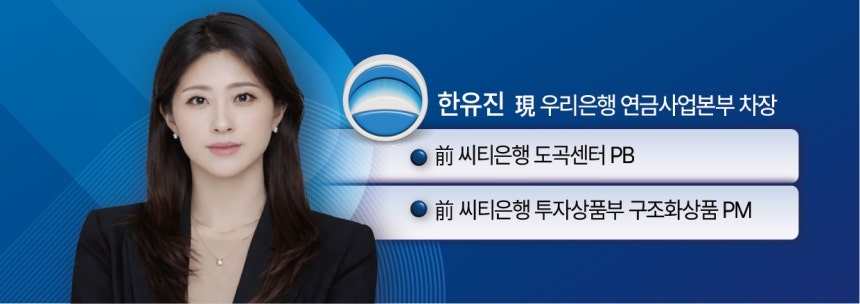
By Seo Sang-hyeok / Han Yu-jin and Lee Ha-yeon, deputy managers at Woori Bank
hyuk@heraldcorp.com