South Korea's won-dollar foreign exchange market shifted to round-the-clock, uninterrupted trading Monday, with market participants divided on whether the change will stabilize the exchange rate or amplify volatility.
Forex authorities said the change, effective Monday, extends interbank won-dollar trading through a broker-mediated system to run from 6 a.m. Monday through 6 a.m. Saturday — replacing the previous window of 9 a.m. to 2 a.m. the following day. The expansion means won-dollar transactions can now take place every day except Sundays and Jan. 1.
The won-dollar rate opened at 1,527.6 — up 2 won from the previous session's daytime close — and continued to climb, reaching 1,529.4 by 8:18 a.m.
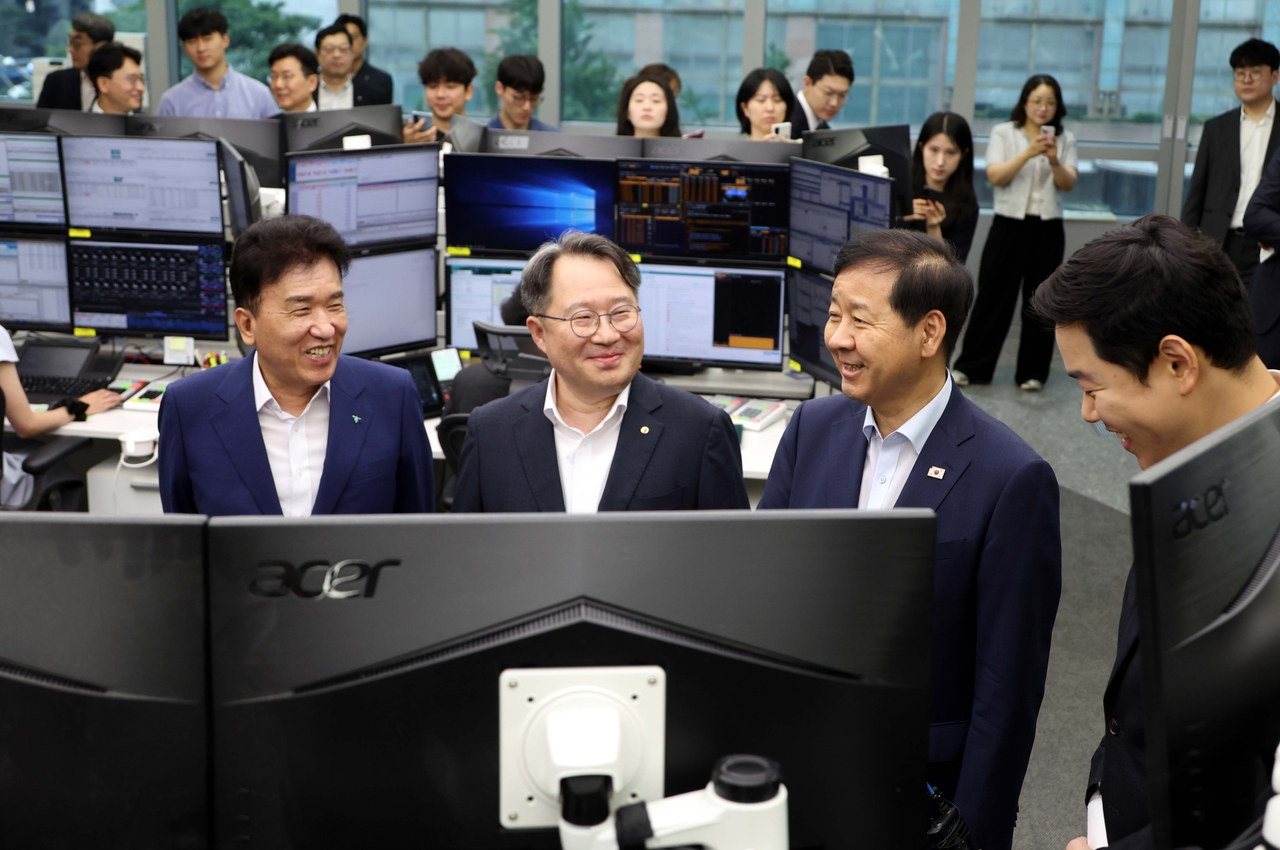
Deputy Prime Minister and Finance Minister Koo Yun-cheol, Bank of Korea Deputy Governor Kwon Min-su and other forex authorities, along with Hana Financial Group Chairman Ham Young-joo and Hana Bank President Lee Ho-seong, visited the bank's foreign exchange dealing room at its Seoul headquarters at 7:30 a.m. to hear from market participants — including domestic banks, overseas branches and exporters — and to encourage dealing room staff.
"The 24-hour launch is a forex market reform measure that reflects our confidence in Korea's economic fundamentals — including solid external soundness and a record current account surplus — as well as strong demand from foreign investors for our foreign exchange and capital markets, as demonstrated by Korea's inclusion in the World Government Bond Index," Koo said.
The extension of trading hours is fundamentally aimed at improving convenience for overseas investors. Authorities expect the move to eliminate gaps in trading hours, making currency exchange more accessible for domestic and foreign investors and import-export companies alike, while also reducing transaction costs.
Officials also expect the change to reduce exchange rate volatility by drawing offshore transactions — previously conducted after the market closed — back into the domestic market. In the past, international news that broke while the market was shut would be absorbed all at once when trading resumed, causing sharp rate moves at the open. Authorities expect that pattern to ease going forward.
According to a Hanwha Investment analysis, gap volatility — a measure of shocks that accumulate while the market is closed — fell 41.6 percent after the forex market's trading hours were extended to 2 a.m. in July 2024. A separate report by the Korea Capital Market Institute found that gap volatility dropped 52.6 percent following that extension.
Concerns remain, however. A large order arriving during the low-volume early morning hours could trigger sharp swings in the exchange rate. Hanwha Investment said overall forex market volatility expanded 30.4 percent after the trading hours extension, driven mainly by the overnight session.
"The 24-hour launch will broaden and deepen our foreign exchange market," Bank of Korea Deputy Governor Kwon said. "We need to continue working with the government on various policy efforts to make that expectation a reality, and we will closely monitor the market impact and trends that emerge from the round-the-clock opening."
Forex authorities plan to accelerate the "internationalization of the won" as part of a broader push that includes the 24-hour market launch. The blueprint calls for improving the accessibility and stability of foreign exchange transactions to international standards, with the aim of promoting won-denominated capital and real-economy transactions and advancing the forex market.
"The 24-hour forex market opening goes beyond simply extending trading hours — it is core infrastructure for achieving the level of accessibility and convenience found in advanced markets," Koo said. "It will serve as the starting point for the won's leap onto the global stage."
An offshore won settlement system set for introduction next year is also part of the won internationalization drive. The system would allow foreign financial institutions to open won-denominated accounts at domestic banks, enabling them to hold, procure and settle directly in won. A new round-the-clock settlement network would be built to allow won-denominated payments even during overnight hours.
"We will push ahead without delay on other forex market reform measures as well, including the offshore won settlement system, which will enable 24-hour monitoring with no gaps and support smooth round-the-clock trading while also making settlement — that is, fund transfers — possible at any hour," Koo said.
kimstar@heraldcorp.com