Samsung Electronics is estimated to have surpassed 100 trillion won ($64.9 billion) in second-quarter operating profit before accounting for semiconductor bonus provisions — a threshold the company has never crossed before. Soaring memory chip prices are expected to drive another set of results that beat market expectations.
The semiconductor industry is watching closely to see whether the record-breaking performance will underpin Samsung's newly announced 450 trillion won investment plan spanning South Jeolla Province and the Chungcheong region, while also putting to rest concerns about a memory bubble.
According to industry sources Monday, Samsung Electronics will release its preliminary second-quarter earnings Tuesday morning. Securities firms estimate the company's Q2 sales and operating profit at approximately 173.86 trillion won and 85.5 trillion won, respectively, with the operating margin expected to approach 50 percent.
The results would surpass the previous record set in the first quarter — sales of 133.87 trillion won and operating profit of 57.23 trillion won — within a single quarter.
Expectations for Samsung's results have also risen after Micron, the world's third-largest memory chip maker, silenced bubble concerns with results that exceeded market forecasts.
Starting in the second quarter, Samsung began booking provisions for performance bonuses in its Device Solutions division, which oversees the semiconductor business. Securities firms recently trimmed their earnings estimates somewhat to account for this.
The Device Experience division, which handles finished-product businesses including mobile and home appliances, is expected to see a sharp deterioration in profitability due to rising component costs. Analysts believe the memory division's record performance will have offset those headwinds, however.
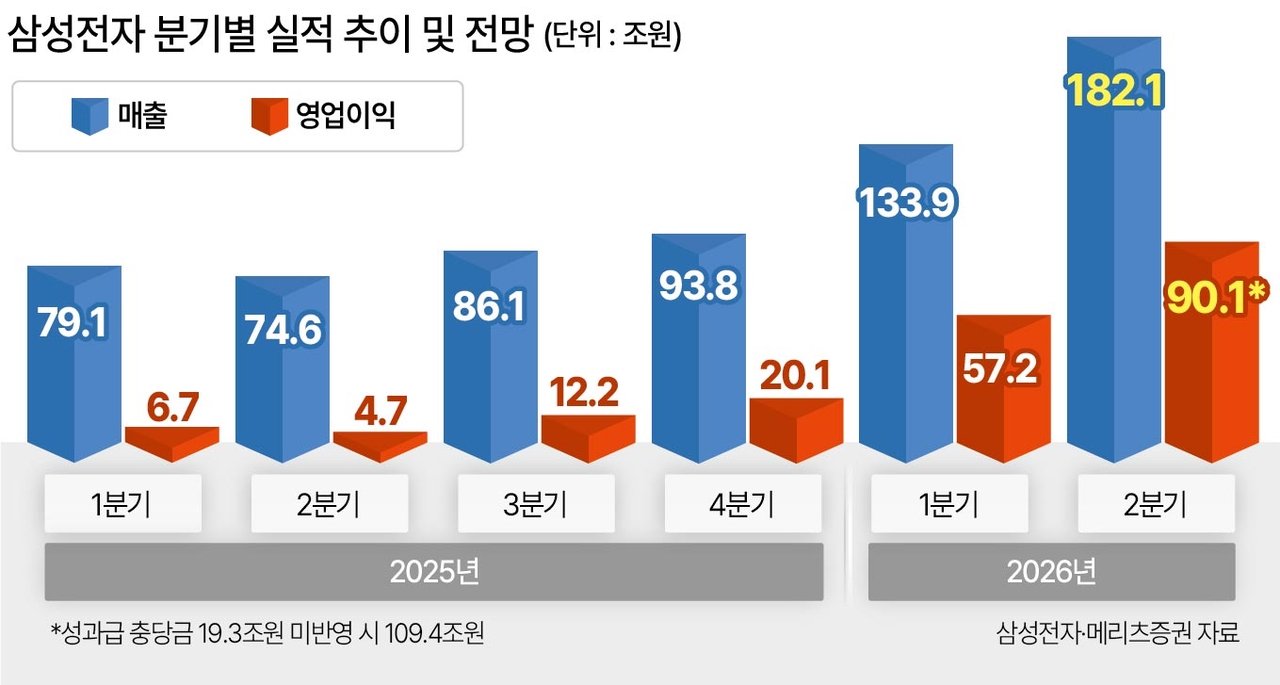
Meritz Securities, in a report published Monday, put Samsung Electronics' second-quarter operating profit at 90.1 trillion won — above the market consensus.
The brokerage estimated semiconductor bonus provisions at 5.6 trillion won for the first quarter (retroactively applied) and 13.7 trillion won for the second quarter. Before reflecting the combined 19.3 trillion won in provisions, second-quarter operating profit would reach 109.4 trillion won.
Meritz Securities said the non-memory segment — comprising the System LSI and foundry units — posted an operating loss of around 2 trillion won, but the memory division generated 112 trillion won in profit, more than covering the shortfall.
The Mobile Experience division faces the possibility of its first-ever quarterly operating loss as the impact of surging memory prices fully materializes. The home appliance and TV businesses are also estimated to have swung back to a loss of around 100 billion won within a single quarter.
With losses assumed across non-memory, mobile, home appliance and TV operations, analysts conclude that Samsung generated essentially all of its second-quarter operating profit from semiconductors alone.
Industry estimates suggest that DRAM and NAND selling prices rose more than 40 percent and more than 60 percent quarter-on-quarter, respectively, in the second quarter. Samsung holds the largest memory production capacity in the industry, and analysts expect the company to continue setting earnings records in the second half of the year by leveraging that supply advantage.
The finished-product businesses, by contrast, face unavoidable margin pressure in the second half as memory costs climb further, and the divide between the DS and DX divisions is expected to widen.
Samsung Electronics, SK hynix and Micron are all racing to expand memory production capacity, but the industry expects the current memory shortage to persist through at least 2027.
With memory selling prices continuing to rise, Samsung's full-year operating profit is estimated to surge 790 percent year-on-year to 380 trillion won this year and reach 570 trillion won in 2027, implying cumulative operating profit of 950 trillion won over the two years.
Samsung has previously announced plans to invest 400 trillion won to build a new front-end fabrication facility in the integrated special city of Gwangju in South Jeolla Province, and 56 trillion won to construct a cutting-edge HBM fab in Cheonan and Onyang in South Chungcheong Province.
joze@heraldcorp.com