![The Bank of Japan headquarters in Tokyo. This photo is not directly related to the article. [Reuters]](https://wimg.heraldcorp.com/news/cms/2026/07/07/9/news-p.v1.20260226.dee87b2e60004d028ae013ee8cbea69e_P1.jpg)
Japan is actively considering adopting South Korea's foreign land-transaction permit system as Tokyo grapples with surging home prices, the Herald has confirmed. It marks the first time Japan — a country with virtually no restrictions on real estate transactions — has sought policy advice from the South Korean government on property regulations.
According to government sources Tuesday, Matsushima Midori, an aide to the Japanese prime minister on foreign affairs policy, visited South Korea in April and requested a meeting with Kim I-tak, first vice minister of the Ministry of Land, Infrastructure and Transport. At the meeting, Matsushima pressed for detailed information on the policy effects of South Korea's owner-occupancy requirement under the foreign land-transaction permit system, as well as the sanctions available for violations.
Matsushima previously served as Japan's 94th minister of justice under the Liberal Democratic Party in 2014 and currently serves as a member of the House of Representatives in the 51st session and as a cabinet aide to the prime minister. The primary purpose of her visit was to meet Justice Minister Jeong Seong-ho to exchange views on integrating foreign nationals into society and on expanding people-to-people exchanges between the two countries. She also called on the Ministry of Land, Infrastructure and Transport to seek advice on measures to address the surge in Tokyo home prices.
Average apartment prices in Tokyo's 23 wards have recently surpassed 130 million yen ($805,000), with home values rising across the greater metropolitan area. The Japanese government attributes part of the increase to foreign capital flowing into the domestic real estate market in pursuit of gains from the weak yen.
South Korea faced a similar challenge and acted on it. Last August, the government designated major areas across Greater Seoul, including all of Seoul, as foreign land-transaction permit zones, restricting home purchases by foreigners without genuine owner-occupancy intent. Under the rules, anyone buying a home in Seoul or parts of Incheon and Gyeonggi Province must move in within four months of receiving a permit and must live there for at least two years after acquiring the property.
Violators receive a compliance order from the local government within three months, and those who fail to comply face repeated enforcement fines of up to 10 percent of the acquisition price. In serious cases, the land-transaction permit may be revoked.
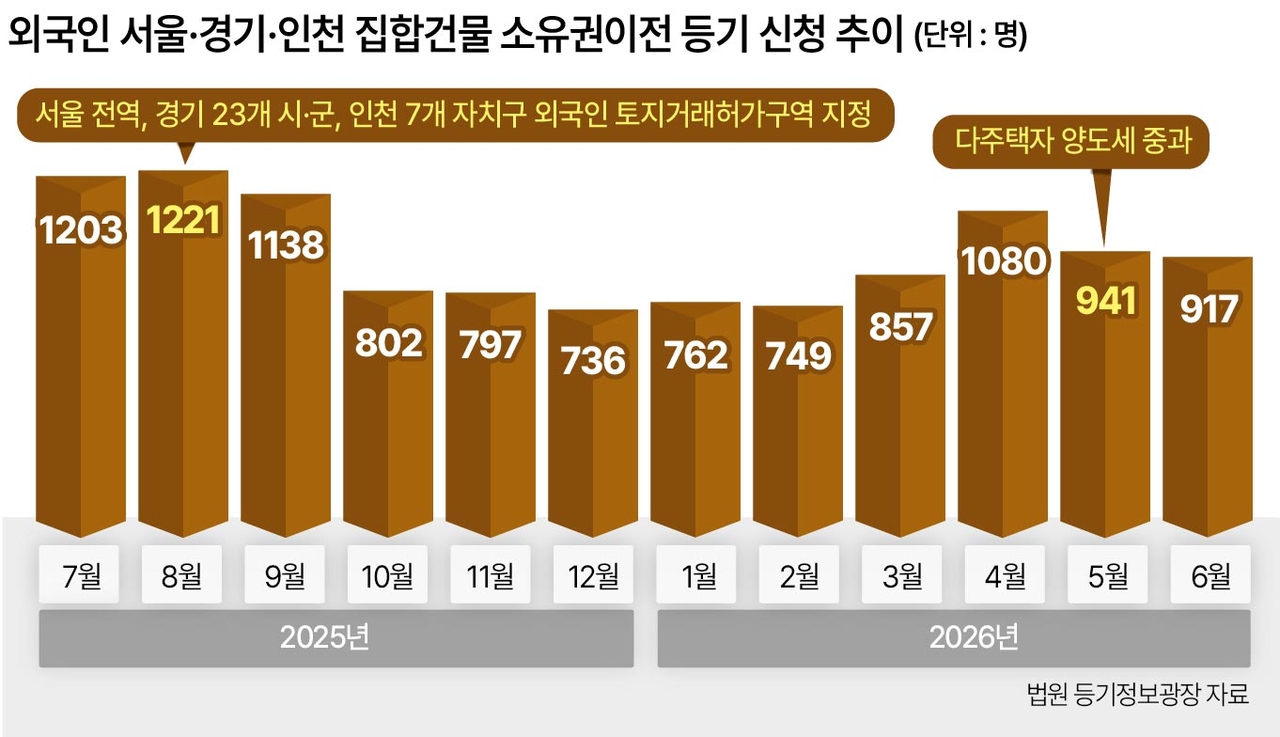
Foreign home purchases in the greater metropolitan area dropped sharply after the regulations took effect. According to the Supreme Court Registry Information Plaza, the number of foreign nationals filing ownership transfer registrations for collective buildings — including apartments, officetels and multi-family homes — in Seoul, Gyeonggi Province and Incheon fell from 1,221 in August, immediately after the permit zone designation, to 1,138 in September, 802 in October, 797 in November and 736 in December, a decline of roughly 40 percent in just four months. The figure briefly rebounded to 1,080 in April as a resumption of the capital gains tax surcharge on multi-home owners triggered a wave of distressed sales, but it settled back to 917 last month.
"Japan has no system for designating land-transaction permit zones to regulate real estate deals, so there was considerable interest from the Japanese prime minister's office," a Ministry of Land, Infrastructure and Transport official said. "They asked for information on the system's effectiveness and outcomes, and we provided our advice. The Japanese government also said it would actively consider adopting the system."
Under international law, national sovereignty includes the authority to impose restrictions on foreign ownership of land for legitimate public interest purposes. China currently allows foreigners only land-use rights, not ownership, and permits home purchases only after at least one year of actual residency. Australia has banned foreign nationals from purchasing existing homes entirely for two years starting in April last year.
hss@heraldcorp.com
smh@heraldcorp.com
hwshin@heraldcorp.com