

With Homeplus's court rehabilitation proceedings scrapped, workers' most pressing concern is whether they will receive their overdue wages and severance pay. About 11,400 employees are estimated to be owed roughly 33 billion won ($21.5 million) in unpaid wages, and the government has activated a dedicated task force and begun preparing to make advance payments through the state wage guarantee system.
According to the Ministry of Employment and Labor on Wednesday, Homeplus's unpaid June wages total between approximately 33.3 billion won and 33.5 billion won, affecting an estimated 11,400 workers. The company normally pays salaries on the 21st of each month but failed to do so last month. The arrears have not yet been reflected in the Labor Ministry's official wage delinquency statistics and are expected to be counted starting with June figures.
The Labor Ministry has operated a dedicated Homeplus wage delinquency task force at the Seoul Southern Employment and Labor Office since last December. Unpaid wages from March through May were investigated in full, and the ministry directed the company to clear the arrears. Management was also criminally referred on charges of violating the Labor Standards Act for failing to pay on time. The ministry is now probing the scale of unpaid June wages and severance.
Homeplus workers have also taken legal action. The Homeplus branch of the Mart Industry Union filed a complaint against management over the wage delinquency, demanded a labor inspection from the ministry, and called on the government to intervene directly and draw up a plan to protect employment. Since the rehabilitation proceedings were scrapped, the union has also demanded a normalization plan to prevent mass layoffs, not just the payment of outstanding wages.
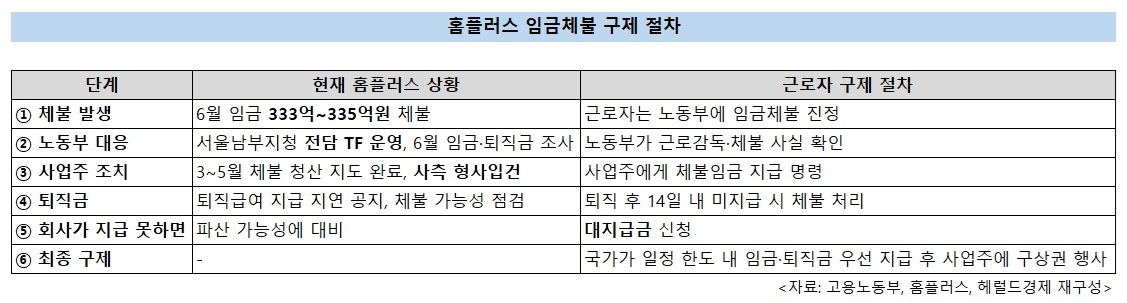
Workers who have not received their wages may first file a complaint with the Labor Ministry. The ministry investigates the facts, directs the employer to pay the outstanding wages, and initiates criminal proceedings if the employer fails to comply. If the employer has lost the ability to pay due to financial difficulties, workers can also turn to the state advance payment system, under which the government pays overdue wages and severance on the employer's behalf — separately from any criminal process.
Under the advance payment system, the state pays outstanding wages and severance first and then seeks reimbursement from the employer. When a company becomes insolvent or effectively loses its ability to pay, workers who meet certain conditions can receive these advance payments. The system has two types: a simplified advance payment made regardless of formal insolvency proceedings, and an insolvency advance payment made after the company goes through court insolvency procedures. Only amounts up to the statutory payment ceiling are covered in advance; any amount above that must be claimed as a creditor through rehabilitation or bankruptcy proceedings.
To limit the damage to workers from the Homeplus situation, the government has moved to provide advance payments and low-interest living expense loans. Workers affected by the wage delinquency will be eligible for advance payments of up to 21 million won per person, and the government plans to offer low-interest living expense loans of up to 10 million won per person within the amount of unpaid wages. Workers who lose their jobs can also receive unemployment benefits and job placement services.
Severance pay is also covered. Homeplus operates a retirement benefit scheme and has been setting aside severance funds, but the company is understood to have fallen short of the legally required minimum funding ratio of 100 percent. On Thursday, the company announced that severance payments for workers who retired in mid-June would be delayed due to a lack of funds.
Under the Labor Standards Act, severance must be paid within 14 days of an employee's departure. Concerns have been raised that severance delinquencies could begin in earnest this week. The Labor Ministry is closely monitoring severance payment conditions in anticipation of a potential wave of departures.
The Labor Ministry is keeping a close watch on the possibility that a prolonged Homeplus crisis could lead to large-scale wage and severance delinquencies. During the 2024 Tmon and WeMakePrice (Qoo10 Group) crisis, unpaid wages and severance exceeded 26 billion won. The ministry is continuing headquarters-level review meetings and monitoring for any further delinquencies.
fact0514@heraldcorp.com





