![Employees work at the dealing room of Hana Bank's headquarters in Jung-gu, Seoul, on Wednesday. [Yonhap]](https://wimg.heraldcorp.com/news/cms/2026/07/08/rcv.YNA.20260708.PYH2026070802900001300_P1.jpg)
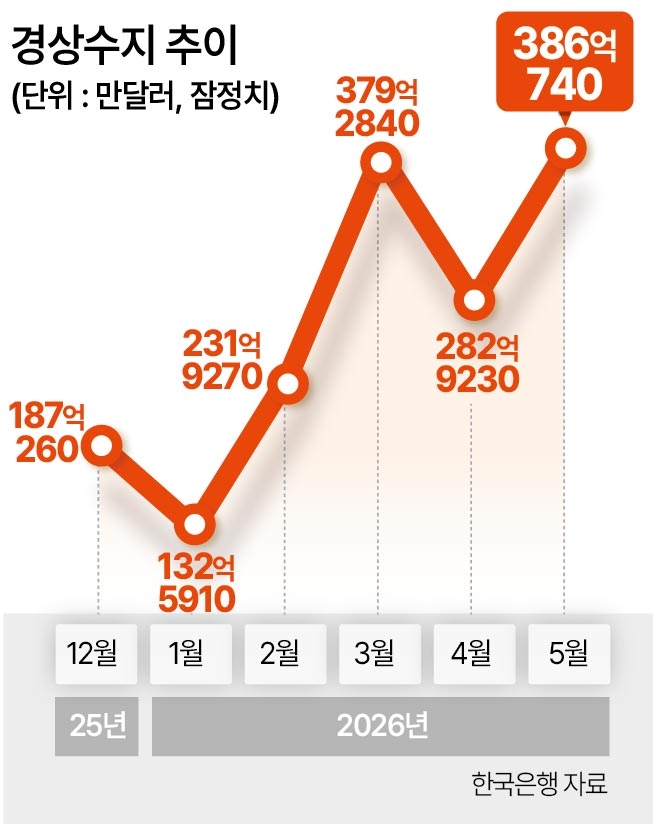
South Korea's current-account surplus is swelling by the day, driven by a sustained export boom led by semiconductors. The surplus hit a record $38.61 billion in May — breaking the all-time high set just two months earlier — and is expected to surpass $40 billion in June.
With upward pressure on economic growth mounting and the won's weakness showing no sign of easing, the Bank of Korea is increasingly likely to raise its benchmark interest rate at its monetary policy meeting on July 16.
June surplus seen near $40 billion; annual figure to exceed forecast
Yu Seong-uk, head of the Bank of Korea's financial statistics department, said Wednesday morning at a briefing on the preliminary balance of payments for May 2026 that the current-account surplus of $38.61 billion set a new record for the second time in two months, surpassing the previous high reached in March. He added that the year-on-year increase in the surplus was also the largest on record for the second consecutive month.
Yu attributed the result to the goods balance hitting an all-time high and pulling the current account higher, while the services balance also reached a record and the primary income account recovered from the seasonal deficit recorded the previous month. "Excluding April, when large dividend payments were made, the current account has posted consecutive record surpluses from February onward," he said.
The cumulative current-account surplus through May stood at $141.3 billion, already exceeding South Korea's previous full-year record set in 2025. The first-half surplus target of $151.5 billion is now just $10 billion away.
The surplus is expected to remain elevated in June. "The trade balance has surpassed $100 billion, led by semiconductors, though we will need to watch how services and other components play out," Yu said. "I think we will record a fairly high current-account surplus in June — I expect it will be around the $40 billion level."
According to the Ministry of Trade, Industry and Energy, exports last month surged 70.9 percent year-on-year to $102.25 billion — the first time monthly exports have exceeded $100 billion. Semiconductor exports accounted for nearly half of that total, jumping 199.5 percent year-on-year to $44.82 billion.
The full-year surplus now looks likely to exceed the Bank of Korea's own forecast of $250 billion. "Looking at the year as a whole, I expect the final figure could come in above our projection," Yu said. One Bank of Korea official expressed astonishment at the pace of gains. "Every day I look at the semiconductor export numbers, I'm surprised," the official said. "I've never seen figures like these."
Growth outlook rises, exchange rate stays elevated — rate hike seen next week
The string of record current-account surpluses is adding to upward pressure on South Korea's economic growth trajectory.
According to the International Finance Center, the average real GDP growth forecast for South Korea this year from eight major investment banks stood at 3 percent as of end-June — up 0.2 percentage points from 2.8 percent at end-May. It is the first time the average forecast from major investment banks has reached the 3 percent range. Some institutions have projected growth in the mid-to-high 3 percent range, while others have gone further: Capital Economics of the United Kingdom recently put its forecast at 4 percent, and domestic reinsurer Korean Reinsurance projected 4.1 percent.
Bank of Korea Governor Shin Hyun-song also signaled an upward revision at a Korea Finance Association academic conference on June 19, saying the bank's annual growth forecast "will be revised upward from 2.6 percent, even on a purely mechanical basis."
Despite the record surpluses, the won-dollar exchange rate has remained stubbornly elevated in the 1,500-won range, diverging from economic fundamentals. Normally, a larger current-account surplus strengthens the won and pushes the exchange rate lower, which in turn moderates the surplus. Recently, however, the rate has moved in the opposite direction, amplifying upward pressure on the surplus. A growing number of companies are holding onto export dollars in deposits rather than converting them into won, creating a paradox in which dollar liquidity is ample yet the exchange rate keeps climbing.
The won closed above 1,500 per dollar for 36 consecutive trading sessions through Tuesday, the second-longest such streak since the 49 consecutive sessions recorded during the financial crisis in late 1997 and early 1998. Last month's average exchange rate of 1,528 won was the highest since the financial crisis. The rate has risen for two consecutive months since April, when it averaged 1,485 won.
Some analysts warn the high-exchange-rate environment could persist. Park Hae-sik, a senior research fellow at the Korea Institute of Finance, wrote in a recent report that the won-dollar rate has shifted structurally higher to the 1,400-won range since 2024 and is likely to remain elevated through February next year.
Against this backdrop of strong growth and a persistently weak won, the Bank of Korea's Monetary Policy Board will hold its rate-setting meeting on July 16. Markets widely expect a rate hike at the meeting, as virtually every indicator — inflation, real estate and beyond — is pointing toward tightening.
Governor Shin has personally raised the need for a rate hike on multiple occasions. Starting with the Monetary Policy Board meeting on May 28 and through a mid-year inflation briefing on June 18, Shin signaled the need for a rate increase four times over roughly three weeks.
![Yu Seong-uk, head of the Bank of Korea's financial statistics department, speaks at a briefing on the preliminary balance of payments for May 2026, held at the Bank of Korea in Jung-gu, Seoul, on Wednesday morning. [Bank of Korea]](https://wimg.heraldcorp.com/news/cms/2026/07/08/news-p.v1.20260708.a65d7f0fc9a645d09c0d7b90ea4beefa_P1.jpg)
kimstar@heraldcorp.com
forest@heraldcorp.com