
"This is the last chance to nurture South Korea's system semiconductor industry. We must commercialize domestic NPUs (neural processing units) and advance into the global market within the golden time of roughly two to three years we have left."
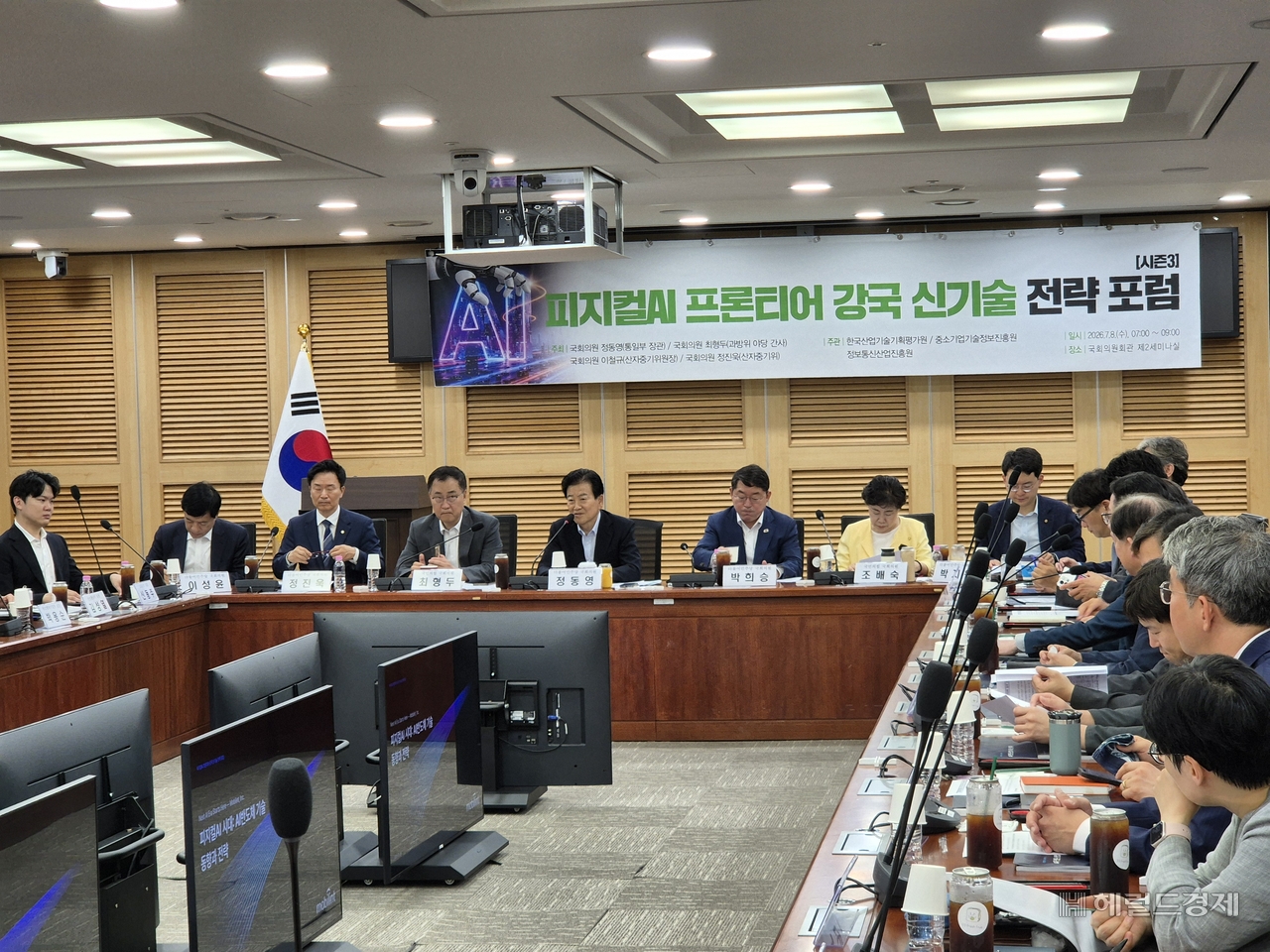
Lawmakers Jeong Dong-young, Choi Hyeong-du, Lee Cheol-gyu and Jeong Jin-uk hosted the Physical AI Frontier Strong Nation New Technology Strategy Forum at the National Assembly Members' Office Building in Yeouido, Seoul, on Wednesday morning, bringing together industry and academic figures to discuss ways to develop South Korea's AI semiconductor ecosystem in the era of physical AI.
Ahn Ki-hyun, executive vice president of the Korea Semiconductor Industry Association, delivered the keynote address, urging Korean companies to move quickly to dominate the NPU market that will underpin the physical AI era.
"South Korea's HBM and Nvidia's GPUs currently lead the global semiconductor market, but in the physical AI era, the NPU will be the essential AI chip," Ahn said.
He added that because the NPU market is only beginning to grow, "we can still take the lead."
Ahn said the longstanding challenge for South Korea's semiconductor industry has been how to foster the system semiconductor sector. "As a latecomer, we have faced limits in reaching the front of the pack," he said.
He said domestic fabless companies — those specializing in chip design — that make NPUs are ready, but added that substantial government support is now needed.
Ahn noted that while South Korea exports memory chips, domestic electronics and automakers paradoxically import the semiconductors they need. "By contrast, the United States, Japan, Europe and China manufacture and use chips domestically," he said.
He added that this must change in the AI era. "South Korea must now be able to manufacture semiconductors for physical AI companies as well," he said.
Ahn called for the semiconductor and physical AI sectors to form a unified team for development. "If the semiconductor industry and the physical AI industry collaborate to jointly develop AI chips, the competitiveness of both will grow together," he said.
He added that unlike memory chips, AI chips are not standardized products, meaning that if a chipmaker develops an AI chip independently without working with physical AI companies, "no one will use it."
At the forum, participants broadly agreed that South Korea should actively adopt domestically made AI chips in industrial settings to build reference cases and support the sector's growth.
Kim Gyeong-su, vice president of KAIST, said government support must shift its focus beyond simply training chip designers. "The emphasis should move toward encouraging individual companies and university research institutes to actually use domestic NPUs," he said.
Cho Young-ho, executive vice president of domestic fabless firm DeepX, said large-scale reference cases are needed in the on-device AI space for South Korea to become the world's top physical AI nation. "I hope discussions around large projects — ones capable of supplying hundreds of thousands or even millions of units — become more active," he said.
Seo Young-su, executive vice president of Hanwha Aerospace, stressed the need to develop a domestic chip ecosystem, warning that relying on foreign chips in the defense sector could undermine the military's core missions of deterrence and guaranteeing the security of its personnel.
joze@heraldcorp.com





