![[123rf]](https://wimg.heraldcorp.com/news/cms/2026/07/08/news-p.v1.20260306.a83e227e2dad4b0ea32012e9f9203a2d_P1.jpg)
Single-stock leverage exchange-traded funds tied to Samsung Electronics and SK hynix have fallen below their listing price within roughly a month of launch, as a sharp drop in semiconductor shares compounds the negative compounding effect inherent in leveraged products.
According to Korea Exchange, 13 of the 14 Samsung Electronics and SK hynix single-stock leverage ETFs closed below their listing price of 20,000 won ($13) on Tuesday. The decline followed a 12 to 13 percent plunge in those ETFs on the same day.
Over the week from June 30 to Monday, Samsung Electronics and SK hynix fell 11.38 percent and 16.94 percent, respectively. Over the same period, the KODEX Samsung Electronics Single Stock Leverage ETF tumbled 25.10 percent, while the TIGER SK hynix Single Stock Leverage ETF fell 35.66 percent.
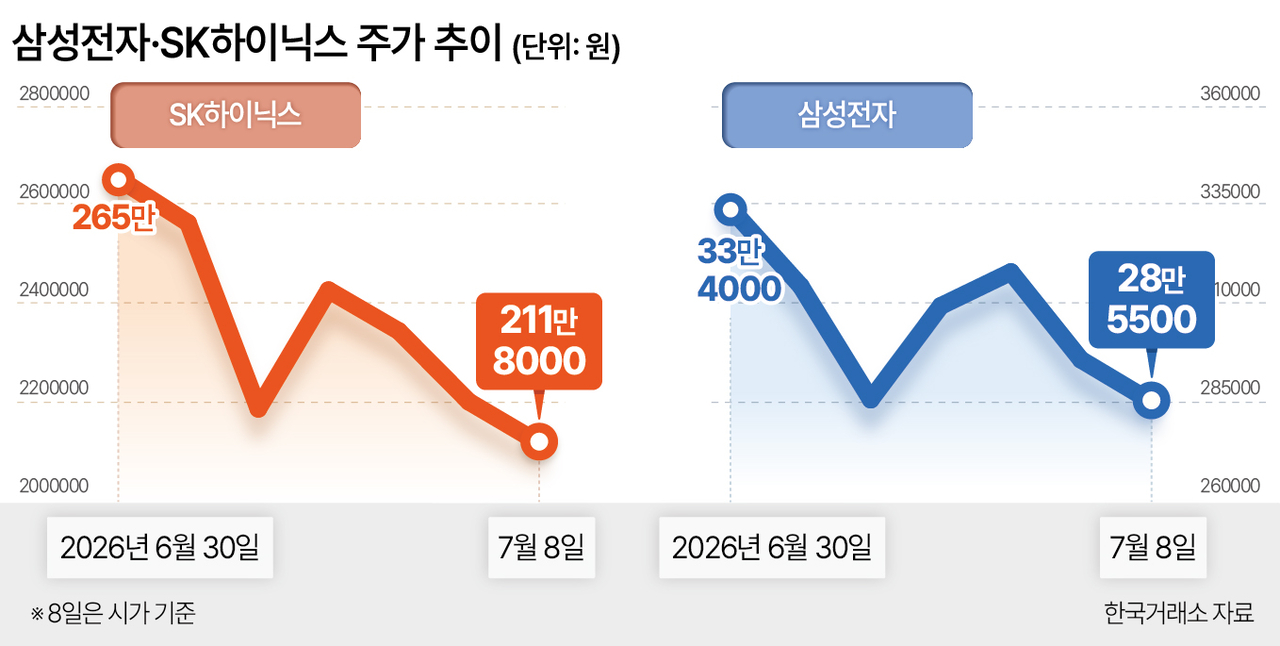
The sharp drop in the single-stock leverage ETFs on Tuesday was driven by steep declines in their underlying assets. Samsung Electronics fell 6.9 percent despite reporting record quarterly earnings, while SK hynix dropped 6.1 percent.
Samsung Electronics posted second-quarter operating profit of 89.4 trillion won, topping the market consensus of 85 trillion won. Still, some analysts said the results fell short of elevated expectations. "The formal consensus was 85 trillion won, but the street consensus — what market participants were actually expecting — may have been closer to 90 trillion won," said Han Ji-young, a researcher at Kiwoom Securities.
Investors in the single-stock leverage ETFs have also swung to a net loss, as unrealized losses from the share price plunge have outpaced net inflows. "Based on an analysis of net inflows and unrealized gains for the KODEX and TIGER products, which have the largest assets under management, net inflows have been gradually increasing — but unrealized losses stand at around 400 billion won for the Samsung Electronics single-stock ETFs and around 600 billion won for the SK hynix single-stock ETFs," said Kim Seok-hwan, a researcher at Mirae Asset Securities.
Retail investors net purchased a combined 2.08 trillion won worth of the KODEX SK hynix Single Stock Leverage, KODEX Samsung Electronics Single Stock Leverage, TIGER SK hynix Single Stock Leverage and TIGER Samsung Electronics Single Stock Leverage ETFs over the past week. Despite those large inflows, the sharp share price decline has left investors sitting on net losses.
The deepening losses reflect the structural characteristics of leverage ETFs. These products are designed to deliver twice the daily return of their underlying asset. They are inherently disadvantageous when the underlying asset moves sideways, and the greater the volatility, the more pronounced the negative compounding effect becomes.
"When the underlying asset price moves in one direction, leveraged ETFs can deliver strong returns — but in a volatile market characterized by repeated swings, they are more likely to underperform the underlying asset," said Lee Sang-hyeon, a researcher at Meritz Securities.
Brokerages are divided on the semiconductor sector outlook following Samsung Electronics' earnings release. Kiwoom Securities cut its target price for Samsung Electronics from 430,000 won to 390,000 won on Tuesday, while KB Securities raised its target from 550,000 won to 600,000 won.
Kiwoom Securities cited the likelihood of slowing earnings-per-share growth in the second half of this year as the basis for its target cut. "Samsung Electronics' share price has been driven by EPS growth, but volatility is expected to expand in the second half as EPS growth slows sharply," said Park Yu-ak, a researcher at Kiwoom Securities.
Kim Dong-won, head of research at KB Securities, said recent concerns about AI amount to noise and that excessive worry represents a buying opportunity.
"Global AI investment is projected to expand from $800 billion this year to $1.1 trillion next year and $1.5 trillion the year after, pointing to a prolonged memory chip supply shortage through 2028," Kim said. He added that Samsung Electronics has greater room to rise as competition to secure memory chips intensifies in the second half.

moon@heraldcorp.com