AI now detects fall hazards at construction sites in real time, forklifts halt automatically when workers enter danger zones, and drones and robots inspect facilities too hazardous for humans to approach. Industrial safety management is rapidly shifting toward accident prevention powered by advanced technology.
The Ministry of Employment and Labor and the Korea Occupational Safety and Health Agency marked Industrial Safety and Health Month on Wednesday by hosting a best-practices showcase at Kintex in Goyang, Gyeonggi Province. The event highlighted AI and smart safety technologies, cooperative safety initiatives between large companies and small and medium-sized enterprises, and worker health management programs.
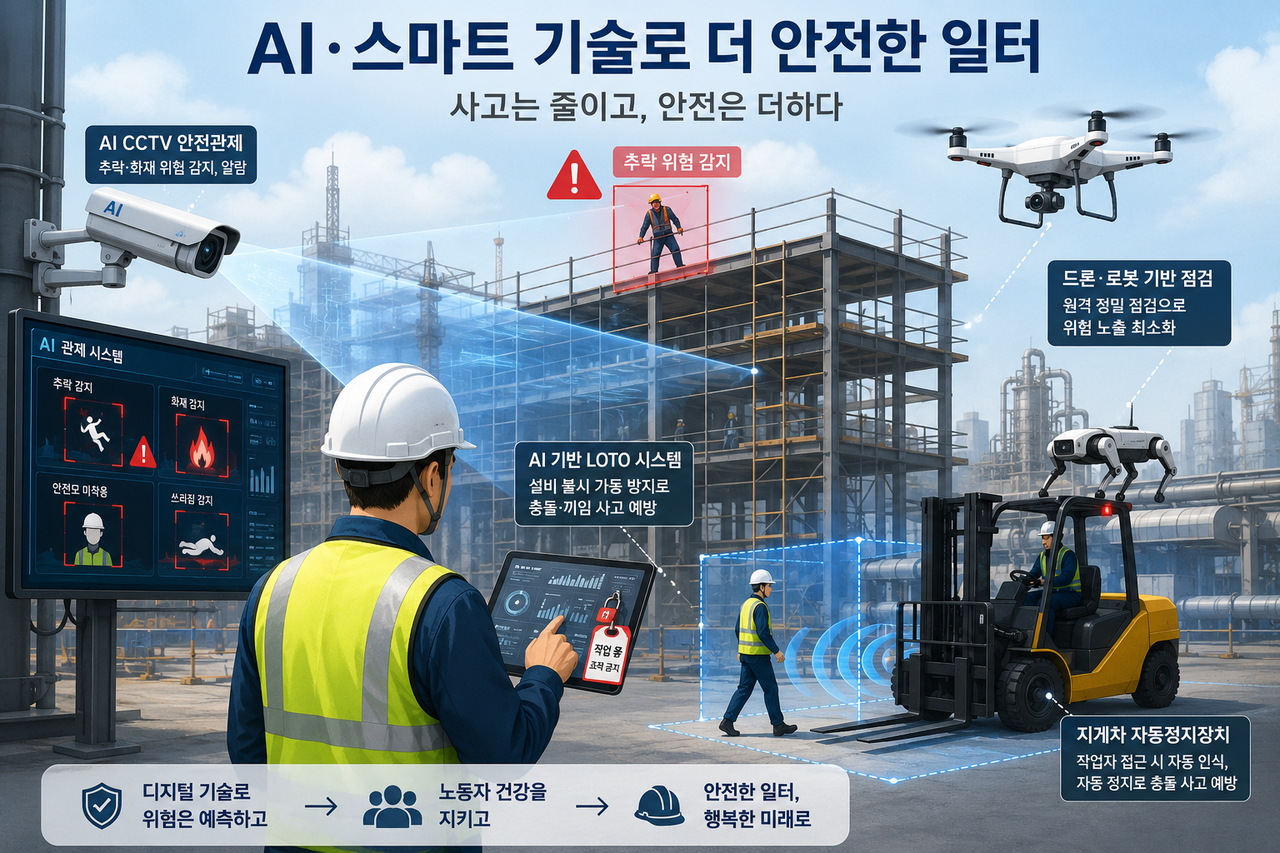
In the AI and smart industrial safety technology category, featured innovations included AI-powered CCTV systems that detect fall and fire risks at construction sites, an AI-based lockout/tagout (LOTO) system that prevents equipment from starting unexpectedly, remote precision safety inspections using drones and robots, and an AI-driven automatic forklift stop device that brakes when workers approach. The cases illustrated how digital safety technologies — capable of detecting workplace hazards in real time and heading off accidents before they occur — are spreading rapidly across industry.
The presentations also covered on-site applications by major companies.
Kia presented an AI-based system for preventing safety accidents in automated manufacturing processes, while Samsung Electronics showcased an AI-powered robot for inspecting electrical switchboards. Hyundai Motor Company introduced a smart safety management system built on process safety data, and Korea Hydro & Nuclear Power unveiled an AI and digital-twin-based integrated safety navigation system for nuclear power plants. Safety management models drawing on AI and digital technology from ports, construction sites and manufacturing facilities were also shared.
In the worker health category, presentations covered reducing chemical exposure, preventing and managing trauma following serious workplace accidents, and a tailored health management program for delivery workers. Particular attention went to health management cases combining counseling, follow-up monitoring and medical referrals, pointing to a path for worker health centers to develop into a core platform for occupational health management.
In the large-company and SME cooperative safety category, cases introduced included joint hazard assessments between prime contractors and subcontractors, smart safety management systems, expanded safety investment by partner companies, and hands-on safety culture initiatives. Samsung C&T, Samsung Electronics, LG Electronics, Hyundai Motor Company and Kumho Petrochemical each presented cases in which they worked with partner firms to manage risk factors and build AI-based safety management systems, sharing approaches to closing the safety gap between large and small businesses.
"The best practices presented today go beyond the achievements of individual workplaces — they are an important benchmark and direction that must spread across industrial sites as a whole," said Ryu Hyeon-cheol, head of the Ministry of Employment and Labor's Industrial Safety and Health Bureau. "We will continue to strengthen policy support and the institutional foundation so that these best practices can take root as new standards across industry."
fact0514@heraldcorp.com