The first signal in any investment environment is not the news or the charts — it is the question investors ask. "Where are the big money players putting their money right now?" This series tracks that flow, examining how high-net-worth investors allocate assets, manage risk and think about markets. Understanding where money moves can change the way you invest.
![[Generated with ChatGPT]](https://wimg.heraldcorp.com/news/cms/2026/07/13/news-p.v1.20260713.35b9c2317c2c406b9c688ededa90af89_P1.png)
[By Lee Yun-ji, team leader at KB Kookmin Bank's Suji PB Center / Compiled by Hong Tae-hwa] Financial markets have been shifting direction multiple times a day. The possibility of a change in US monetary policy, geopolitical tensions in the Middle East and fears of a global economic slowdown are rattling markets all at once, deepening the dilemma for investors.
When equity markets rebound, capital flows toward risk assets; when bad news hits, it rushes back to safe havens. In a market more uncertain than ever, investors are searching for alternatives beyond stocks to protect their portfolios — yet genuinely compelling options are scarce. In that environment, gold is the asset that comes up most often.
The same dynamic plays out in client consultations. When gold prices hit all-time highs earlier this year, the most common question was, "Should I buy now?" As the recent correction deepened, that question shifted to, "Is gold finished?"
The question has changed, but the blind spot has not. Most investors start by checking how much gold has risen or fallen. Gold, however, is not an asset you can judge by price alone. The price of gold is the outcome of reading the market — not the starting point.
Investors should therefore look first at the variables that drive gold prices — real interest rates, the direction of the dollar, safe-haven sentiment and central bank buying trends — before looking at the price itself. Ignoring that context and chasing the price alone makes it easy to fall into a cycle of buying late during rallies and panic-selling during corrections.
No dividends, no interest: the essence of investing in gold
Gold moves differently from other financial assets. Equities gain value as corporate earnings and profits grow; bonds are driven by interest rates and coupon income. Gold, by contrast, pays neither interest nor dividends. That makes real interest rates and the value of the dollar the two most important variables in determining its price.
When real interest rates rise, the opportunity cost of holding gold increases, weighing on its price. Conversely, when rate-cut expectations build and real rates fall, gold's relative appeal grows.
The dollar is equally important. A stronger dollar typically puts downward pressure on gold, while a weaker dollar tends to support it. Ultimately, the first thing to examine in any gold investment decision is not a price chart but the broader macroeconomic environment.
The recent correction in gold prices is itself the product of several macroeconomic forces converging. Stronger-than-expected US employment data prompted markets to scale back their Federal Reserve rate-cut expectations. Real interest rates rose and the dollar strengthened. On top of that, hopes for an easing of geopolitical tensions and a wave of profit-taking combined to push gold sharply lower in a short period.
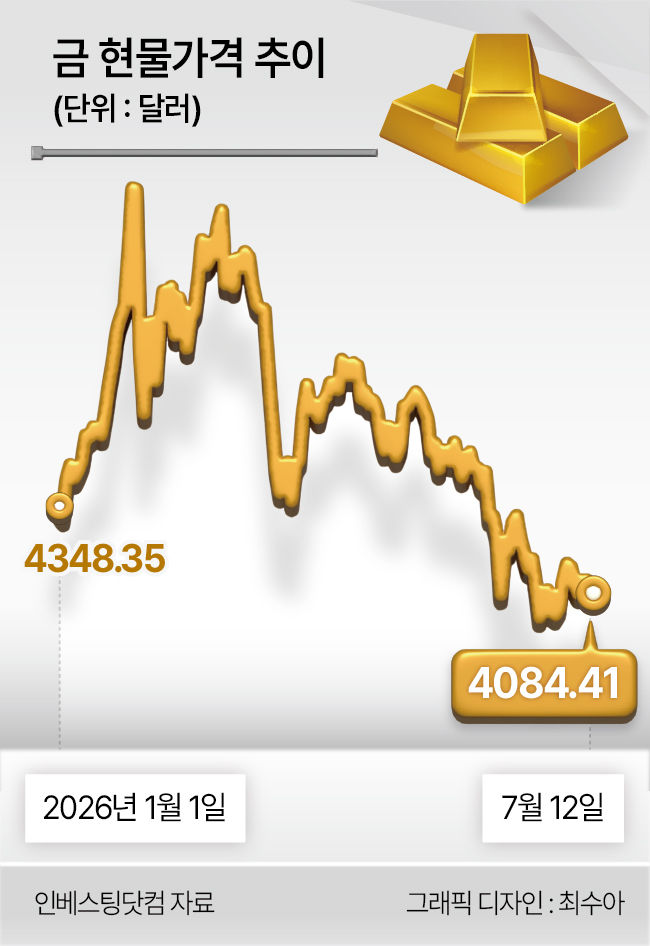
Even so, reading this price correction as a shift in the long-term trend is premature. In the gold market, supply-and-demand dynamics matter as much as price.
In the short term, ETF fund flows can swing prices sharply, but over the medium to long term, central bank purchases act as a floor for the market. The current correction therefore needs to be interpreted by distinguishing between short-term supply-and-demand shifts and longer-term demand trends.
In particular, central banks in emerging economies — China chief among them — have for several years been reducing the dollar's share of their foreign reserves and steadily increasing gold holdings. This reflects not a simple investment motive but a strategic judgment about diversifying reserves and managing currency risk.
Retail investors can buy and sell quickly as conditions change, but central bank purchases are long-term in nature. That structural demand is widely regarded as an important factor supporting a floor under gold prices.
Of course, it would be wrong to assume gold prices will keep rising indefinitely. If geopolitical risks ease and the global economy recovers faster than expected, appetite for risk assets could increase and gold's relative appeal could diminish.
On the other hand, if the economic slowdown deepens, monetary policy shifts toward easing and the dollar weakens, conditions favorable to gold are likely to return. What matters is not betting on a single scenario but weighing a range of possibilities together.
History supports this view. Gold has never risen in a straight line. After the oil shocks of the 1970s it endured several steep corrections, and after hitting an all-time high in 2011 it spent years in a prolonged downturn. At the time, many in the market declared that gold's era was over.
Yet as a new macroeconomic environment took shape, gold resumed its upward trend and eventually surpassed its previous peak. Corrections of 20 to 30 percent within a broader bull market were not unusual. Concluding that a long-term uptrend has ended simply because a correction has occurred may therefore be a hasty judgment.
Major global investment banks also maintain a broadly constructive view of gold's long-term role. While their price forecasts differ, they consistently cite steady central bank buying and global uncertainty as long-term support factors. The implication is that short-term market volatility alone is not sufficient reason to remove gold from a portfolio entirely.
Why buy gold? Start with the reason
The question investors should be asking is not "Should I buy gold now?" The more important question is "What role should gold play in my portfolio?" Gold does not generate profits like a company, nor does it pay interest like a bond. In a period when equity markets are surging, it may therefore lag in relative returns.
When market uncertainty rises, however, the calculus changes. Gold acts as a buffer, reducing portfolio volatility and absorbing unexpected shocks. What matters in long-term investing is not the high return of any single asset but the stable management of the overall portfolio through holding a mix of assets that behave differently from one another.
In practice, the key variable explaining long-term performance in financial markets is not the return of any individual asset but the diversification effect that comes from exploiting low correlations between assets. If gold can provide a meaningful degree of defense even when stocks and bonds fall simultaneously, the overall risk of a portfolio can be substantially reduced. For this reason, global pension funds and institutional investors treat gold not as a vehicle for short-term gains but as one pillar of strategic asset allocation.
The investment strategy for individual investors follows naturally from this. First, gold should be approached not as a trading instrument for timing short-term price moves but as part of a medium- to long-term asset allocation.
Second, because gold is a highly volatile asset, it is better to build a position gradually — using physical gold or gold ETFs — rather than investing all at once.
Third, a gold allocation of roughly 5 to 10 percent of the total portfolio is a practical starting point, to be adjusted based on the investor's risk tolerance and the volatility of other holdings.
Investing is not the art of predicting the future with precision. It is closer to designing a portfolio that can withstand a wide range of futures that are difficult to foresee. Gold may not be the asset that promises the highest returns, but it is one of the assets that has weathered market uncertainty for the longest time.
What investors should be thinking about now is not whether gold prices will rise or fall in the short term. The prior question is how to protect a portfolio through the economic slowdowns, geopolitical risks and policy shifts that will inevitably recur. Markets can change direction at any moment, but the principle of diversification does not.
The current correction may be less a signal that gold is finished than an opportunity — viewed through the lens of long-term asset allocation — to reassess gold's role in a portfolio and calmly build a position. The value of gold lies not in how much it rises but in how steadily it protects a portfolio in an uncertain market. In that sense, gold remains an asset investors cannot easily afford to leave out — now and in the future.

th5@heraldcorp.com