A government program introduced this year to promote shorter working hours has already surpassed its annual participation target in the first half of the year.
With companies reporting not only reduced hours but also gains in productivity and new hiring, the government plans to accelerate the model by supporting AI adoption and workplace innovation.
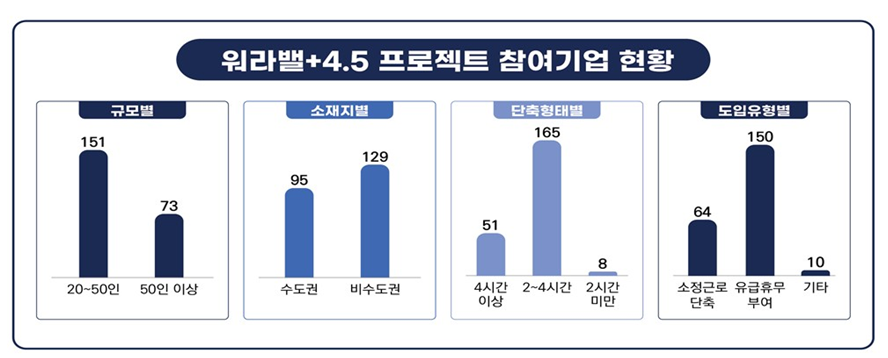
The Ministry of Employment and Labor announced Tuesday that 224 companies had joined the Work-Life Balance +4.5 Project as of the end of June, reaching 101.8 percent of the full-year target of 220 companies — in the program's very first year of operation. Small businesses with fewer than 50 employees accounted for 67.9 percent of participants, spanning industries including manufacturing and services.
The project supports companies that, through labor-management agreement, reduce actual working hours — such as by adopting a 4.5-day workweek — without cutting wages. Firms can choose from several models tailored to their circumstances: a 4.5-day week with Friday afternoons off, a 38-hour week with four hours off twice a month, or a 35-hour week achieved by cutting one hour each day.
Companies in the program say the shorter hours have helped them attract talent and improve productivity.
Fintech firm Wirebarley introduced a 38-hour workweek and cut unnecessary meetings and reports while establishing focused work hours. The number of employees who left in the first half of this year fell to one from four in the same period last year — a 75 percent drop — while new hires doubled to six from three, a 200 percent increase.
Ecoworld Farm, located in a regional industrial complex, adopted a 4.5-day week with paid Friday afternoons off. By streamlining work processes and expanding AI use across departments, the company reduced total weekly working hours for office staff to 648 from 673 and succeeded in bringing on new employees.
Daesin S&NC introduced twice-monthly voluntary short days and hired two additional on-site workers to cover the resulting gaps. Through pre-shift equipment checks and focused work hours, the company cut the time needed to produce 10,000 parts to 38 hours from 40, improving productivity by about 5 percent.
Building on these results, the government plans to strengthen productivity support to ensure the shorter-hours trend is sustained. A public-private productivity support task force launched in May will provide assistance with AI adoption, business process redesign and vocational training, while an operating committee involving labor, management and outside experts will help spread industry-specific working-hours reduction models.
"There is no single way to reduce working hours — there are many approaches that can fit a company's circumstances," Employment and Labor Minister Kim Young-hoon said. "The fact that labor and management can work together to build a company-specific model and deliver results has been confirmed on the ground, and we will actively support small and medium-sized enterprises in reducing working hours."
fact0514@heraldcorp.com