Survey of 973 workers across 10 occupations finds 57.1% faced verbal abuse; 95% back mandatory standard contracts
Average monthly net income reaches 2.18 million won; 86.9% say they cover their own medical costs after injury
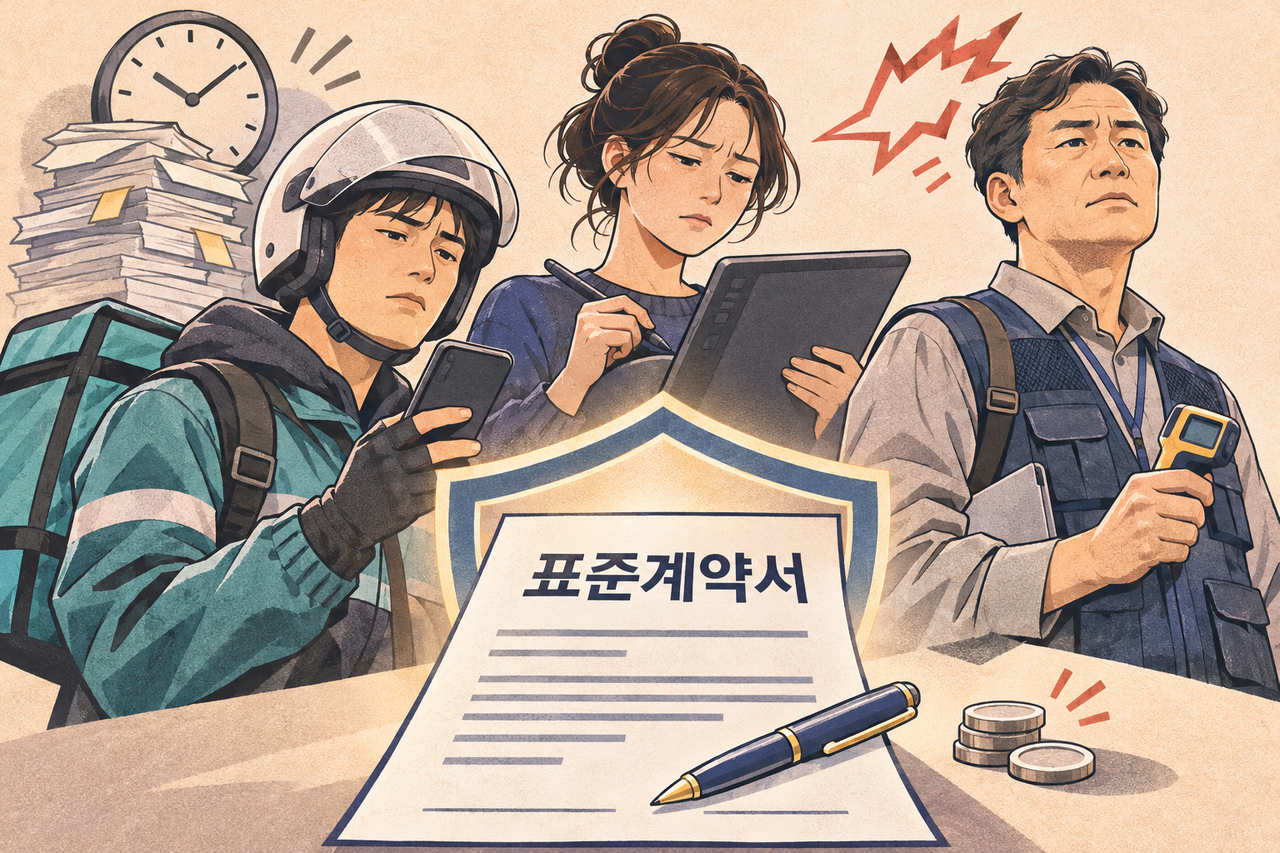
About seven in 10 special-employment and freelance workers — including delivery drivers, webtoon artists and home-visit inspectors — said they had performed additional work without compensation, according to a new survey.
More than half also reported experiencing verbal abuse or humiliation. Most said they simply endure unfair treatment rather than take action, while the support measure that drew the highest level of agreement was mandatory application of standard contracts.
The findings come from a survey on the actual conditions of special-employment workers, released Saturday by the Samugeumyung Ubuntu Foundation and the Korea Non-Standard Workers Center at the Seoul Welfare Foundation in Mapo-gu, Seoul. Among respondents who answered questions about unfair experiences, 67.3% said they had been assigned unpaid extra work and 57.1% reported verbal abuse or humiliation.
The survey covered 973 workers across 10 occupations: delivery platform riders, designated drivers, home-visit inspectors, broadcast writers, insurance planners, after-school instructors, caregivers, webtoon and web-novel authors, artists and domestic workers.
By occupation, the share reporting unpaid extra work was highest among broadcast writers at 96.8%, followed by home-visit inspectors at 95.6%. Verbal abuse or humiliation was most commonly reported by designated drivers at 79.8% and caregivers at 71.4%.
When asked how they respond to unfair treatment or disputes, 57.2% of respondents said they simply put up with it and move on — the most common answer by far.
On the question of needed support measures, 95.4% of respondents backed mandatory application of standard contracts. Guaranteed access to social insurance (94.6%), a guaranteed minimum wage or fair pay (93.5%), the establishment of a dispute-mediation body (93.3%) and fee regulation (91%) all drew agreement from more than 90% of respondents.
The gap between actual income and expected pay was also wide. Average monthly net income — after deducting work-related expenses — reached 2.18 million won ($1,640), with a median of 2 million won. By contrast, respondents said they considered 3.66 million won per month to be fair pay on average, with a median of 3 million won.
The financial burden of illness and injury was equally stark. When asked whether they could manage financially if they fell ill, 86.7% said they could not. That figure rose to 97.8% among webtoon and web-novel authors, 97% among broadcast writers, 96.9% among after-school instructors and 93% among home-visit inspectors. The share who said they cover their own medical costs when injured reached 86.9%.
The research team said the results reflect the economic dependence of these workers on platforms or the entities that engage them.
A workshop presenting the findings also raised occupation-specific concerns. Oh Seung-min, organizing director of the National Designated Drivers Union, said algorithms are being used to discriminate against older drivers and female drivers.
Lee Su-gyeong, head of the digital content creators' chapter of the Korean Women Workers Association, said it is difficult to know how fees are determined between platforms and intermediary agencies. Lee noted that webtoon production has been broken down into separate tasks — story, illustration, speech bubbles and more — but the absence of standard rate guidelines forces authors to negotiate pay among themselves.
Lee said the situation breeds conflict among authors and called on authorities to "distribute a standard rate table and make standard contracts mandatory."
fact0514@heraldcorp.com