
![Workers on the morning shift leave Hyundai Motor's Ulsan plant in Buk-gu two hours early on Monday, the first day of a three-day partial strike by the Korean Metal Workers' Union's Hyundai Motor chapter. [Yonhap]](https://wimg.heraldcorp.com/news/cms/2026/07/14/rcv.YNA.20260713.PYH2026071314310005700_P1.jpg)
The Hyundai Motor union has launched a strike demanding that the mandatory retirement age be raised to 65 — even as nearly all retirees already benefit from a two-year rehiring program. Critics inside and outside the industry are calling it the "retirement-age extension paradox": a union whose members enjoy some of the country's most generous continued-employment benefits is pressing for even more, while the resulting surge in rehiring steadily narrows the door for young job seekers.
According to industry sources Tuesday, labor and management at Hyundai Motor have reached agreement on eight of the union's 12 demands in this year's wage negotiations. Although this is a wage-only bargaining year — collective agreement talks are held every other year and are not formally on the table — management also accepted several additional union requests, including new headcount additions, employment stability measures in preparation for future industry shifts, a full monthly salary system, reduced working hours and adjustments to commuter bus fares.
After 15 rounds of negotiations since May, the four items on which the two sides remain deadlocked are: a base pay increase of 149,600 won ($99) per month and a performance bonus equal to 30% of last year's net profit; a bonus raise from 750 to 800 percent; reinstatement of dismissed workers; and retirement age extension. Of these, management has held firm against two: reinstatement of dismissed workers and retirement age extension.
Hyundai Motor rehires most retirees for up to 2 years
Retirement age extension has been a recurring flashpoint for years. The Hyundai Motor union has put the demand on the bargaining table every year since 2018. Management's position is that the issue has already been debated for years without resolution, and that last year's wage-and-conditions agreement settled the matter by deferring any action until after legislation is enacted.
In a statement issued July 10, Hyundai Motor CEO Choi Young-il said it was "regrettable" that the union was striking over issues such as reinstatement of dismissed workers and retirement age extension. "Given that the political sphere is in the midst of intense debate over legislating a retirement age extension, can individual company labor and management really be expected to reach a conclusion first?" he said.
Hyundai Motor has operated a skilled re-employment system — known internally as the senior contract worker program — since 2019, under which retirees are rehired on fixed-term contracts for a set period. The program is open to any retiring worker at the manager level or below, regardless of job category, and those with no disqualifying work record can be rehired for up to two years on annual contracts. Compensation starts at the level of a newly hired military-service-completed employee in the first year, with a partial base pay increase in the second.

Post-retirement rehires top 3,000 — six times Posco, 19 times Korean Air
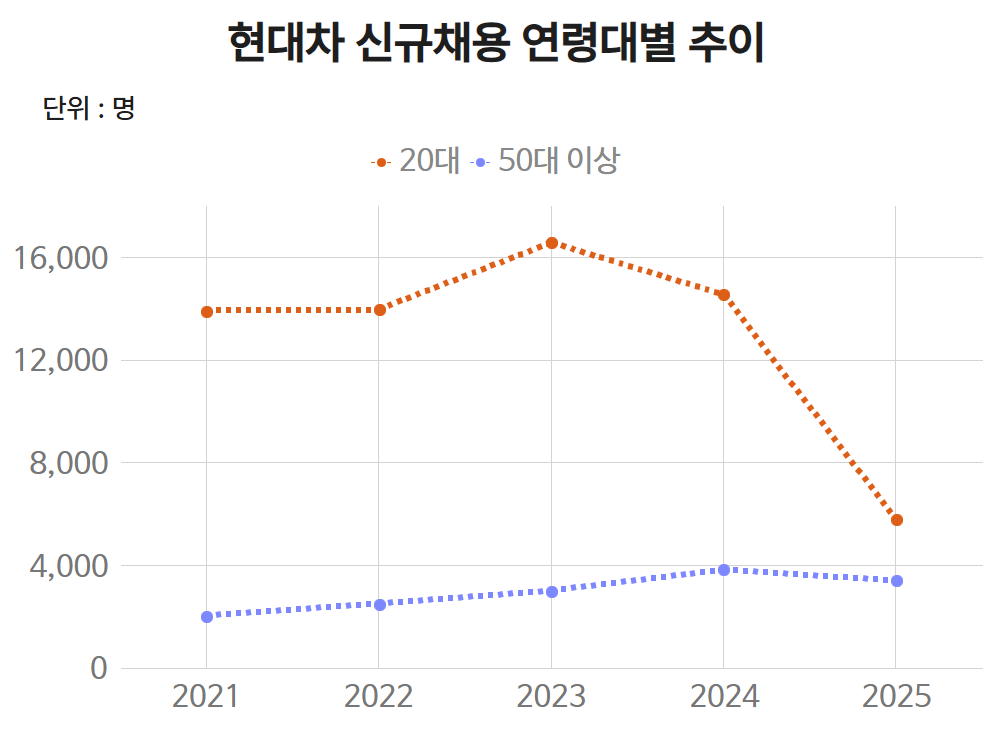
Hyundai Motor hires roughly 3,000 workers aged 50 or older each year. That figure stood at 1,998 in 2021, rose to 2,455 in 2022 and 2,968 in 2023, then jumped to 3,807 in 2024. Last year it remained in the 3,000s at 3,383.
Workers aged 50 and older have also accounted for a growing share of all new hires — 11.7 percent in 2023, 16.1 percent in 2024 and 23.7 percent last year. That means roughly one in four new hires is now 50 or older. The vast majority are retirees brought back under the skilled re-employment program. It is the largest continued-employment program among domestic companies — about six times the 548 rehires at Posco and about 19 times the 178 at Korean Air, both of which use more selective rehiring practices.
An industry official said the rehiring rate is close to 99 percent and that cases where rehiring is refused are almost nonexistent. Excluding workers who choose not to return, nearly all retirees are given the opportunity to keep working.
Given that about 2,628 union members retired from Hyundai Motor last year, in effect nearly all of them had the chance to return to work. That trend is expected to continue for now. According to the union, 16,325 members are set to reach retirement age over the eight years from last year through 2032 — equivalent to 40.2 percent of the 40,592 union members on the rolls at the end of 2024.

40% of union members to retire within 8 years; hires in their 20s plunge 60%
Hyundai Motor's scale of rehiring older workers is large even compared with its affiliates. Hyundai Mobis operates a similar skilled re-employment program, but hired only about 532 workers aged 50 or older last year. The rehiring benefit is available only to union members, which has also drawn criticism over fairness. That is why Hyundai Motor union members are widely seen as receiving preferential treatment not only compared with group affiliates but also with other major domestic companies.
Meanwhile, as rehiring has grown year after year, hiring of young workers has fallen sharply. New hires in their 20s at Hyundai Motor held in the 13,000-to-16,000 range from 2021 through 2024, but plunged to 5,782 last year. That was a 60.2 percent drop from the previous year and roughly one-third the level seen in 2023.
Workers in their 20s also fell as a share of all new hires — from 65.1 percent in 2023 and 61.5 percent in 2024 to 40.6 percent last year.
![Federation of Korean Trade Unions Chairman Kim Dong-myeong (right) and Korean Confederation of Trade Unions Chairman Yang Gyeong-su call for legislation to raise the mandatory retirement age to 65 at a joint press conference at the National Assembly on June 16. [Yonhap]](https://wimg.heraldcorp.com/news/cms/2026/07/14/rcv.YNA.20260616.PYH2026061607500001300_P1.jpg)
Three more years than rehiring, plus wage-peak adjustments — what the union really wants
The union's insistence on retirement age extension is widely seen as tied to the pay cut that comes with rehiring. Under the current system, rehiring after retirement takes the form of a fixed-term contract lasting up to two years. The union's demand, by contrast, calls for maintaining regular full-time employment up to age 65 — linked to the national pension eligibility age — which would mean up to three additional years of employment beyond what the current rehiring program offers.
The financial difference is significant: rehired workers receive first-year pay at the level of a newly hired military-service-completed employee, whereas a retirement age extension would preserve their existing status as regular employees. Resentment over the wage-peak system, which kicks in at age 59, also appears to be a factor. If the retirement age were extended, that could open the door to demands that the wage-peak trigger be pushed back as well — and the additional years of employment could in turn generate calls to extend the post-retirement rehiring period by an equivalent amount.
![So Byeong-hun, chairman of the Democratic Party of Korea's special committee on retirement age extension for recovery and growth, delivers opening remarks at a meeting with field workers from the Korean Confederation of Trade Unions at the National Assembly members' office building on April 29. [Yonhap]](https://wimg.heraldcorp.com/news/cms/2026/07/14/rcv.YNA.20260429.PYH2026042904590001300_P1.jpg)
Industry observers are calling the union's decision to strike over retirement age extension the "retirement-age extension paradox." The argument is that a union already receiving the country's most generous continued-employment benefits has turned retirement age extension into a vehicle for demanding even more in pay and job security. Concern is also growing that the expansion of continued employment is having a significant impact on the company's capacity to hire young workers.
An industry official said that because Hyundai Motor already runs an active rehiring program, the direct shock of a formal retirement age extension might be relatively limited. "The real problem," the official said, "is that if retirement age extension or rehiring becomes mandatory, it becomes harder for the company to screen out underperforming workers, and the room to hire young people could shrink further."
kwater@heraldcorp.com





