The business world is full of companies — merging, splitting, rebranding, launching new ventures or walking away from old ones. This series uses on-the-ground reporting and data analysis to tell the stories behind them in plain language.
![The environmental wind tunnel at Hanon Systems' Daejeon R&D center replicates real-world driving conditions — wind speed, temperature, humidity and solar radiation — to test the performance of vehicle air-conditioning and thermal management systems. [Hanon Systems]](https://wimg.heraldcorp.com/news/cms/2026/07/15/news-p.v1.20260714.aa3fdf4a5c5d47568b223207457c88ce_P1.jpg)
As the auto industry's competitive axis shifts from engine performance to electrification, software and energy efficiency, thermal management technology is emerging as a defining edge for next-generation vehicles. How effectively a car controls the heat generated by its battery, drive motor, power-conversion unit, autonomous-driving sensors and semiconductors determines driving range, safety, ride comfort and vehicle longevity.
Hanon Systems, which bills itself as an "automotive thermal management solutions company," is growing its presence in this market. The company traces its roots to Halla Climate Control, a joint venture launched in 1986 by Ford of the United States and Mando Machinery. Now marking its 40th anniversary, Hanon Systems has evolved from a maker of vehicle air-conditioning components into a global thermal energy management company spanning heating and cooling, battery thermal management, compressors, heat exchangers and electronic control parts.
![Officials from Mando and Ford pose for a commemorative photo after signing a joint-venture agreement on Dec. 12, 1985. That partnership gave rise to Halla Climate Control in 1986, the predecessor of Hanon Systems. [Hanon Systems]](https://wimg.heraldcorp.com/news/cms/2026/07/15/news-p.v1.20260710.552bab99079f49e98ede44e869becf70_P1.jpg)
Hanon Systems posted sales of 10.88 trillion won ($7.29 billion) last year, crossing the 10 trillion won threshold for the first time. The milestone came even as the broader auto parts industry struggled with the costs of the electrification transition and softening demand from automakers. The company now ranks No. 1 in South Korea and among the top two globally in automotive thermal management.
Marking its 40th anniversary as a turning point, Hanon Systems is broadening its business beyond automotive thermal management into data center cooling systems and the global aftermarket, building a foundation for medium- to long-term growth. The company aims to leverage its accumulated vehicle thermal management expertise across industries and reach the No. 1 position in global thermal management solutions by 2036, its 50th anniversary.
"The dedication and relentless pursuit of quality shown by our employees at global operations around the world are the driving force behind the company's growth," said Lee Su-il, vice chairman and chief executive of Hanon Systems. "Our 40th anniversary is more than a milestone — it is a new starting point from which we will leap forward to become the world's top thermal management solutions company, backed by strong execution and solid fundamentals."
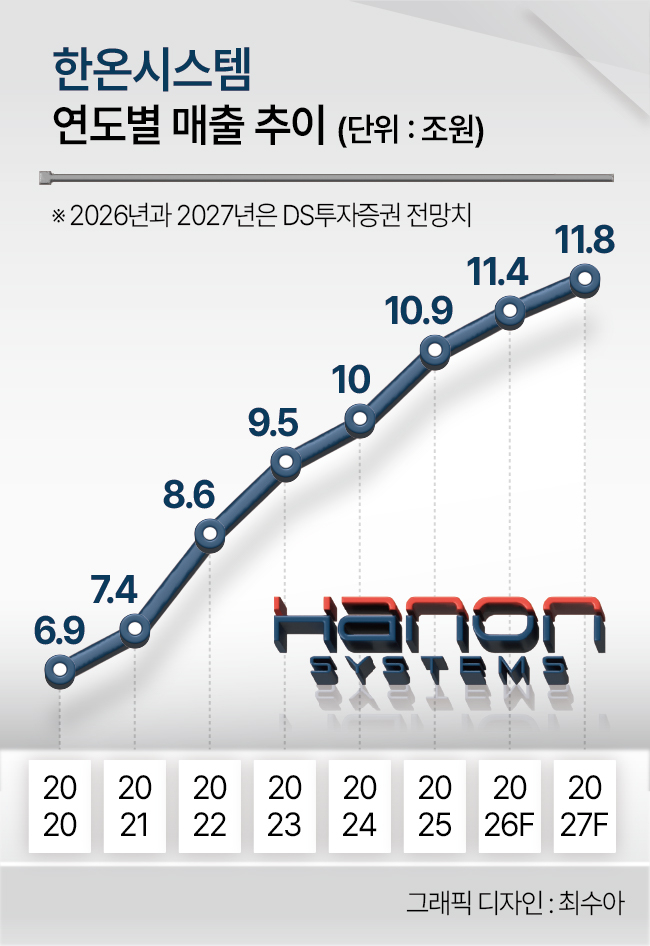
From Detroit's Big Three to German premium brands — 73% of sales come from overseas
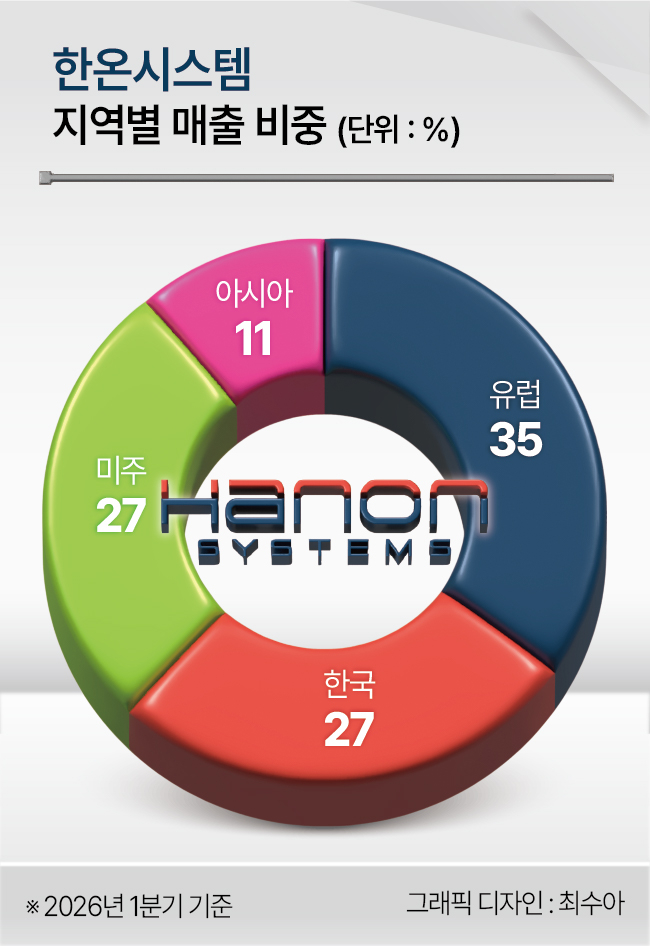
Hanon Systems' greatest strength is a customer portfolio not overly concentrated in any single automaker or region. As of the first quarter of this year, South Korea accounted for just 27 percent of its sales, with the remaining 73 percent generated abroad.
By region, Europe was the largest contributor at 35 percent, followed by the Americas at 27 percent — a distribution that reflects broad, balanced exposure to the world's core automotive markets.
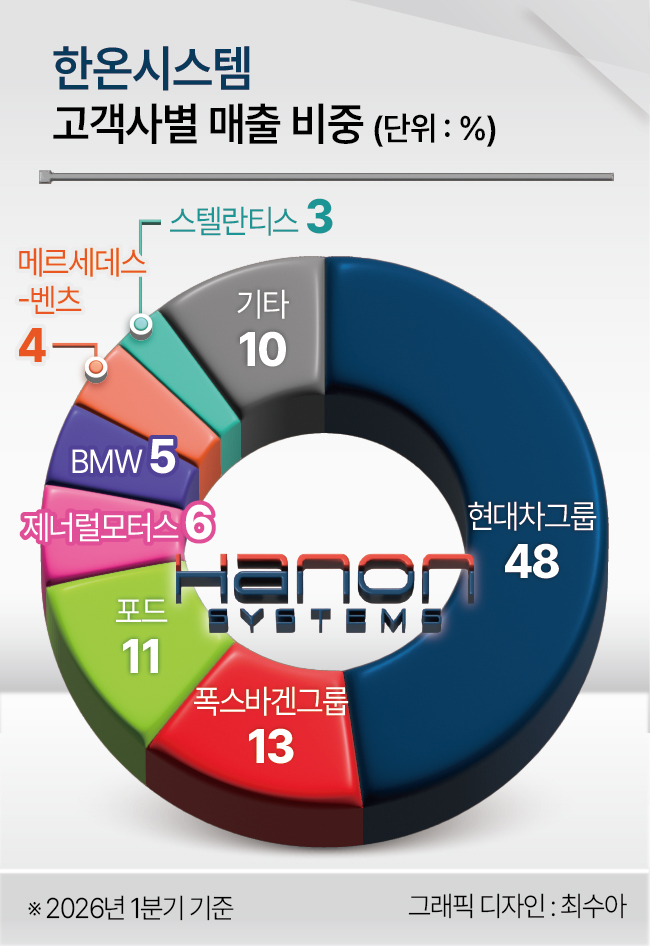
Its customer base is equally diverse. Hyundai Motor Group accounts for the largest share at 48 percent, but Hanon Systems also supplies Volkswagen (13 percent), Ford (11 percent), General Motors (6 percent), BMW (5 percent), Mercedes-Benz (4 percent) and Stellantis (3 percent). Counting all three of Detroit's major automakers and Germany's premium brands among its customers carries significant weight as a validation of the company's quality and technology.
Its production and research network matches that global footprint. Hanon Systems operates 50 manufacturing plants and 23 engineering centers across 21 countries, with a workforce of about 20,000. As automakers diversify production locations and push for local sourcing, the ability to respond across a global supply chain has become a core competitive advantage for parts suppliers.
In the EV era, thermal management is core performance — not an accessory
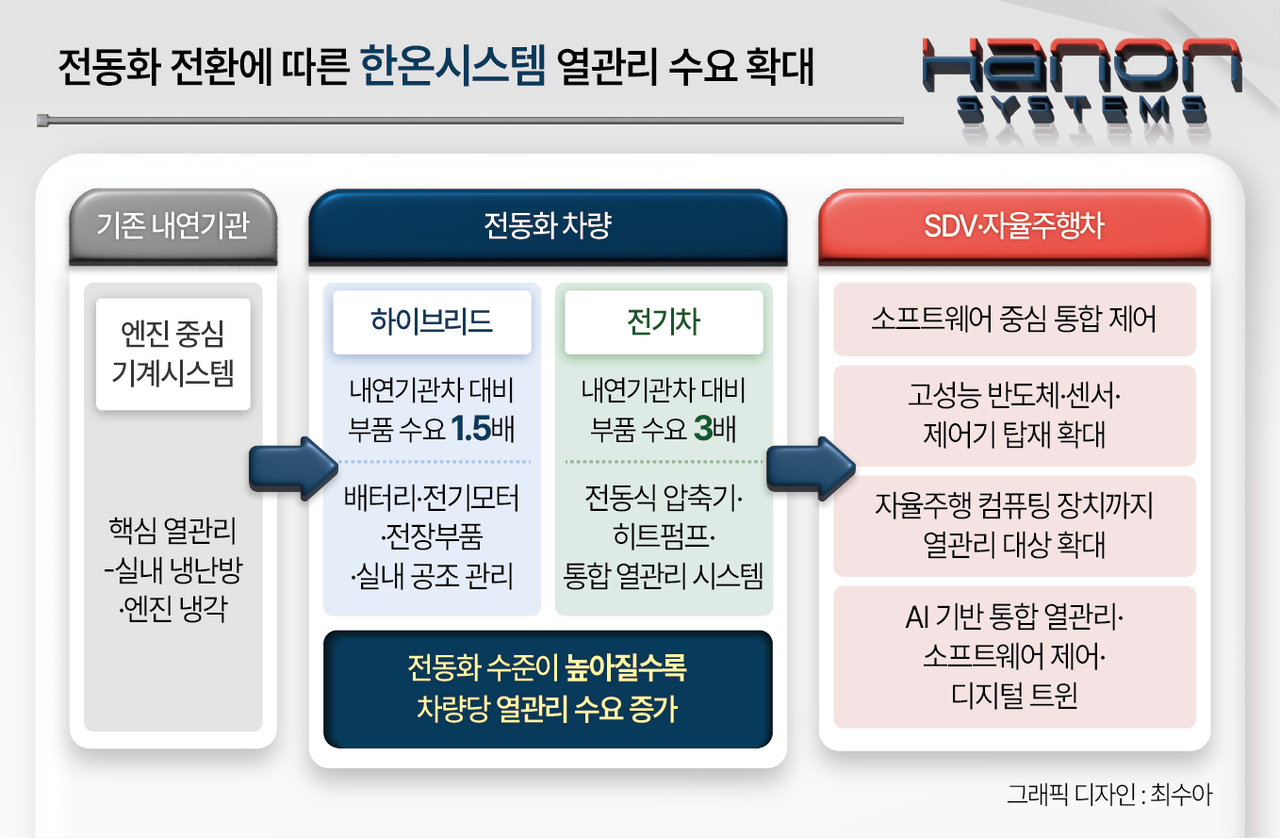
The shift to electrification is sharpening Hanon Systems' technological edge. In internal combustion engine vehicles, cabin heating and cooling sat at the center of thermal management. In electric vehicles, battery temperature control and heat recovery determine driving range and charging performance. Thermal management components have moved from supporting roles to become the core systems that define EV performance.
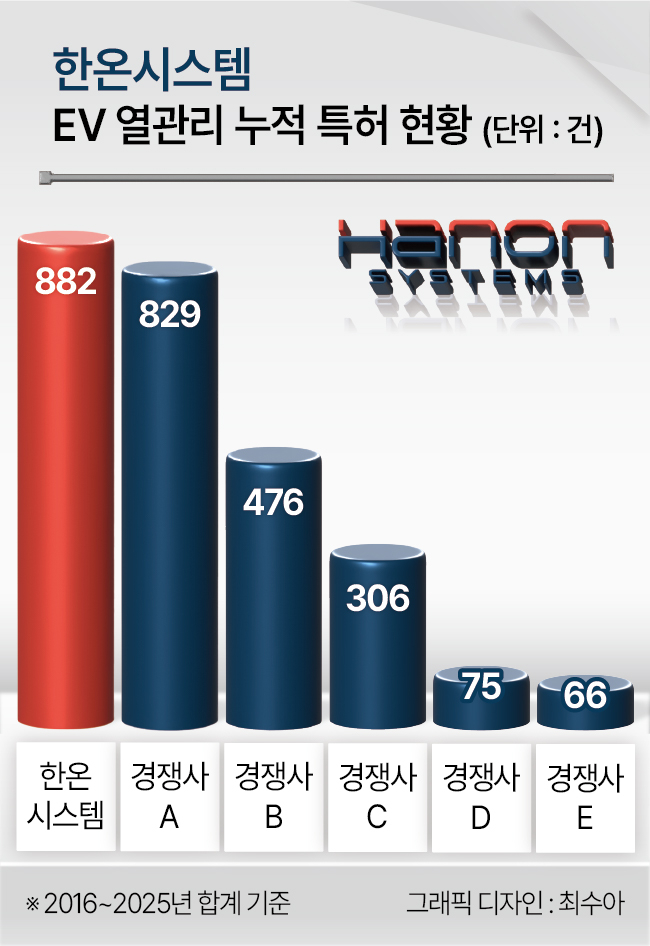
Hanon Systems has built up its technology assets rapidly in step with that shift. The company secured 882 publicly disclosed EV thermal management patents over the 10 years from 2016 through last year — far more than its major Japanese and European competitors. Patents related to electric compressors, which handle cabin heating and cooling in EVs, and heat pump systems, which reduce the range loss that cold weather causes, numbered roughly 390 and 330, respectively.
![Hanon Systems' fourth-generation heat pump system, a core thermal management technology that improves EV heating and cooling efficiency to reduce winter driving range loss. [Hanon Systems]](https://wimg.heraldcorp.com/news/cms/2026/07/15/news-p.v1.20260710.3ed9b24a3a684fc38d5f3bb572e632e0_P1.jpg)
International technology awards have followed. In April last year, Hanon Systems became the first Korean auto parts company to win the Automotive News PACE Award three times, at the ceremony held in Detroit. The PACE Award recognizes innovation in automotive technology and is widely referred to in the industry as the "Oscar of auto parts technology."
The winning technology was a visible-light LED photocatalytic antibacterial and deodorizing system that sterilizes and eliminates odors from cabin air. Independent testing recorded a virus sterilization rate of 98.5 percent and a gas deodorization rate of 97.5 percent, far exceeding the 66.1 percent virus sterilization rate of existing products. The system generates no electromagnetic interference or ozone and is designed for semi-permanent use. It has been applied to the Genesis G90, Hyundai Motor's flagship sedan.
The company also drew recognition at home for its hybrid vehicle thermal management technology. In December last year, Hanon Systems received the Minister of Trade, Industry and Energy Award — the "Industrial Technology Innovation Award of the Year" — for its integrated thermal management control technology for hybrid electric vehicles. The technology improves winter fuel efficiency in hybrid vehicles by more than 15 percent at temperatures as low as minus 20 degrees Celsius while enhancing cabin heating performance. The company plans to extend the technology to plug-in hybrid electric vehicles and range-extended electric vehicles.
Cutting chemical refrigerants, switching to natural ones — getting ahead of green regulations
Adapting to environmental regulations is another key growth pillar for Hanon Systems. Fluorine-based chemical refrigerants have long been widely used in automotive air conditioners and heat pumps. The concern is that some refrigerants can produce persistent substances when they break down in the atmosphere. These fluorinated chemical compounds that resist natural decomposition are commonly known as PFAS — or, in industry parlance, "forever chemicals."
Growing concern that these substances can accumulate in rainwater, soil and waterways has accelerated regulatory discussions, particularly in Europe. Automakers are responding by seeking alternative technologies that use naturally occurring refrigerants such as carbon dioxide and propane.
Earlier this month, Hanon Systems published a technical white paper analyzing the potential environmental impact of conventional chemical refrigerants and presenting natural refrigerant technologies using carbon dioxide and propane as alternatives. Its carbon dioxide refrigerant-based thermal management system is already deployed on the Volkswagen Group's MEB electric vehicle platform and has been installed in more than 1 million vehicles.
A propane refrigerant-based system has completed vehicle testing under high-heat and extreme-cold conditions in Spain, Sweden and Finland, and Hanon Systems is developing the key components with a target of mass production in 2029.
![Hanon Systems' ultra-compact integrated refrigerant module consolidates key EV thermal management components into a single unit to improve efficiency. [Hanon Systems]](https://wimg.heraldcorp.com/news/cms/2026/07/15/news-p.v1.20260401.d4b422232ba64f78b656f00b307cf0d7_P1.jpg)
Autonomous vehicles need thermal management too — and now software capability
The era of software-defined vehicles and autonomous driving presents another opportunity. Self-driving cars carry high-performance semiconductors, an array of sensors including lidar, radar and cameras, and multiple controllers. In a robotaxi environment where vehicles operate around the clock, the ability to reliably manage the heat those systems generate is directly tied to vehicle uptime.
In response, Hanon Systems launched a global software organization last year to strengthen its capabilities in controlling refrigerant and coolant flow and in managing heat generated by batteries and electronic components in an integrated way. The company is developing a platform that uses a high-efficiency heat pump system as its core to provide integrated thermal control across the entire vehicle.
![Hanon Systems' R744 electric compressor, a key component in EV thermal management systems using carbon dioxide refrigerant, designed to improve heating and cooling efficiency and support the transition to eco-friendly refrigerants. [Hanon Systems]](https://wimg.heraldcorp.com/news/cms/2026/07/15/news-p.v1.20250916.914375b0421a4e43b4ed4050a2d0c1ad_P1.jpg)
In the autonomous driving space, Hanon Systems is also working with Zoox, Amazon's self-driving subsidiary. The company signed a contract to supply a dedicated air-conditioning and thermal management system for Zoox's fully autonomous robotaxi, developing a personalized climate control system that independently regulates temperature and airflow for each of the four face-to-face seats in the driverless cabin.
Hanon Systems' incorporation into the Hankook & Company Group as a subsidiary in January last year is also broadening its medium- to long-term growth base. Hankook & Company Group is building out a future mobility portfolio that connects tires, batteries and thermal management.
![Lee Su-il, vice chairman and chief executive of Hanon Systems. [Hanon Systems]](https://wimg.heraldcorp.com/news/cms/2026/07/15/news-p.v1.20260715.978181679ac54e65900d2a8d0686b6a7_P1.jpg)
"Because software-defined vehicles and autonomous cars involve greater system complexity and more demanding thermal management challenges, we are co-developing software technologies with automakers from the earliest stages and working in close collaboration," a Hanon Systems official said. "By adding powerful software control capabilities on top of our existing mechanical component expertise, we will maintain our position as an unrivaled global leader in the automotive paradigm that lies ahead."

kwater@heraldcorp.com