![Minister of Employment and Labor Kim Young-hoon delivers opening remarks at a forum on new paths for social innovation in step with AI technological advancement, held Tuesday at Peace&Park in Yongsan-gu, Seoul. [Yonhap]](https://wimg.heraldcorp.com/news/cms/2026/07/16/rcv.YNA.20260714.PYH2026071414420001300_P1.jpg)
The government has been stepping up discussions on "social solidarity investment" — channeling corporate excess profits into youth employment and support for subcontractors — but the existing large-and-small business co-prosperity programs it funds at more than 400 billion won ($268 million) a year have gone without a proper performance review for the past six years, a new report shows.
The government is running 441 billion won worth of co-prosperity programs through six ministries this year, yet key policy instruments have failed to take root in the field. Experts say the government should assess the effectiveness of its existing co-prosperity policies before moving on to new corporate profit-sharing schemes.
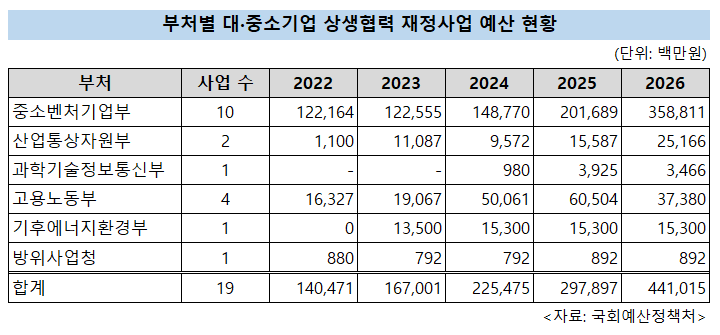
According to a report on large-and-small business co-prosperity support programs and policy evaluation released Thursday by the National Assembly Budget Office, the government currently operates 19 co-prosperity programs — 17 of which were analyzed — across six agencies: the Ministry of SMEs and Startups, the Ministry of Employment and Labor, the Ministry of Trade, Industry and Energy, the Ministry of Science and ICT, the Ministry of Climate, Environment and Energy, and the Defense Acquisition Program Administration (DAPA).
The combined budget for these programs stands at 441 billion won, a 48 percent increase from last year, with the Ministry of SMEs and Startups alone accounting for 358.8 billion won, or 81.4 percent of the total. Yet despite this quantitative expansion, the performance management framework has been in effect nonfunctional. The ministry's role as pan-government coordinator of co-prosperity policy has also fallen short.
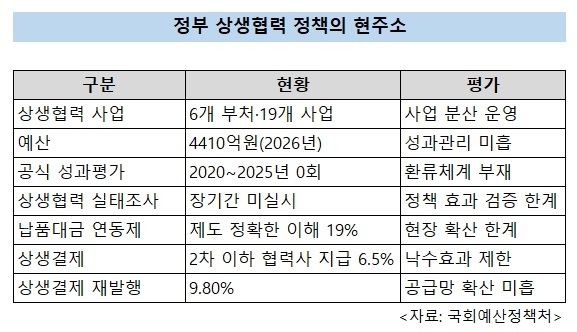
The Co-prosperity Cooperation Act requires an annual evaluation of implementation results, but no official performance review has been conducted even once since 2020. A co-prosperity field survey meant to verify policy effectiveness has likewise gone unperformed for years, meaning hundreds of billions of won in fiscal spending has been managed without any objective assessment of results.
Core co-prosperity mechanisms have also underperformed in practice. Only 19.0 percent of companies said they fully understood the supplier price-linkage system, which requires that rises in raw material costs be reflected in procurement prices. Among subcontractors surveyed, 35.4 percent said they were unaware the system existed at all.
The co-prosperity payment system — designed to let suppliers convert procurement receivables into early cash by leveraging the credit of large anchor companies — has also failed to spread across supply chains. The system is intended to extend an anchor company's credit rating throughout the supply chain so that second- and third-tier suppliers can receive payment at lower financing costs.
Of the 189.1 trillion won disbursed through the co-prosperity payment system last year, 98.2 percent went only to payments from anchor companies to first-tier suppliers, with just 6.5 percent flowing down to second-tier suppliers and below. Among companies that received co-prosperity payments, only 9.8 percent reissued them to second- or third-tier suppliers.
The profit-sharing program has been in operation for more than a decade since its introduction, yet not a single field survey to objectively verify its outcomes has ever been conducted. While the number of registered projects grew from 4,313 in 2021 to 5,899 last year, the post-implementation monitoring framework needed to confirm policy effectiveness is in effect absent, critics say.
The findings have prompted calls for the government to first put its existing fiscal co-prosperity programs on sound footing before pursuing the redistribution of chipmakers' excess profits. Jeong Geun-ju, an analyst at the National Assembly Budget Office, said the government needs to "restructure the co-prosperity policy framework around effectiveness and sustainability, rather than simply expanding the scope of policy."
Meanwhile, Minister of Employment and Labor Kim Young-hoon — despite criticism that the idea runs counter to free-market principles — convened a forum Tuesday titled "New Paths for Social Innovation in Step with AI Technological Advancement," at which he shared a proposal to levy a special tax on corporate excess profits modeled on the reconstruction profit recoupment levy, with the proceeds used to fund a social solidarity wage and address threats to industrial competitiveness.
fact0514@heraldcorp.com