![Apartments in the Seocho and Yongsan areas as seen from Namsan in Seoul [Yonhap]](https://wimg.heraldcorp.com/news/cms/2026/07/16/rcv.YNA.20251009.PYH2025100906340001300_P1.jpg)
Young people who settle outside Greater Seoul are more likely to have children and own homes than those who settle in the metropolitan area — yet marriage continues to drive population concentration toward the capital region. However, that concentration intensified in the period after marriage when couples relocated, and the data showed that marriage and regional migration had a significant impact on the labor market, particularly for women, whose full-time employment rate fell sharply after getting married.
The Ministry of Statistics released the findings Thursday, drawing on population dynamics panel statistics to analyze changes in residence, employment, childbirth and homeownership among men born between 1984 and 1990 who married for the first time at age 32, and women born between 1985 and 1991 who married for the first time at age 31. The analysis is the first in-depth study to use the population dynamics panel statistics.
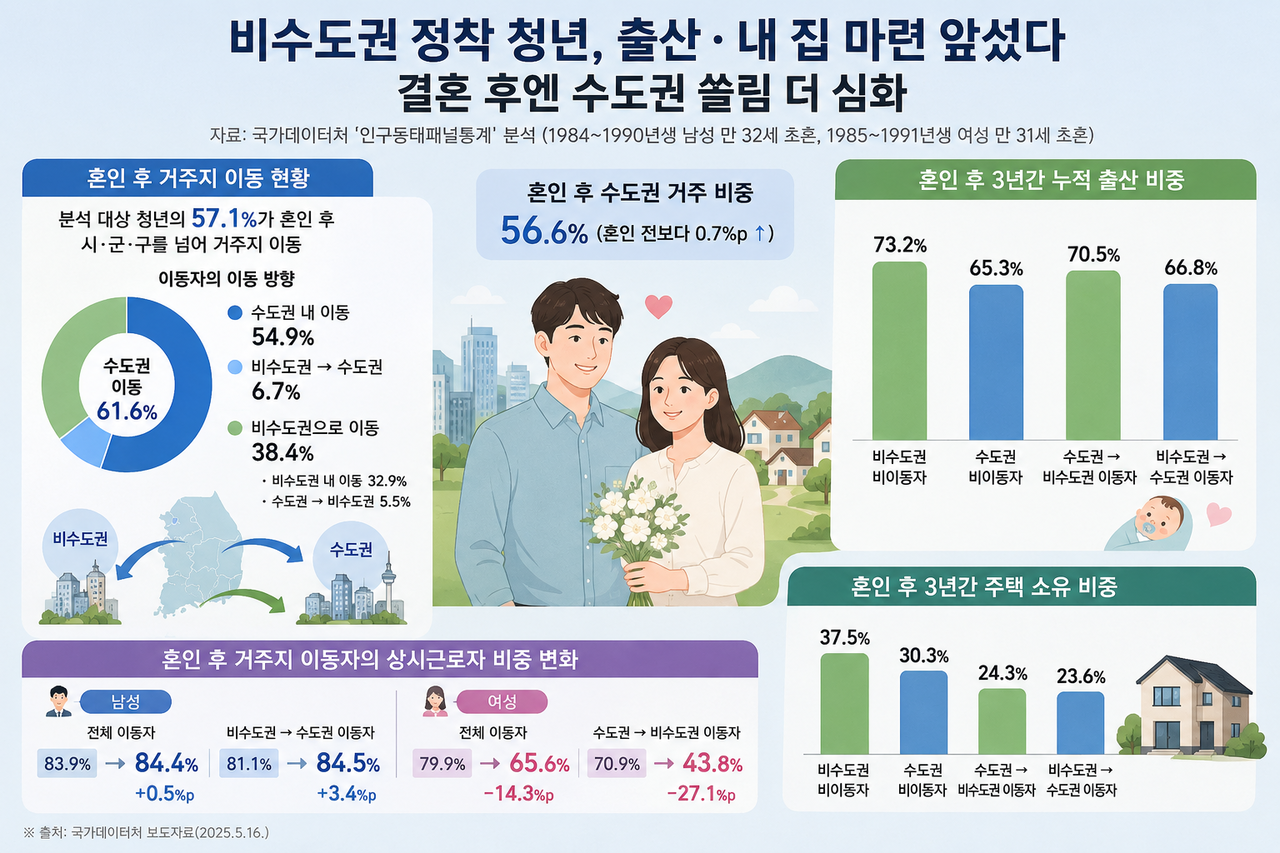
Young people who stayed in their existing area after marriage had higher rates of childbirth and homeownership than those who moved. The rates were particularly high among those who remained outside Greater Seoul or relocated from the metropolitan area to non-metropolitan regions.
The cumulative share of those who had a child within three years of marriage was 73.2% among youth who continued living outside Greater Seoul, compared with 65.3% among those who stayed within the metropolitan area — a gap of 7.9 percentage points. Among those who moved from Greater Seoul to non-metropolitan areas, the childbirth rate was 70.5%, also higher than the 66.8% recorded for those who moved in the opposite direction.
The same pattern held for homeownership. Within three years of marriage, 37.5% of those who remained outside Greater Seoul owned a home, compared with 30.3% of those who stayed in the metropolitan area. Those who moved from Greater Seoul to non-metropolitan regions also edged out those who moved the other way, at 24.3% versus 23.6%.
At the same time, the concentration of newlyweds in Greater Seoul deepened after marriage.
The share of the study group living in Greater Seoul rose 0.7 percentage points after marriage to 56.6%, while the share living outside the metropolitan area fell by the same margin. Overall, 57.1% of those analyzed moved across city, county or district boundaries after getting married.
Among those who moved, 61.6% either relocated within Greater Seoul or moved into the metropolitan area from outside — with intra-metropolitan moves accounting for 54.9% and inflows from non-metropolitan areas making up 6.7%. Moves toward non-metropolitan areas accounted for the remaining 38.4%, comprising intra-non-metropolitan relocations at 32.9% and moves from Greater Seoul to non-metropolitan regions at 5.5%.
By province and city, Gyeonggi Province saw the largest increase in residential share, rising 3.2 percentage points after marriage, while Seoul's share fell 2.6 percentage points. The shift was more pronounced among women: Gyeonggi Province's share of female residents rose 3.8 percentage points, while Seoul's fell 3.4 percentage points — larger swings than those recorded for men.
Gender differences were stark when it came to employment. Among men who relocated after marriage, the share in full-time employment edged up 0.5 percentage points, from 83.9% to 84.4%, while the share among women fell 14.3 percentage points, from 79.9% to 65.6%. The steepest decline was among women who moved from Greater Seoul to non-metropolitan areas, whose full-time employment rate dropped 27.1 percentage points. By contrast, men who moved from non-metropolitan areas to Greater Seoul saw their full-time employment rate rise 3.4 percentage points.
fact0514@heraldcorp.com