
![Employees work at the dealing room of Hana Bank's headquarters in Jung-gu, Seoul, on Monday, the first day of round-the-clock foreign exchange market operations. [Yonhap]](https://wimg.heraldcorp.com/news/cms/2026/07/16/rcv.YNA.20260706.PYH2026070601000001300_P1.jpg)
The government has unveiled a blueprint to transform the won into a "freely convertible currency" that can be traded without restriction anywhere in the world. The plan envisions building an offshore won payment network that would allow foreign users to open won-denominated accounts and make settlements abroad, while sharply easing regulations on foreign won transactions to raise the currency's international standing. Measures to strengthen the foreign exchange safety net and market monitoring will run in parallel to guard against financial instability from greater cross-border capital flows.
The Ministry of Economy and Finance, the Financial Services Commission, the Bank of Korea, the Financial Supervisory Service and the Korea Securities Depository jointly announced the "won internationalization roadmap" Sunday. The government will pursue four strategies to shift the won from its current status as a "restricted currency" to a freely convertible one: building offshore won transaction infrastructure and improving the foreign exchange regime; expanding demand for won transactions; broadening won liquidity supply; and establishing a multilayered risk management framework.
The government concluded that won internationalization can no longer be deferred given the size of the Korean economy and the development of its capital markets. Officials acknowledged that while greater won internationalization would reduce currency conversion and hedging costs for businesses and improve capital market access, it could also accelerate the transmission of global shocks into the domestic economy — making parallel risk management essential.
Offshore won accounts and settlements: building the cross-border payment network
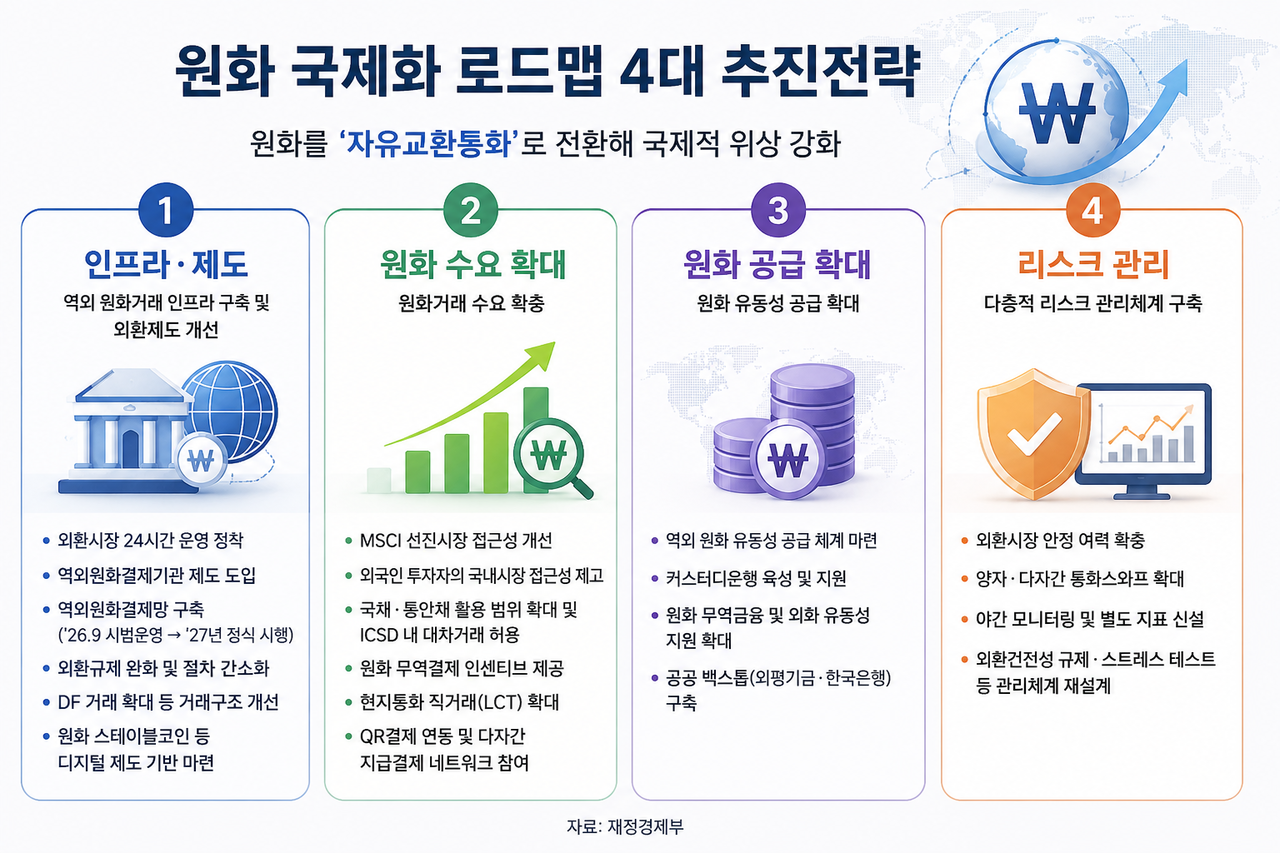
The most significant change is the construction of offshore won transaction infrastructure.
Building on the round-the-clock foreign exchange market that launched Monday, the government will introduce a system to register overseas financial institutions as "offshore won settlement institutions." This will allow foreigners to hold, remit and settle in won using accounts opened in their own names at overseas financial institutions, without needing a domestic bank account in Korea.
Won capital transactions between foreigners conducted through registered offshore won settlement institutions will be exempt from prior reporting requirements — except for domestic real estate transactions — and banks' transaction verification procedures will be simplified. Foreigners who conduct won transactions without using such institutions will remain subject to existing procedures under the Foreign Exchange Transactions Act.
The Bank of Korea will also establish a new 24-hour "offshore won settlement network" to ensure that won transactions between foreigners are settled on the central bank's payment system, enabling won settlement abroad without time-zone constraints. The government plans to run a pilot in September before formally launching the network in 2027.
Incentives will be introduced to gradually shift offshore won trading away from non-deliverable forwards, which currently dominate, toward deliverable forward transactions. Options under review include giving preferential treatment to deliverable forwards over non-deliverable forwards when calculating forward positions and the foreign exchange soundness levy.
Foreign exchange regulations will also be substantially overhauled. The government plans to more than double the threshold amounts that trigger prior reporting requirements for capital transactions such as foreign won-denominated loans and foreign currency borrowings, and will review a phased shift from the current prior-reporting framework to one centered on post-transaction reporting. Foreign financial companies will be permitted to act as direct counterparties in third-party foreign exchange transactions, and the complex won account structure will be consolidated and simplified.
The government will also respond to changes in the digital financial environment. It plans to establish a legal basis for the issuance, distribution and trading of won-denominated stablecoins and to institutionalize cross-border payment and settlement. A pilot project will tokenize government bonds in conjunction with the Bank of Korea's institutional central bank digital currency, and Korea will participate in Project Agorá, the Bank for International Settlements' digital international settlement initiative.
Easing forex rules, boosting won demand and reinforcing safeguards against volatility
A set of policies to expand demand for the won will be pursued alongside the structural reforms.
The government will complete remaining tasks on the MSCI developed-market accessibility improvement roadmap and enhance foreign investors' access to domestic securities markets. The range of uses for government bonds and monetary stabilization bonds held by foreign investors — including as collateral and for securities lending — will be broadened, and securities lending transactions between foreigners involving those instruments within international central securities depositories will be permitted.
In trade, the government will offer incentives for won-denominated settlement. Companies that settle import and export payments in won may receive preferential policy financing rates and higher trade insurance limits, and won settlement track records and expansion plans will be factored in as preferential criteria when selecting recipients of government export support programs.
The government will also expand local currency direct trading arrangements with major trading partners, allowing settlement in each country's own currency without routing through the dollar. Plans include increasing cross-border QR payment linkages and exploring participation in multilateral payment networks connecting small-value payment systems across Asia.
Mechanisms to supply won liquidity will also be put in place. Overseas financial institutions will be able to borrow won without limit on a temporary basis from domestic foreign exchange banks during overnight offshore settlement, and a public backstop will be established under which the government's foreign exchange equalization fund and the Bank of Korea can supply liquidity when needed.
The government will strengthen foreign exchange market safeguards to prepare for greater financial market volatility as won internationalization advances. It will gradually build up foreign exchange market stabilization capacity, reinforce the function of public-sector foreign currency assets as a source of liquidity in emergencies, and expand bilateral and multilateral currency swap arrangements.
Real-time monitoring of exchange rate swings, asking price spreads and trading volumes will be conducted through overnight monitoring desks at the Ministry of Economy and Finance and the Bank of Korea, and separate monitoring indicators will be created to track liquidity in the offshore won market and won funding volumes by financial institution. The soundness management framework will be redesigned in stages, including incorporating offshore won market conditions into foreign exchange soundness regulations and stress tests.
fact0514@heraldcorp.com





