Youth employment and startup budget rises 41.6% next year; advanced-field training slots to double to 120,000
Companies cite early hiring costs and labor rigidity as barriers; additional support to be reviewed in National Assembly budget deliberations
The government will expand next year's budget for youth employment and startup support by 41.6 percent to 5.1 trillion won ($3.8 billion), up from 3.6 trillion won this year, as it moves to address a prolonged slump in youth hiring. The plan doubles vocational training slots in advanced and in-demand fields and strengthens hiring incentives for companies that take on young workers. Businesses, however, pointed to early-stage labor costs and rigid employment rules as the main obstacles to expanding their payrolls. The government said it would review proposals for additional support during the National Assembly's deliberations on next year's budget.
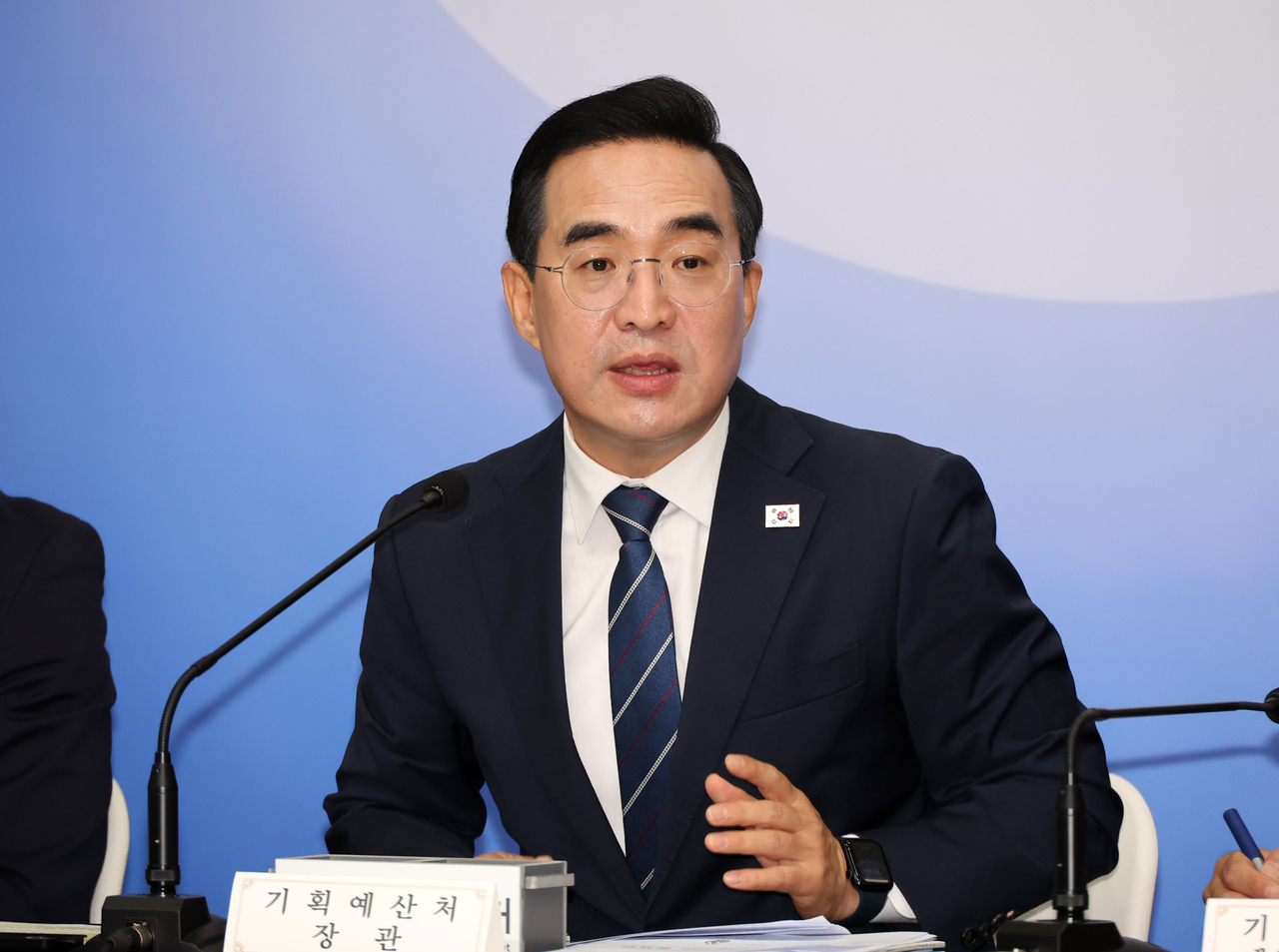
Ministry of Planning and Budget Minister Park Hong-keun visited Mediintech, a medical-robot startup in Jongno-gu, Seoul, on Monday to hold a roundtable on expanding private-sector employment, attended by officials from related ministries, business associations and corporate hiring managers. The meeting was convened to discuss ways to encourage private companies to hire more young workers and create higher-quality jobs amid a prolonged deterioration in youth employment.
The overall employment rate for people aged 15 to 64 hit a record high of 70.6 percent in September, but the youth employment rate fell for the 29th consecutive month. While the broader labor market continues to improve, conditions for young job seekers have shown little sign of recovery.
In response, the government raised the youth employment and startup support budget from 3.6 trillion won this year to 5.1 trillion won next year, a 41.6 percent increase. The core of the plan is to strengthen step-by-step support covering vocational training, first employment, corporate hiring and long-term retention.
Training slots in advanced and in-demand fields will double from 60,000 this year to 120,000 next year. The K-New Deal Academy, led by large conglomerates, will train 50,000 people, while 20,000 will receive support through the AI-focused K-Digital Training program.
Support for young people with no work experience will also be expanded. A new first-employment support program will be established to assist 160,000 youth, and a work-experience project will provide on-the-job exposure to 39,000 participants. A new specialized work-experience track targeting vulnerable youth will support an additional 3,000 people.
The government will also expand the Youth Employment Jump Incentive — a hiring subsidy aimed at encouraging companies to take on young workers — to cover 130,000 people. The subsidy will be extended to mid-sized companies in the Greater Seoul area and large companies outside it that hire graduates of government-run training programs, and new support for young people in the metropolitan area will be introduced.
At the roundtable, participants said that boosting actual corporate hiring would require not only fiscal support but also a reduction in the burdens companies face during the hiring process.
Representatives from companies and business associations called for government assistance with early-stage labor and training costs. Some also raised the need to account for the hiring risks that stem from labor market rigidity.
Participants proposed strengthening long-term retention incentives and career development support to help small and medium-sized enterprises attract and keep talented workers. They also suggested expanding integrated career management support so that young people can leverage experience gained at smaller firms when seeking future employment or changing jobs.
Before the roundtable, Park toured Mediintech's facilities to review the company's growth and youth hiring record, and observed a demonstration of its medical-robot products. Mediintech is a medical-robot startup founded in 2020 that was selected this year for the Ministry of SMEs and Startups' Unicorn Bridge project.
"To create an environment where people — including young people whose employment conditions have been deteriorating — can work to their full potential, the private sector must ultimately generate enough good jobs," Park said. "We will look closely at the difficulties companies face in hiring and developing young talent, and work to strengthen a structure in which the private sector can create jobs voluntarily and sustainably."
The Ministry of Planning and Budget said it would continue to discuss private-sector employment support measures with related ministries — including the Ministry of Employment and Labor, the Ministry of SMEs and Startups, and the Ministry of Trade, Industry and Energy — based on the opinions raised at the roundtable. Items requiring additional funding will be reviewed during the National Assembly's deliberations on next year's budget.
fact0514@heraldcorp.com