
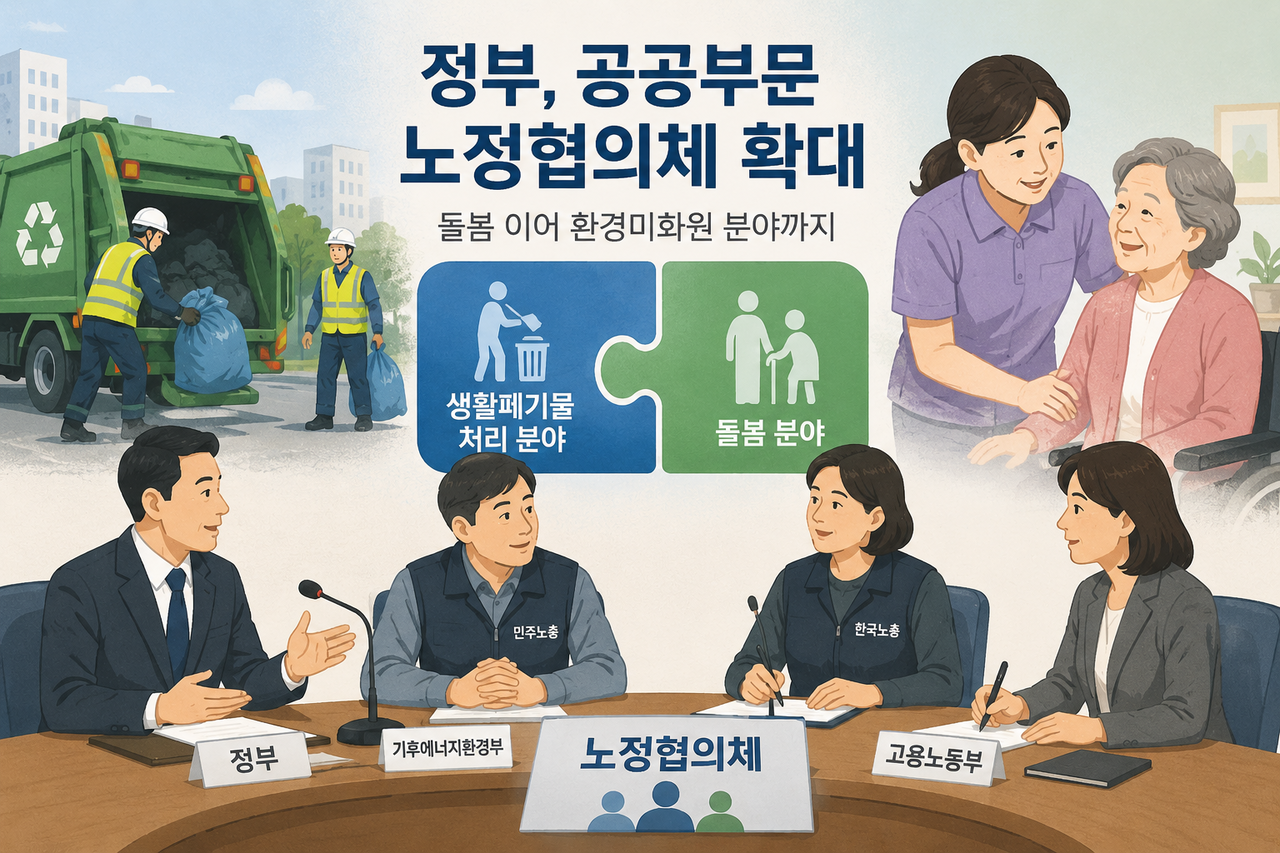
The government is broadening its labor-management dialogue in the public sector, extending the labor-government council model from care workers to municipal waste management. Following the enactment of the so-called "Yellow Envelope Act" — amendments to Articles 2 and 3 of the Trade Union Act — the sector-by-sector council format, in which the government and labor directly discuss improvements to working conditions, is spreading across public services.
The Ministry of Climate, Environment and Energy and the Ministry of Employment and Labor, together with the Korean Confederation of Trade Unions (KCTU) and the Federation of Korean Trade Unions, held the inaugural meeting of the Labor-Government Council for Municipal Waste Management on Thursday, beginning discussions on improving conditions for workers engaged in household waste collection, transport, sorting and incineration.
The council will focus on employment stability and wage structure reform for waste management workers employed by private contractors on behalf of local governments, as well as improvements to working environments, staffing and equipment levels, and sanitation and rest facilities.
The new body is the second sector-specific public-sector labor-government council, following the care-sector council launched in March. The government formed that council after care workers demanded collective bargaining with the state, and announced plans to extend the model to other public service sectors. The waste management council follows as the next step in that effort.
In the waste management sector, the KCTU called for direct bargaining with the Ministry of Climate, Environment and Energy in March, arguing that because the government sets waste management standards and appropriate wage levels, it should bear substantive employer responsibility. The government, while stopping short of conceding employer status, concluded that improving working conditions was necessary and opted for the council framework.
The poor working conditions facing public-sector sanitation workers also helped drive the council's formation.
A survey by the Busan Labor Rights Center found that 91.7 percent of sanitation workers perform night shifts. A separate survey by lawmaker Jeong Hye-gyeong of the Progressive Party and the Public Solidarity Union found that more than half said the safety rule requiring three workers per team was not being properly observed. In 2024, 8,446 municipal waste workers suffered industrial accidents, and 723 died on the job over the past five years.
Meanwhile, a probe into 2,462 municipal waste collection, transport and street-cleaning service contracts awarded over the past three years found that 561 cases — 22.8 percent — involved wages paid below the contracted amount. An additional 586 contracts, or 23.8 percent, were found to have set wages below the appropriate level from the contracting stage itself.
fact0514@heraldcorp.com





