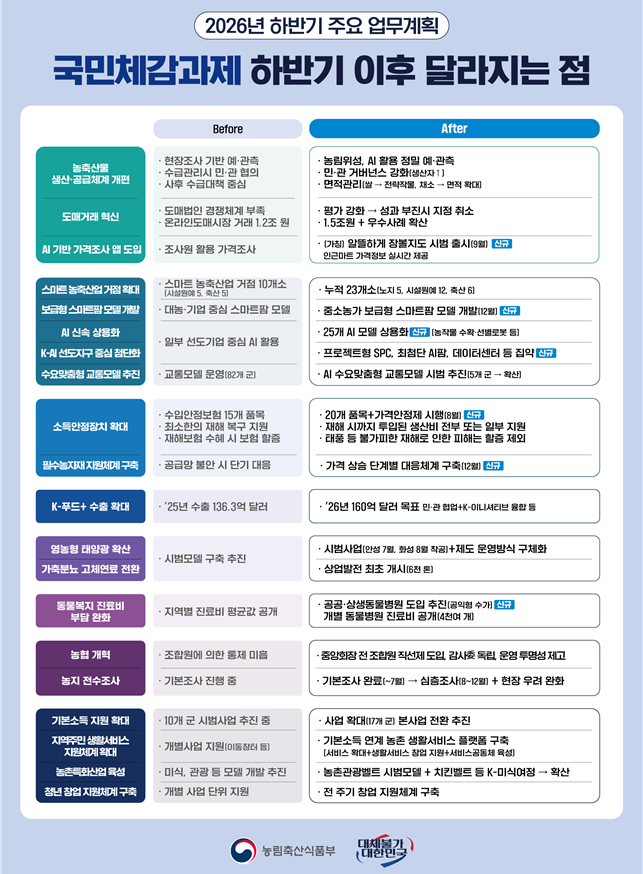
The government will push ahead in the second half with agricultural policy initiatives that citizens can feel directly, including expanding AI-based farming and introducing a new price stabilization scheme. An AI-powered price comparison app for farm and livestock products will debut, and the commercialization of AI harvesting robots will also accelerate.
Agriculture, Food and Rural Affairs Minister Song Mi-ryong announced the ministry's key second-half priorities Thursday at a departmental briefing held at Cheong Wa Dae's state guesthouse, presided over by President Lee Jae Myung. Having completed institutional reforms in the first half, the ministry said it will focus its policy efforts in the second half on delivering tangible results for the public.
To respond to climate change, the ministry will build a proactive supply-and-demand management system in line with the implementation of the revised Grain Management Act and the Agricultural and Fishery Products Distribution and Price Stabilization Act. Using an agricultural satellite that began operating this month and AI, the ministry will forecast production and supply of farm and livestock products, with producers and the government jointly drawing up supply management plans.
In the retail sector, an AI-based price comparison app for farm and livestock products will be piloted in five regions in September. Consumers will be able to compare prices at hypermarkets, small and mid-sized supermarkets, and traditional markets at a glance. The government plans to run the pilot for one year before deciding whether to expand it nationwide.
AI farming will also advance. The ministry will move quickly to commercialize 25 AI models — including crop harvesting and sorting robots — and expand smart farming hubs from 10 to 23 locations. In Muan, South Jeolla Province, a "K-AI Farming Pioneer District" will be established to promote AI farming demonstrations and data-driven industry development.
The ministry will also strengthen the farm management safety net. The number of crops covered by income stabilization insurance will expand from 15 to 20, and a new price stabilization scheme will be introduced. The scheme compensates farmers when falling prices reduce their income below a set level; the eligible crops and compensation thresholds will be finalized by a price stabilization review committee. A support plan for rising essential farm input costs will also be prepared in November.
K-Food exports will be expanded as well. The ministry has set an export target of $16 billion for this year. It plans to strengthen joint public-private marketing and promotions tied to Korean culture, and to step up its push into ASEAN markets — including Taiwan and the Philippines — as well as Latin America. The ministry also plans to enhance overseas regulatory and licensing consulting by product category to support companies expanding abroad.
The rural basic income program will be broadened. Seven additional counties — Hwacheon, Boeun, Jinan, Muju, Gurye, Boseong and Cheongsong — will begin receiving basic income payments in August. The government plans to continue supporting existing pilot program areas next year and to back locally driven growth through initiatives such as rural tourism belt development and youth entrepreneurship support.
Reform of the National Agricultural Cooperative Federation and a comprehensive farmland probe will also move forward. A preliminary farmland survey found that 27.6 percent of all farmland requires on-site verification, and the ministry plans to conduct in-depth investigations in the second half with a focus on detecting speculation and illegal use. Additional reform tasks — including the expansion of agrivoltaic solar power and the enactment of a basic animal welfare law — will also be pursued.
"In the first half, we focused on restructuring the agricultural policy framework to advance state priorities," Minister Song said. "In the second half, we will devote all our efforts to producing results that people can feel as real changes in their lives."
adastra@heraldcorp.com