First shipment of 19.6 tons to arrive in Shanghai on Tuesday, a month ahead of schedule
Produce to be sold at premium retailers including City Super
Promotional events planned in Shenzhen, Shanghai and Beijing through year-end
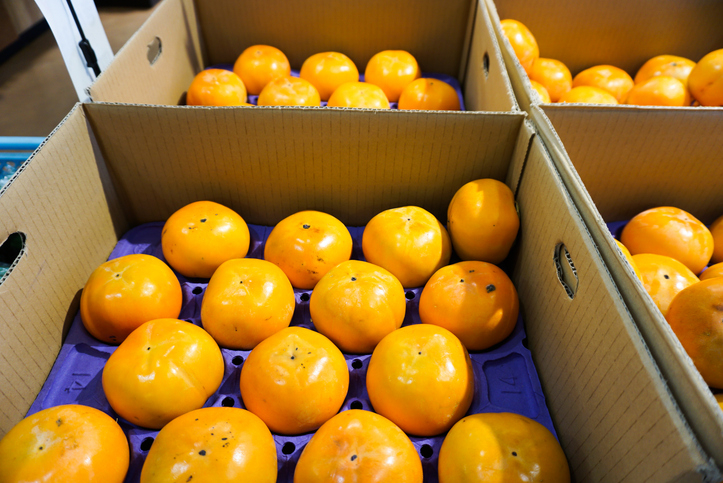
South Korean sweet persimmons have entered the Chinese market for the first time, capping 17 years of quarantine negotiations. The first shipment of 19.6 metric tons is set to arrive in Shanghai on Tuesday and go on sale at premium retail stores.
South Korea's Ministry of Agriculture, Food and Rural Affairs and the Korea Agro-Fisheries and Food Trade Corporation held a shipment ceremony Friday at Dongeup Agricultural Cooperative in Changwon, South Gyeongsang Province, to mark the occasion.
The inaugural export consists of 19.6 metric tons — 1,960 boxes filling a single 40-foot container — sorted and packed to Chinese quarantine standards by Dongeup Agricultural Cooperative and South Gyeongsang Persimmon Horticultural Cooperative. The shipment departed from Busan and is due in Shanghai on Tuesday, after which it will be distributed through a local importer to premium retailers including City Super.
Getting to this point took 17 years. Quarantine negotiations on Korean persimmon exports to China began in 2008 and were concluded at the South Korea-China summit held in Gyeongju on Nov. 1, 2025. At that meeting, attended by President Lee Jae Myung and Chinese President Xi Jinping, Agriculture Minister Song Mi-ryeong and Chinese General Administration of Customs Director Sun Meijun signed an MOU on plant quarantine requirements for the export of fresh Korean persimmons to China.
The government rolled out export quarantine guidelines in February and designated five export complexes in South Gyeongsang Province in May. Two rounds of pre-inspections and rehearsals were conducted in preparation for a Chinese on-site review. The General Administration of Customs completed a remote inspection in mid-October and on Oct. 30 officially registered 25 orchards and six sorting facilities. The approval process was completed about a month ahead of schedule, making it possible to export this year's harvest.
The opening of the Chinese market broadens export channels that had been concentrated in Southeast Asia. South Korea exported 3,217 metric tons of persimmons last year, with about 80 percent going to five markets including the Philippines, Malaysia and Hong Kong. South Gyeongsang Province, which accounted for 3,202 metric tons — 99 percent of the national total — is the country's leading persimmon-producing region. Export revenue stood at $5.74 million.
The Agriculture Ministry expects Chinese exports to boost income for South Gyeongsang persimmon farmers and help stabilize domestic prices by spreading out the volume hitting local markets during the harvest season.
Marketers in China will highlight the crisp texture and high sugar content of Korean sweet persimmons. Unlike the astringent Chinese varieties that require ripening before consumption, Korean sweet persimmons can be eaten immediately after harvest — a distinction the government plans to leverage in targeting the premium fruit segment.
In Shanghai, promotional events will run at fruit wholesale markets and premium retail stores from Nov. 14 through Dec. 27. In Beijing, a product presentation for 35 local buyers on Nov. 19 will kick off a series of retail trade shows and consumer promotions.
In Shenzhen, which hosts the Asia-Pacific Economic Cooperation summit Nov. 18-19, K-food consumer experience events and business-to-business trade consultations are scheduled for Nov. 21-24. The ministry said it will review whether to expand the number of designated export complexes based on sales results and consumer response in China.
Jeong Gyeong-seok, the Agriculture Ministry's director general for food industry policy, said the export milestone is "the fruit of 17 years of quarantine negotiations, summit diplomacy, and the efforts of South Gyeongsang persimmon farmers and exporters." Jeong added that the ministry would provide seamless support — from quarantine management to on-the-ground promotions — to ensure that "the export path opened at last year's Gyeongju APEC summit reaches the tables of Chinese consumers at this year's Shenzhen APEC."
adastra@heraldcorp.com