![A Korea Airport Service employee loads cargo onto a Korean Air aircraft using a belt loader. [Korean Air]](https://wimg.heraldcorp.com/news/cms/2026/07/16/news-p.v1.20250305.a63b092127724b2cb65cdd4c539225bf_P1.png)
Korean Air's second-quarter cargo revenue rose by roughly 500 billion won from a year earlier. Volume was little changed from a year ago, but the global buildout of AI data centers fueled demand for time-sensitive, high-value cargo such as semiconductors and server equipment, pushing average freight rates up more than 40%.
Korean Air's cargo traffic in the second quarter reached 2.19 billion ton-kilometers, up 3.0% from the same period last year, according to industry data. Available cargo capacity expanded 4.5% to 3.08 billion ton-kilometers. Because capacity grew faster than actual volume, the cargo load factor slipped 1.0 percentage point to 71.3% from 72.3%. In terms of volume and load factor alone, performance was essentially flat.
The average yield — revenue earned per ton of cargo carried per kilometer — told a different story, jumping 41.8% to 703 won from 496 won. The airline moved only 3% more freight yet earned more than 40% more for carrying the same weight over the same distance, reflecting the pricing power that came with concentrated demand.
As a result, cargo route revenue climbed 46.1% year-on-year to 1.54 trillion won ($1.04 billion). The increase of 486.5 billion won exceeded the 451.4 billion won gain in combined international and domestic passenger route revenue over the same period.
Among routes, the Americas posted the largest cargo revenue increase, rising 47% year-on-year to lead overall freight performance. Europe was up 40%, while Southeast Asia and China gained 51% and 49%, respectively, confirming broad rate strength across major long- and medium-haul routes. Japan, though smaller in scale, recorded the highest growth rate at 57%, and Oceania and domestic routes rose 28% and 5%, respectively.
Cargo accounted for roughly 47% of Korean Air's total revenue increase of 1.03 trillion won. The share of cargo in total revenue also rose, from about 27% in the second quarter of last year to about 31% this year.
Korean Air's total second-quarter revenue reached 5.02 trillion won, up 25.9% from a year earlier. Operating profit fell 34.4% to 261.8 billion won as fuel costs surged, but the result far exceeded market expectations. iM Securities and KB Securities both cited cargo strength as the reason actual operating profit came in roughly four times higher than the initial market consensus of 60 billion to 70 billion won.
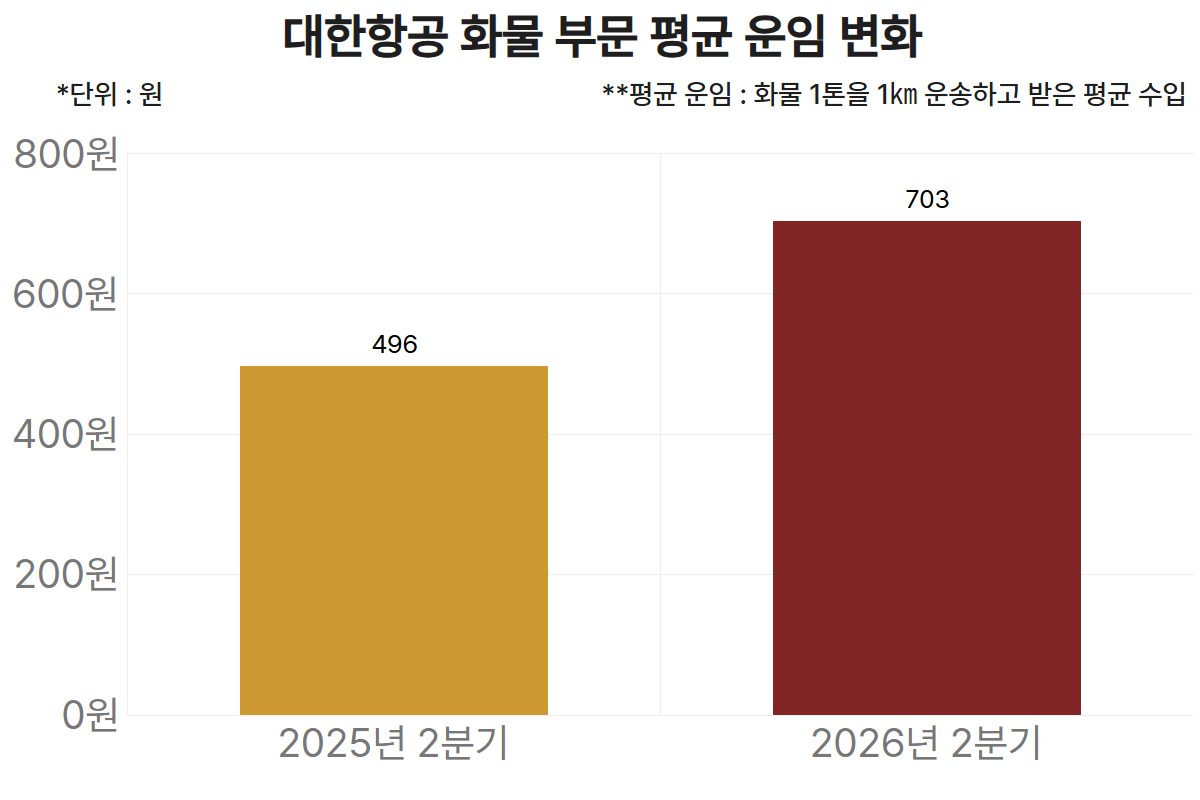
Price effect outweighs volume
Higher freight rates were the primary driver of cargo earnings. KB Securities estimated that the rate increase generated an additional 268.3 billion won in revenue during the second quarter.
The rate increase also helped absorb a portion of sharply higher fuel costs. Korean Air's second-quarter fuel expenses reached 2 trillion won, up 1.05 trillion won, or 110.9%, from a year earlier. Fuel accounted for the bulk of the 1.17 trillion won increase in total operating expenses.
KB Securities estimated that higher average yields on both passenger and cargo services generated an additional 704.6 billion won in revenue, offsetting roughly 67% of the fuel cost increase through pricing. Cargo was particularly well-positioned to pass on higher fuel costs, the brokerage said, because freight demand is strong and many shipments involve time-critical goods.
Fuel efficiency also improved. Although both passenger and cargo capacity each grew 4.5% year-on-year in the second quarter, fuel consumption was estimated to have risen by only about 0.6%.
![Ground handling workers unload cargo from a Korean Air aircraft. [Herald DB]](https://wimg.heraldcorp.com/news/cms/2026/07/16/news-p.v1.20250220.394fb5b6cfe5420fbac4b38222a42787_P1.png)
Why AI servers and chips are moving by air
The biggest factor pushing cargo rates higher has been the expansion of AI infrastructure investment. Building AI data centers requires not only semiconductors but also large, expensive components such as server racks, power equipment and networking gear — all in substantial quantities.
Speed of delivery matters for these goods. Delays in data center construction or semiconductor production schedules can generate losses that far exceed the cost of air freight. Shippers are therefore willing to pay premium rates to secure cargo space during periods of peak demand.
According to KB Securities, US imports of semiconductors and AI servers and related equipment jumped 99.1% year-on-year in April and May. Over the same period, South Korea's air cargo export volume rose 9.2% and outbound volume at Taiwan's Taoyuan Airport increased 18.3%. As prices for major AI equipment also climbed, freight costs fell as a share of total product value, easing the burden of high air cargo rates on shippers.
Korean Air's cargo revenue grew broadly across its major routes. Americas cargo revenue rose 47% year-on-year in the second quarter, with Europe up 40%, Southeast Asia up 51%, China up 49% and Japan up 57%. The Americas accounted for 51% of Korean Air's total cargo route revenue.
Korean Air's competitive strengths in cargo are its dedicated freighter fleet, route network and geographic position in Northeast Asia. The airline currently operates 23 freighters — 11 Boeing 747-series aircraft and 12 Boeing 777Fs — giving it significantly greater capacity to handle large and heavy shipments than carriers that rely solely on belly cargo space.
Korean Air plans to expand its pursuit of large, heavy cargo beyond semiconductors and server racks to include transformers and other oversized equipment for AI data centers. The airline will also upgrade automated handling facilities at its cargo terminals in Incheon and New York, and introduce an online platform allowing shippers to check rates and flight schedules and book directly.
![Employees of Korea Airport Service, a Korean Air subsidiary, load cargo toward the front of a freighter using a ULD loader. [Korea Airport Service]](https://wimg.heraldcorp.com/news/cms/2026/07/16/news-p.v1.20250305.9d3a4bb2ade04f779ba52add19b6b2db_P1.png)
Rates seen staying above last year's levels after Q2 peak
Analysts expect cargo yields to ease somewhat from the second-quarter peak of 703 won per ton-kilometer, but the prevailing view is that rates will remain well above last year's levels. iM Securities forecast a third-quarter cargo yield of 618 won, Shinhan Investment projected 646 won and KB Securities estimated 683 won. Those figures are 3 to 12 percent below the second-quarter level but 25 to 39 percent above the 493 won recorded in the third quarter of last year.
Global air cargo demand is also outpacing supply. According to the International Air Transport Association, worldwide air cargo volume rose 6.0% year-on-year in May, while capacity grew just 1.9%.
A decline in global oil prices could further boost the profitability of the cargo business. iM Securities estimated that if jet fuel prices fall below the threshold used to calculate fuel surcharges in the third quarter, the effect could add roughly 200 billion won to operating profit.
Risks remain, however. Changes in US and European tariff policy, tighter regulations on low-value e-commerce shipments and geopolitical uncertainty all pose headwinds. If high rates persist for an extended period, some shippers may shift a portion of their cargo to maritime transport. Korean Air said it plans to manage volatility by adjusting routes in response to demand shifts and increasing the share of cargo covered by fixed-rate contracts.
kwater@heraldcorp.com