
![Workers on the morning shift leave Hyundai Motor's Ulsan plant through the Myeongchon main gate two hours early on Monday, when the Korean Metal Workers' Union's Hyundai Motor chapter launched a three-day partial strike. [Yonhap]](https://wimg.heraldcorp.com/news/cms/2026/07/17/rcv.YNA.20260713.PYH2026071314180005700_P1.jpg)
The Hyundai Motor union, whose members worked a maximum of 26 hours last week, is set to double the intensity of its strike action this week. After staging two-hour partial strikes per shift from Monday through Wednesday, workers returned to normal operations only on Thursday before rejecting scheduled holiday overtime on Saturday and Sunday. Starting Monday, both day and night shifts will walk out for four hours each on three consecutive days — raising fears that Hyundai Motor's production disruption this year could reach its worst level in nine years since 2017.
According to industry sources, the Korean Metal Workers' Union's Hyundai Motor chapter will hold four-hour partial strikes from Monday through Wednesday. In a strike committee directive, the union said it would "raise pressure on management through the full solidarity of 40,000 union members, given that management has made no forward-looking proposals and has not requested a resumption of negotiations."
The strikes this week are more intense than last week's. The union has decided that both day and night shifts will halt work for four hours each from Monday through Wednesday. The day shift will strike from 10:50 a.m. to 3:30 p.m., while the night shift will walk out from 7:30 p.m. to 12:10 a.m. the following day. Excluding meal breaks, the actual strike time amounts to four hours per shift, which could cause up to eight hours of production line downtime per day.
Permanent day-shift workers will join the strike from 12:40 p.m. to 4:40 p.m., while general office staff will participate from 1 p.m. to 5 p.m. The sales, service, Namyang and Mobis committees will adjust their daily strike hours to fit their respective circumstances. If full negotiations resume, however, the strike schedule for that day will be suspended.
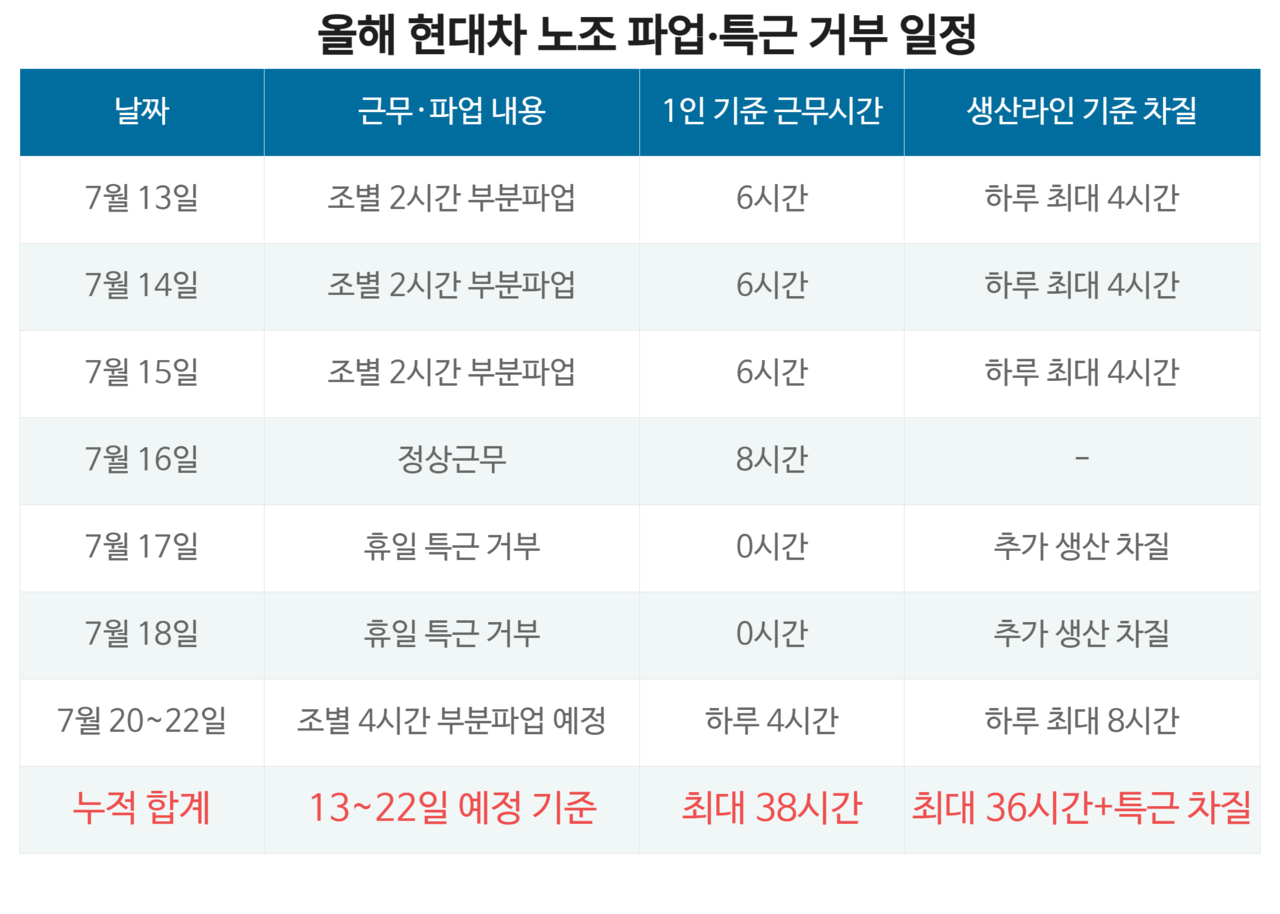
Maximum 26 hours worked last week — parts supplier strike compounds disruption
Production disruption at Hyundai Motor has already taken hold. The union staged two-hour partial strikes per shift from Monday through Wednesday last week, with workers returning to normal operations only on Thursday. Based on a standard eight-hour workday, each union member worked a maximum of six hours on each of the three strike days and eight hours on Thursday — totaling no more than 26 hours for the week. The rejection of holiday overtime scheduled for Saturday and Sunday further blocked any chance of recovering lost output.
Actual working hours on the shop floor may have been even shorter. A strike by parts suppliers coincided with the finished-vehicle union's walkout. The Motras union, which supplies electronic components and automotive modules, joined the Korean Metal Workers' Union's general strike on Wednesday, disrupting the supply of certain parts including chassis modules and struts. Some trim assembly lines at the Ulsan plant exhausted their remaining in-process inventory and halted operations ahead of the scheduled strike hours.
Finished-vehicle assembly lines run in real time, tied directly to parts supply. Module components in particular are typically fed into production on a just-in-time basis rather than stockpiled, meaning that when a supplier stops operating, the finished-vehicle line is immediately affected. This is why concerns are growing that the actual production loss from the strike could exceed the union's direct strike hours.
Cumulative 36-hour disruption projected — production loss estimated at 23,790 vehicles
The concern is that cumulative disruption hours will accelerate sharply starting this week. The four-hour strikes by both day and night shifts scheduled from Monday through Wednesday amount to eight hours of production line downtime per day, or 24 hours over three days. Adding last week's 12 hours brings the total projected strike-related downtime to 36 hours. When the Saturday and Sunday overtime refusals and parts supplier-related line stoppages are factored in, actual production losses could exceed the raw strike hours.
Management also views the damage from even the three-day partial strike from Monday through Wednesday as significant. According to the company, production and sales losses from those three days alone were estimated at around 11,520 vehicles. Factoring in the Saturday and Sunday holiday overtime refusals, the total loss could climb to as many as 23,790 vehicles.
Workers are also bearing a heavy cost. The estimated wage loss per employee from the three-day partial strike was about 448,000 won ($301). Including the Saturday and Sunday overtime refusals, the per-person wage loss rises to about 1.06 million won. For an employee with 30 years of service in a technical role, the estimated retirement pay loss from the three-day strike alone stands at about 3.5 million won, rising to about 10.5 million won when the overtime refusals are included.
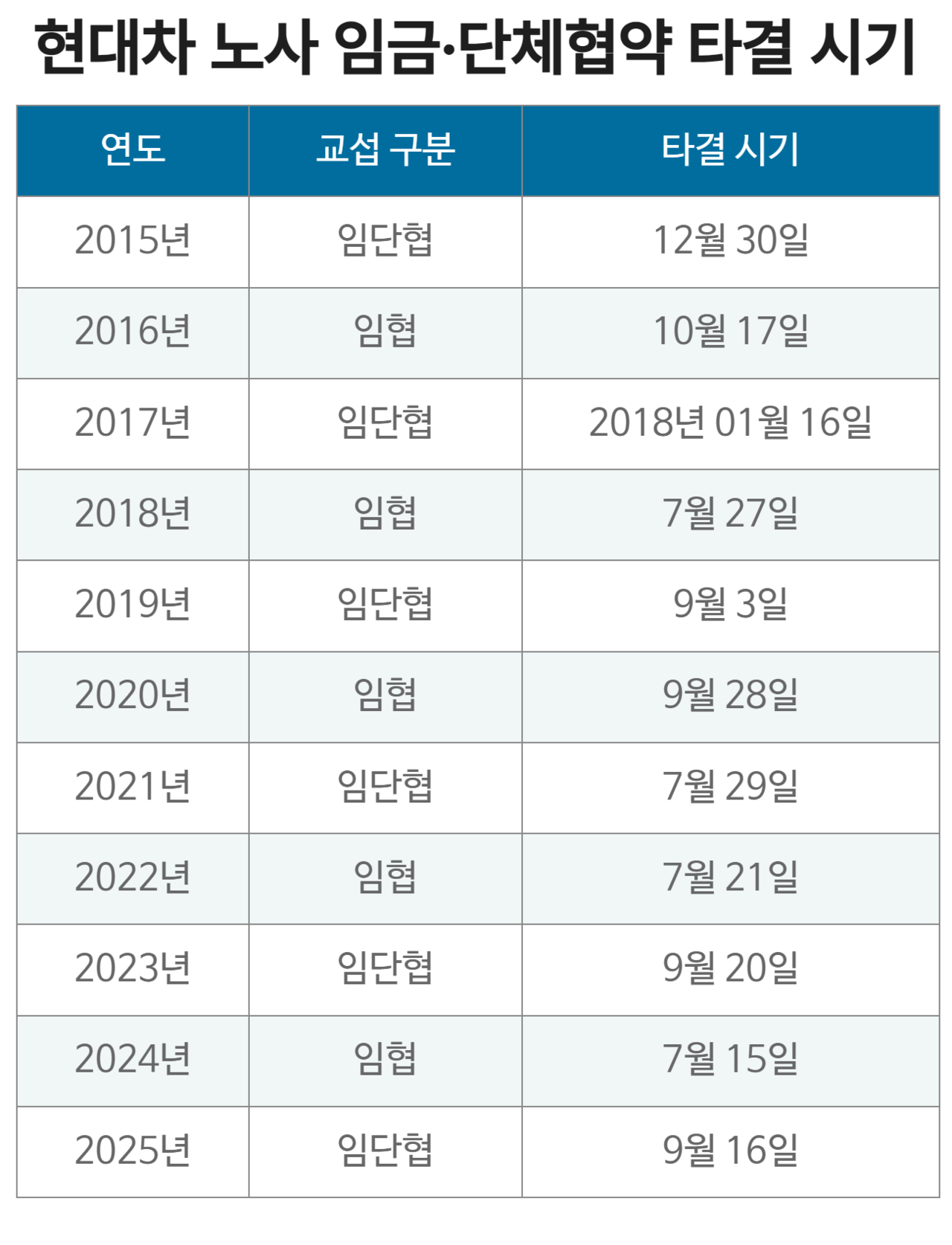
Disruption set to surpass 2025 and 2018 levels — worst since 2017
If the union proceeds with strikes through Wednesday as planned, the cumulative strike hours this year will reach 36 — the highest in nine years since 2017. Last year, the Hyundai Motor union launched its first strike in seven years since 2018, carrying out partial walkouts of two hours, two hours and four hours before reaching a tentative agreement — amounting to about 16 hours of production line downtime. During the 2018 wage negotiations, the union staged partial strikes totaling six hours combined across both shifts on July 12 and six hours per shift on July 13, but the cumulative strike volume at the time was around 18 hours.
The most prominent example of large-scale strike action was 2017. That year, the Hyundai Motor union staged 24 rounds of strikes during wage and collective bargaining negotiations, resulting in an estimated production disruption of more than 76,900 vehicles worth 1.62 trillion won. Negotiations dragged into the following year, with a final settlement reached only in January 2018.
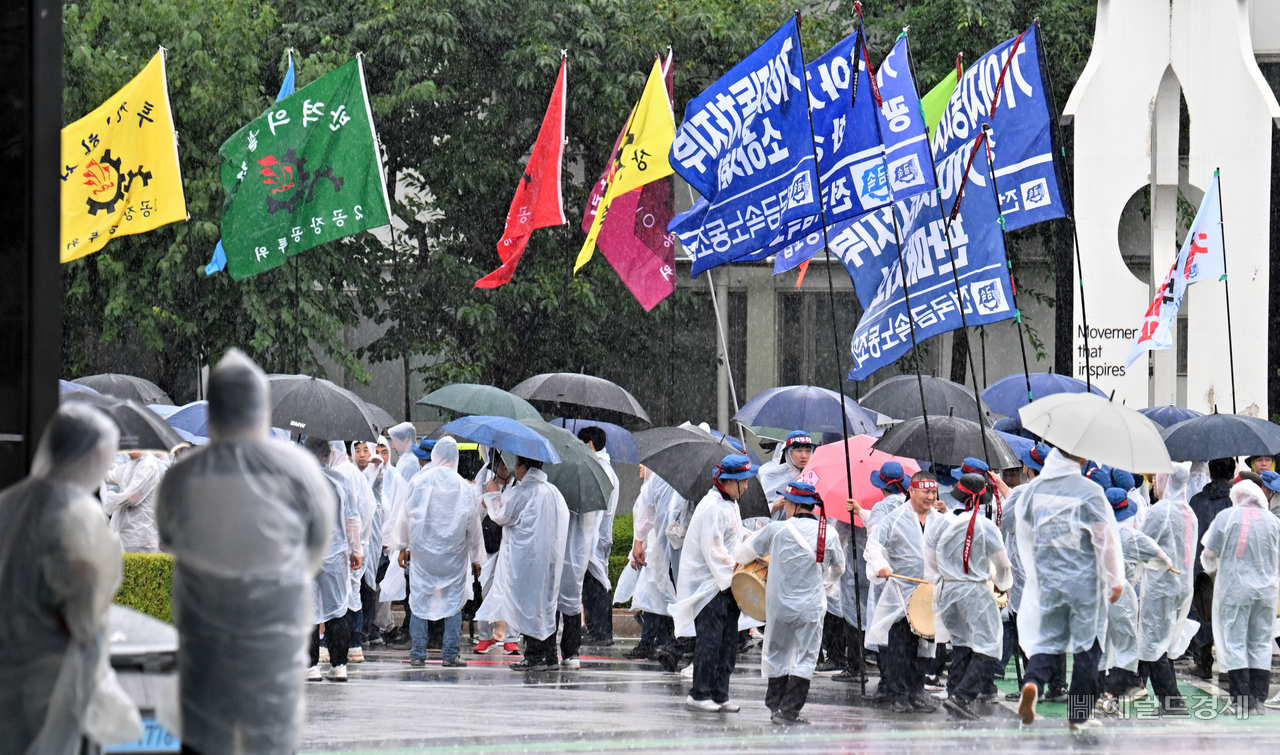
![Members of the Korean Metal Workers' Union's North Jeolla Province chapter hold a rally in front of Hyundai Motor's Jeonju plant on Wednesday afternoon, chanting "Hyundai Motor must come to the bargaining table for irregular workers," as the Korean Confederation of Trade Unions holds its Seoul general strike rally. [Yonhap]](https://wimg.heraldcorp.com/news/cms/2026/07/17/rcv.YNA.20260715.PYH2026071517090005500_P1.jpg)
Bonus and retirement age extension at impasse — management says it has offered its best
The gap between labor and management remains wide. At the 15th round of negotiations, management put forward its third proposal, which included a base pay increase of 89,000 won, a performance bonus of 350 percent plus 10 million won, and 15 shares of company stock — but the union judged the offer to fall short of members' expectations. The union is demanding a base pay increase of 149,600 won, a performance bonus equivalent to 30 percent of last year's net profit, an 800 percent increase in bonuses, an extension of the retirement age, and the reinstatement of dismissed workers.
Management maintains that it has already offered what is in effect its best proposal. Hyundai Motor CEO Choi Young-il said in an earlier statement that it was "regrettable that the union is striking over issues such as the reinstatement of dismissed workers and an extension of the retirement age," adding that the company "must not go down a path of strikes from which there is no turning back."
An industry official said the bigger concern this year is not the peak daily strike intensity but the accumulation of lost hours. "With overtime refusals and parts supplier strikes piling on top, the actual production disruption could end up far exceeding the union's direct strike hours," the official said.
kwater@heraldcorp.com





