

"I tried investing in Kosdaq this year and even bought semiconductor leveraged products, but I ended up losing money on all of it. From now on, I plan to invest only in the US S&P 500 for the long term."
A 38-year-old freelancer surnamed Oh, who lives in Dobong-gu, Seoul, recently sold all of his domestic stock holdings and shifted into US benchmark index ETFs.
As South Korea's stock market falls sharply, retail investors are moving into US benchmark index ETFs, drawn by relatively smaller drawdowns and broader diversification.
According to ETF CHECK, retail investors net purchased 161.1 billion won ($109 million) worth of the TIGER US S&P500 ETF in the week of July 10 through July 16, making it the top net-purchased ETF among all products during the period.
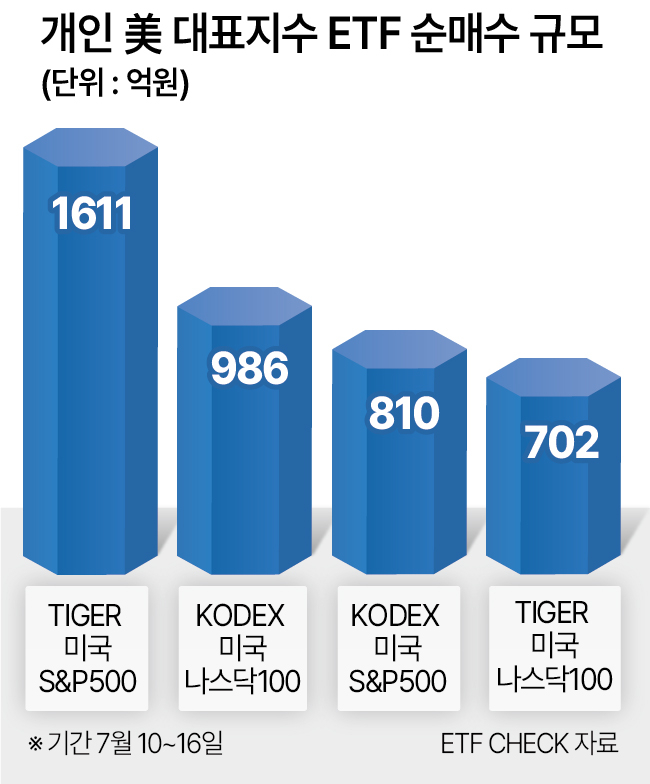
The KODEX US Nasdaq 100 (98.6 billion won), KODEX US S&P500 (81 billion won) and TIGER US Nasdaq 100 (70.2 billion won) ranked third, fourth and sixth, respectively, in retail net purchases over the same period.
US benchmark index ETFs spread exposure across a wide range of sectors — including global large-cap technology stocks such as Apple, Nvidia, Microsoft, Amazon and Meta — which helps reduce volatility. Their diversification effect is considered greater than that of the Kospi, where Samsung Electronics and SK hynix together account for more than half the index weighting.
Meanwhile, semiconductor ETFs — which had drawn heavy retail buying until recently — saw significant outflows.
During the same period, retail investors net sold 229.8 billion won worth of the KODEX Samsung Electronics Single-Stock Leverage ETF and 115.7 billion won worth of the TIGER SK hynix Single-Stock Leverage ETF. The SOL AI Semiconductor TOP2 Plus ETF also saw net selling of 88.8 billion won, with semiconductor-related ETFs sweeping the top three spots for retail net selling.
These products had been among the most actively bought by retail investors as recently as last month. The sharp declines in Samsung Electronics and SK hynix appear to have prompted loss-making retail investors to exit concentrated semiconductor bets and rotate into US benchmark index ETFs.
According to Korea Exchange, the Kospi tumbled 19.53 percent from the start of this month through July 16. Samsung Electronics and SK hynix, the two dominant semiconductor stocks, fell 18.92 percent and 28.05 percent, respectively.
US benchmark indexes, which attracted the retail inflows, fared considerably better than the domestic market over the same period. The Nasdaq 100 fell just 2.63 percent, while the S&P 500 rose 0.68 percent.
Direct investment in US equities has also been rising. According to the Korea Securities Depository, domestic investors net purchased $1.95 billion worth of US stocks from the start of this month through July 17 — about 3.1 times the $632.96 million recorded last month.
Market analysts expect the domestic market's weakness to persist for now, as uncertainty over the semiconductor industry outlook continues and deteriorating conditions in the Middle East further dampen investor sentiment.
Shin Seung-jin, a researcher at Samsung Securities, said the Kospi had tumbled roughly 25 percent from its peak over the past month. "A series of developments are shaking investor sentiment all at once — Meta's announcement of its entry into the cloud business, reports that Apple is exploring purchases of Chinese semiconductors, the strong reception of CXMT's initial public offering, and the emergence of the Kimi AI model," he said.
Kim Jun-young, a researcher at iM Securities, said the market was more likely to trade sideways in a range for the rest of the year than to correct all at once, with investors watching to see whether the index can break through the 10,000 level.

moon@heraldcorp.com





