
![Andy Burnham waves as he leaves a special Labour Party conference in London on Friday, where he was confirmed as the party's new leader and incoming prime minister. [AFP]](https://wimg.heraldcorp.com/news/cms/2026/07/20/rcv.YNA.20260718.PAF20260717189801009_P1.jpg)
The 'King of the North' has become Britain's prime minister.
It is not a title bestowed by the royal family. It is a nickname given by people in northern England — a region that endured long decline after the collapse of manufacturing — to the politician who fought hardest for them.
Andy Burnham, 56, was once written off as a finished politician after losing two Labour leadership contests. He left Westminster and started over in Manchester, reshaping transport, housing and homelessness policy as mayor, and standing up to the central government during the COVID-19 pandemic to defend the livelihoods of northern residents.
That comeback culminated Monday, when King Charles III invited Burnham to form a government and he was sworn in as Britain's 59th prime minister. He is the second prime minister from the Labour government that came to power in the 2024 general election, and the seventh prime minister in the decade since the Brexit referendum.
British politics has always centered on London. Prime ministers have emerged from Westminster, and power has been concentrated in Whitehall. Burnham's rise — a political resurrection achieved not in Westminster but in Manchester — signals a shift in Britain's political center of gravity, from the capital toward the regions.
From a telephone engineer's son to Britain's political leader: how football and working-class life shaped Burnham
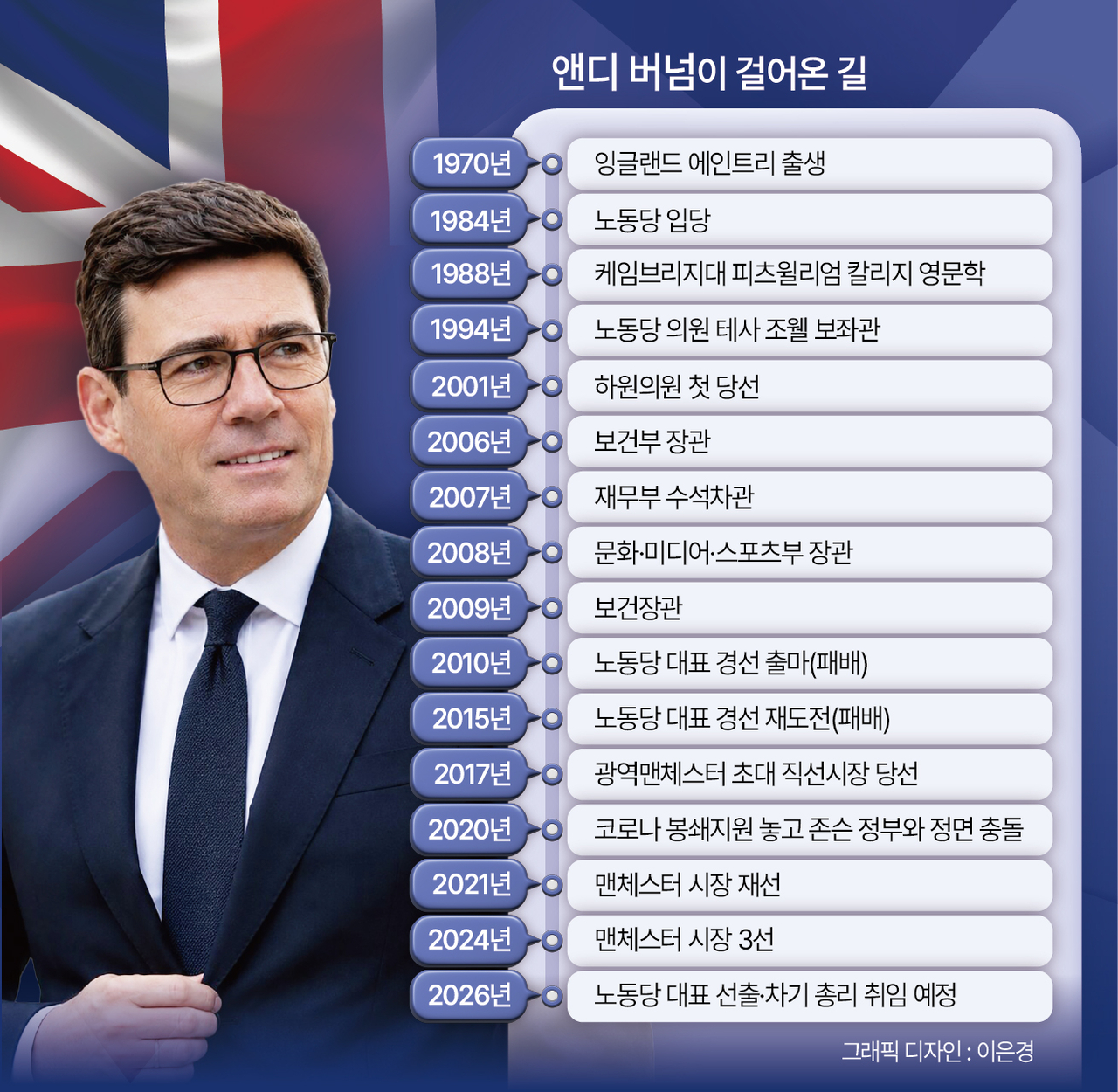
Burnham was born in 1970 in Aintree, Merseyside, and grew up in a bungalow in Culcheth, Cheshire. He was the middle of three sons raised by a telephone engineer father and a mother who worked as a hospital receptionist.
Football dominated his childhood. A lifelong Everton FC supporter, he played football and cricket at Cambridge University and wrote about football, karate and cricket as a sports reporter for the student newspaper Varsity. He still makes time to attend matches whenever he can. British media have described him as a politician who meets constituents at the stadium.
![Andy Burnham, then Greater Manchester mayor, poses for photos with fans in the stands at Hill Dickinson Stadium in Liverpool after a Premier League match between Everton and Sunderland on May 17. [Reuters]](https://wimg.heraldcorp.com/news/cms/2026/07/20/rcv.YNA.20260518.PRU20260518058701009_P1.jpg)
The spark that drew him to politics came from an unexpected source: the 1980s BBC drama series "Boys from the Blackstuff." The show depicted the lives of working-class men destroyed by mass unemployment under Margaret Thatcher's government and made a deep impression on British society at the time.
In an interview with British GQ, Burnham recalled watching every episode with his parents and deciding then that he had to do something. He joined the Labour Party and went on to study English literature at Fitzwilliam College, Cambridge, nurturing his political ambitions.
He did not enter politics immediately after graduating. He began his career as a reporter at the now-defunct local paper the Middleton Guardian, then moved to London in 1992 to work at a publishing house handling trade titles such as Tank World and Container Management. There he met Eleanor Mills, stepdaughter of Labour lawmaker Tessa Jowell, who suggested over drinks that he apply for a parliamentary researcher post. That chance encounter set Burnham's political career in motion.
![A young Andy Burnham, second from left, during his time as a reporter at the Middleton Guardian. [The Guardian]](https://wimg.heraldcorp.com/news/cms/2026/07/20/news-p.v1.20260717.bad5aaeff68f43828e8dfcd4033ead7d_P1.png)
From prime-minister-in-waiting to 'finished politician' — and back again: how Manchester rescued Burnham
Burnham rose quickly after joining Labour in the mid-1990s. The party was then rallying around Tony Blair under the "New Labour" banner, preparing to return to government. Burnham learned the mechanics of politics as an aide to Tessa Jowell and later built experience in central government as a special adviser in the Department for Culture.
Elected to the House of Commons in 2001, he went on to serve as a junior minister at the Home Office, then as culture secretary, chief secretary to the Treasury and health secretary. As health secretary in particular, he won recognition for his crisis-management skills, overseeing NHS reform and the government's response to the swine flu outbreak. Still only in his late thirties when he held major cabinet posts, he was seen within Labour as a rising star and a future leader.
But his political career did not unfold as expected. In the 2010 Labour leadership contest he was beaten by both David Miliband and Ed Miliband, and in 2015 he lost to Jeremy Corbyn. The two defeats were damaging.
In 2017, Burnham left Westminster to run for the inaugural directly elected mayor of Greater Manchester. Westminster looked on with puzzlement. A politician who had served as a cabinet minister moving to local government was widely read as a sign that he had been pushed out of national politics.
Burnham saw it differently. "The reason people don't trust politics is that politics feels too far away," he said. "Politics has to start where people live."
![Andy Burnham, then Greater Manchester mayor, explains his integrated transport policy in front of a Bee Network bus. The Bee Network — which brought buses, trams and cycling under a single public transport system — is considered the signature policy of his mayoralty. [Office of the Greater Manchester Mayor]](https://wimg.heraldcorp.com/news/cms/2026/07/20/news-p.v1.20260719.1c08c259ab8a4b098df23cffb5ebbbcd_P1.png)
The first thing Burnham tackled after taking office as mayor was, perhaps surprisingly, transport. Manchester's buses were run by private operators, each setting its own routes and fares, to widespread public frustration. Fares varied by company even for the same destination, and transfer arrangements were poorly coordinated.
Burnham proposed integrating the system into a single public transport network, along the lines of London's. The result was the Bee Network. Named after the bee that symbolizes Manchester, the policy unified buses, trams and cycling under one system with a single fare structure. Bringing bus services — privatized under Thatcher in the 1980s — back under local government control was a bold step even by British standards.
The Bee Network has since become one of the standout successes in British local transport policy, and other cities have begun exploring similar models.
Burnham also moved boldly on homelessness. Shortly after taking office he launched the "Everyone In" project to reduce rough sleeping, building a partnership model that brought together local government, charities and private businesses. Insisting that "homeless people are people, not statistics," he expanded housing support. These practical, everyday policies built his reputation as a politician who could actually govern.
Standing with residents through COVID-19: the moment the 'King of the North' was born
![A pro-EU demonstrator holds a placard bearing Andy Burnham's name outside Parliament in London on July 1. Pro-EU campaigners are hoping Burnham, the frontrunner to become prime minister, will move to repair Britain's relationship with the EU. [EPA]](https://wimg.heraldcorp.com/news/cms/2026/07/20/rcv.YNA.20260701.PEP20260701202901009_P1.jpg)
The event that made Burnham a national political figure was COVID-19. In the autumn of 2020, Boris Johnson's government pushed for the toughest lockdown restrictions in northern England. Burnham did not oppose the lockdown itself.
Instead, he demanded that any lockdown be accompanied by adequate financial support to help residents get by. The government refused. Burnham called a live press conference and publicly confronted the central government.
"The lives of people in Manchester are no less valuable than the lives of people in London."
"The North is not a region that begs from the government."
The press conference was broadcast live across Britain. A public clash between the government and a regional mayor was highly unusual. The BBC and Sky News led with his remarks, and social media filled with responses calling him a politician who spoke for ordinary people. The Guardian called him "the voice of the North," and in political circles the nickname "King of the North" took firm hold.
COVID-19 left Burnham with the image of a mayor who had stood with his residents against central government, and that trust spread beyond the region to the rest of the country. The politician who had twice failed to become Labour leader began, in that moment, to find his way back to the center of British politics.
From by-election win to Downing Street in a month: Starmer's resignation opened the door
![Andy Burnham, Labour Party leader, adjusts his glasses as he speaks at the People's History Museum in Manchester on June 29. [AP]](https://wimg.heraldcorp.com/news/cms/2026/07/20/rcv.YNA.20260629.PAP20260629235201009_P1.jpg)
The final path to the premiership opened quickly for Burnham.
Former Prime Minister Keir Starmer had led Labour to a landslide victory in the July 2024 general election, ending 14 years of Conservative rule. But in office he faced a steady erosion of support, driven by repeated policy reversals, a lack of governing vision and misjudged appointments. Labour was routed in local elections by the right-wing Reform UK party, and voices within the party grew louder warning of defeat at the next general election in 2029.
As pressure for his resignation mounted within the party, Starmer ultimately announced he would step down as both prime minister and Labour leader.
The complication was that Burnham was not then a member of Parliament. To become prime minister in Britain, a politician must conventionally lead the governing party as a sitting MP. Burnham returned to the Commons for the first time in nine years after winning a by-election on June 18.
What followed was swift. Burnham secured overwhelming support from Labour MPs and stood as the sole candidate in the party leadership contest, before being formally elected Labour leader at a special party conference in London on Friday.
The transfer of power without a general election reflects the nature of Britain's parliamentary system: as long as the party holding a Commons majority remains in government, a new leader can take over as prime minister when the old one steps down.
Burnham had the backing of 379 Labour MPs and 23 affiliated organizations. Elected leader without a challenger, he entered 10 Downing Street three days later — in much the same way Gordon Brown took over from Tony Blair without a contested leadership race.
'I will give the country room to breathe': the first tests facing the King of the North
![Andy Burnham greets his wife Marie-France Vanderhille at a special Labour Party conference in London on Friday, where he was confirmed as the party's new leader and incoming prime minister. [Reuters]](https://wimg.heraldcorp.com/news/cms/2026/07/20/rcv.YNA.20260717.PRU20260717209301009_P1.jpg)
Burnham visited Buckingham Palace on Monday, where King Charles III invited him to form a government. He then delivered his first address to the nation outside 10 Downing Street.
He said he was "acutely aware" that he was the seventh prime minister to enter Downing Street in a decade, and called for more stable and accountable politics. The message was clear: he would first address the deep public distrust bred by years of revolving-door leadership and policy confusion.
Burnham described his taking office as a moment for reflection and resolve, pledging to honestly acknowledge the challenges Britain faces, build an efficient government and restore the world's confidence in the country.
The challenges ahead are considerable. The British economy is burdened by a combination of slow growth, a high cost of living, chronic NHS backlogs, a severe housing shortage and a post-Brexit slowdown in investment. The gap between North and South remains as wide as ever.
The core reasons for the collapse in support for the Starmer government were an economic recovery and improvements in public services that people could not feel in their daily lives. Burnham's inaugural pledge to "give the country room to breathe" reflected his judgment that unless Labour can ease the cost-of-living burden and restore public faith that the government is working, the party's troubles will continue.
Formidable tests await on the international stage as well. The biggest variable is US President Donald Trump.
Trump said last month that he had heard Burnham was "very progressive" and predicted he "probably won't" develop North Sea oil fields. But on Monday, the day Burnham took office, Trump expressed optimism, saying Burnham would "fully open up" the North Sea and "make Britain one of the wealthiest countries in the world" — a public signal that he expects Britain to expand fossil fuel development.
Burnham has long backed Labour's pledge to halt new North Sea oil and gas licensing, though recent reports suggest he has shown a more open attitude toward North Sea development.
Burnham has also been openly critical of Trump. He has described American-style political polarization as a poison in politics, and publicly criticized British politicians who backed Trump during the January 2021 Capitol riot. Whether he can set aside those political differences and build a pragmatic US-UK relationship with Trump will be his first test in diplomacy.
sjy@heraldcorp.com





