![[Getty Images Bank]](https://wimg.heraldcorp.com/news/cms/2026/07/21/news-p.v1.20260721.bbce87c13572496891e6be9f592969de_P1.jpg)
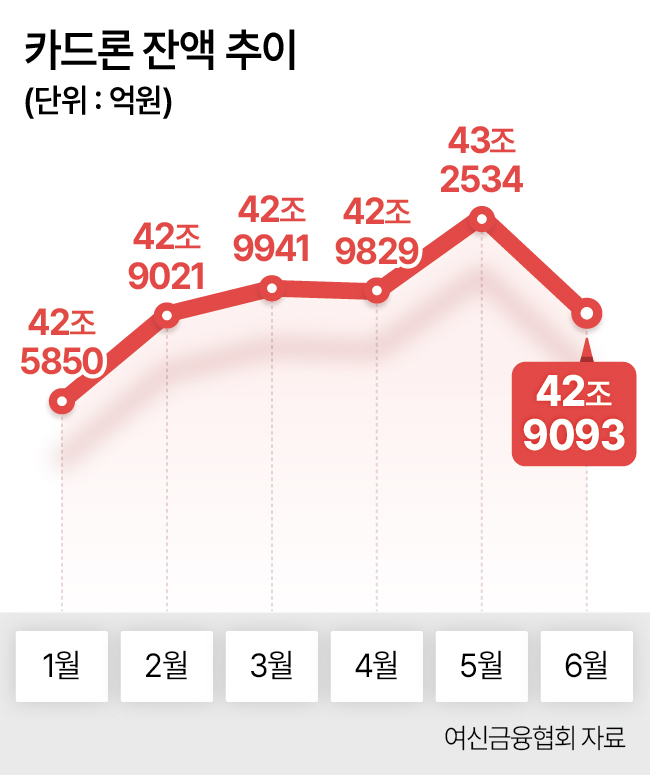
Outstanding card loan balances fell back to the 42 trillion won ($28.3 billion) range at the end of June, reversing course within a month. The Financial Supervisory Service had stepped up oversight by monitoring individual card companies' household lending on a daily basis.
The Credit Finance Association said Tuesday that the combined card loan balance of eight dedicated card issuers stood at 42.91 trillion won at the end of June, down 0.80%, or 344.1 billion won, from the previous month's 43.25 trillion won.
Hyundai Card led the industry in tightening its loan book. Its card loan balance fell 2.76%, or 170.7 billion won, to 6.02 trillion won from 6.19 trillion won the prior month — the steepest decline among all issuers. Woori Card followed with a 1.57% drop of 67.2 billion won to 4.21 trillion won, while Samsung Card posted a 1.28% decrease of 87.8 billion won to 6.67 trillion won.
The pullback reflects proactive steps by card companies amid the financial authorities' push to curb household debt and growing concern over "debt-funded investing" — borrowing to put money into financial markets. Card issuers are currently reporting their lending trends to the Financial Supervisory Service on a daily, weekly and monthly basis. The household loan growth target for the credit finance industry this year, including card loans, is set at around 1.5%, and regulators are encouraging compliance through regular monitoring.
"As the financial authorities have urged proactive management of household lending, we are focused on controlling card loan balances by scaling back marketing, among other measures," an official at one card company said.
Shinhan Card, which holds the largest card loan balance in the industry, bucked the trend with a slight increase. Its balance edged up 0.38%, or 31.3 billion won, to 8.19 trillion won, keeping it at the top of the industry. By market share, Shinhan Card led at 19.08%, followed by Samsung Card at 15.54%, KB Kookmin Card at 15.04%, Hyundai Card at 14.04% and Lotte Card at 11.66%.
Weakening repayment capacity among borrowers is also complicating efforts to bring balances down. Delinquencies are partially offsetting the reductions that card companies are trying to achieve through tighter lending. "We understand that a small number of existing card loan customers are failing to make repayments," an official at another card company said. "We are cutting the supply of new loans, but there is a limit to how much we can reduce balances because repayment amounts themselves have declined." The rise in borrowers falling behind on repayments has raised concerns about a deterioration in card companies' asset quality.
Meanwhile, end-of-quarter write-offs of bad debt also appear to have contributed in part to the decline in balances. Card companies typically sell or write off loans delinquent for six months or more to asset management companies at the end of each quarter to limit losses. Industry observers believe write-offs account for only a limited share of the overall decline in card loan balances this time.
won@heraldcorp.com