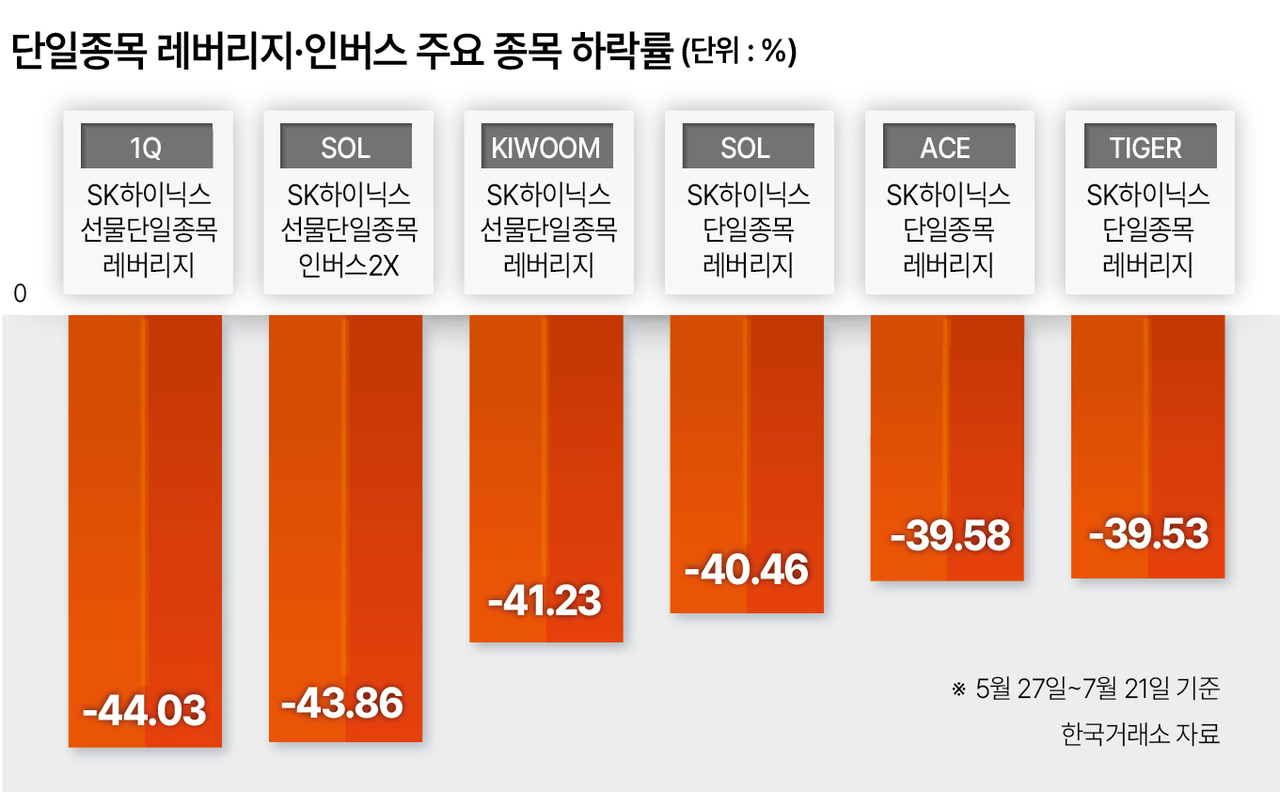
The Democratic Party of Korea's "Korea Premium K-Capital Markets Special Committee" is reviewing a plan to reduce the 2x multiplier on single-stock leveraged and inverse ETFs, but procedural hurdles — including unitholder meetings and Korea Exchange rules — are expected to complicate the process. Still, given that the products have shed more than 40 percent since their listing and market volatility has intensified, some observers say the measure represents a more realistic compromise.
Under Article 190 of the Financial Investment Services and Capital Markets Act, investment trusts are required to hold a unitholder general meeting composed of all beneficiaries. Financial authorities have determined that changing a fund's leverage multiplier — a fundamental shift in its return structure — must clear such a meeting.
A unitholder meeting may be convened by the asset management company operating the fund. Trustees responsible for safeguarding fund assets, as well as investors holding 5 percent or more of total units, also have the right to call one.
A resolution requires the approval of a majority of voting rights held by attending unitholders, as well as at least one-quarter (25 percent) of all issued beneficiary certificates. Given the nature of ETFs — where a broad and constantly changing pool of investors buys and sells at will — gathering 25 percent of unitholders is no easy task. If a resolution fails, however, a deferred unitholder meeting must be held within two weeks, at which the threshold drops sharply to one-eighth (12.5 percent) of all issued beneficiary certificates.
Korea Exchange rules present another obstacle. Under current regulations, any change to an ETF's index calculation standard in principle triggers a delisting procedure. An exception applies if the exchange determines that investor protection is not at risk — for instance, when a regulatory amendment makes the change unavoidable, or when the index's original objective and target assets remain unchanged after the revision. Political circles are understood to be examining these complex legal and regulatory issues from multiple angles.
"It is true that there are many practical hurdles to clear, from convening a unitholder meeting to interpreting listing rules," a financial investment industry official said. "That said, it could serve as a realistic middle ground — one that shields retail investors from the risk of their accounts being wiped out in a sudden share price plunge, while still offering the prospect of returns above those of ordinary stocks."
The Financial Services Commission is expected to focus first on accelerating the implementation timeline for the initial set of remedial measures it announced July 16, and to consider follow-up steps — including a multiplier adjustment — if volatility remains uncontained.
That package centered on tightening minimum deposit requirements and strengthening asset managers' and brokerages' responsibility for managing tracking-error spreads. Most measures — including spread management, higher deposit requirements and expanded investor education — were set for an August rollout, while a plan to raise the minimum trading unit from one share to 20 shares was slated for November. A ban on new listings of single-stock leveraged ETFs and a complete prohibition on advertising were to take effect immediately. "Our policy is to bring forward the timeline as much as possible, but since discussions have only just begun, a specific implementation date has not been finalized," a financial authority official said.
Share prices of Samsung Electronics and SK Hynix have fallen sharply since single-stock leveraged ETFs were introduced, deepening investor losses. According to the Korea Exchange, from the listing date of May 27 through Tuesday, 1Q SK Hynix Futures Single-Stock Leverage, SOL SK Hynix Futures Single-Stock Inverse 2X, KIWOOM SK Hynix Futures Single-Stock Leverage, SOL SK Hynix Single-Stock Leverage and other products have recorded declines exceeding 40 percent.
Beyond investor losses, criticism has grown that the products are amplifying systemic volatility risk across the broader market. Seol Tae-hyeon, a researcher at DB Securities, said that comparing intraday trading data for Samsung Electronics and SK Hynix before and after the listing of single-stock leveraged·inverse ETFs reveals a structural deepening of supply-demand distortions. On days when individual share prices swung more than 10 percent before the ETF launches, the average share of closing simultaneous-bid trading volume was a stable 6.6 percent for SK Hynix and 5.3 percent for Samsung Electronics. Since June, when ETF activity picked up in earnest, those averages have risen to 9.1 percent for SK Hynix (with a peak of 13.8 percent) and 8.9 percent for Samsung Electronics (peak of 12.5 percent), he said.
In response, the FSC said when announcing its earlier measures that it could take additional steps, including periodic investor re-education, new requirements for prior investment experience, incorporating persistent tracking-error spread widening as a delisting criterion, and ongoing spread monitoring.
Industry officials say more fundamental measures to curb volatility are needed beyond the FSC's recently announced package. An executive at one asset management firm said regulators should consider "capping the leverage portion of an account at 10 percent — similar to how safe-asset ratios are managed in retirement pension accounts."

jiyun@heraldcorp.com
moon@heraldcorp.com