Despite the Kospi's recent plunge to the 6,000 level, research heads at major Korean brokerages say the selloff reflects excessive fear and supply-demand distortions rather than any deterioration in corporate earnings.
Doubts about the sustainability of AI investment, combined with foreign profit-taking, have sharply dampened investor sentiment — but actual damage to corporate earnings has yet to materialize, they said. The research chiefs put significant weight on the possibility of a third-quarter market rally, provided that US big-tech second-quarter earnings, AI investment plans and interest rate stability are confirmed.
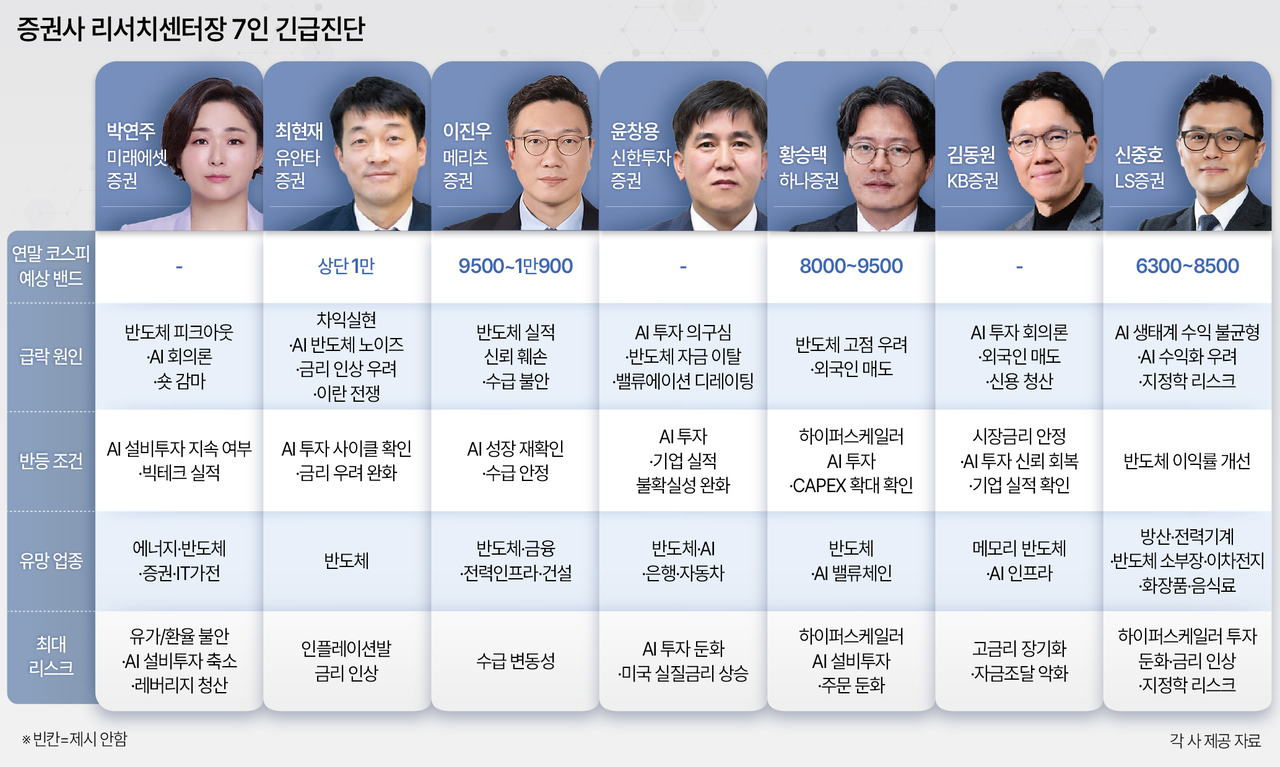
In a survey conducted Wednesday covering major research centers — including Mirae Asset Securities, Meritz Securities, KB Securities, Shinhan Investment, Hana Securities, Yuanta Securities Korea and LS Securities — every respondent said they do not view the current decline as the start of a sustained bear market.
The consensus view is that the market is being driven more by fear than by corporate earnings, and that the direction from here will likely be determined by US big-tech companies' commitment to AI investment, their second-quarter results, and whether interest rates stabilize. If AI investment continuity and corporate earnings are confirmed, the domestic market could regain upward momentum in the third quarter, the research heads said.
▶ Decline triggered by semiconductor peak-out fears, amplified by leverage — The research heads identified a combination of factors behind the sharp drop: doubts about the sustainability of AI investment, the semiconductor peak-out debate, foreign profit-taking, and the unwinding of leveraged positions alongside ETF rebalancing.
Park Yeon-ju, head of research at Mirae Asset Securities, said that amid the semiconductor cycle peak-out debate and AI investment skepticism, the "short gamma" effect from single-stock leveraged ETFs and margin financing triggered forced selling that amplified the decline.
Choi Hyeon-jae, head of research at Yuanta Securities Korea, said volatility expanded as profit-taking impulses following a short-term surge were compounded by noise around AI semiconductors, inflation concerns and geopolitical risk. Shin Jung-ho, head of research at LS Securities, cited a market shift in focus from AI investment to monetization as a key driver.
There was broad agreement on the nature of the decline. Yoon Chang-yong, head of research at Shinhan Investment, said the move was "not a recession or an earnings collapse, but a supply-demand shock stemming from doubts about the sustainability of the AI investment cycle," adding that it was "appropriate to interpret this as a high-volatility correction within a bull market."
The research heads were united in saying the domestic market has entered a historically unusual zone of undervaluation. Hwang Seung-taek, head of research at Hana Securities, noted that the Kospi's 12-month forward price-to-earnings ratio has fallen to 5.8 times — below the levels seen during the 2008 global financial crisis (6.4 times) and the COVID-19 pandemic (8.5 times) — and called it "a clear undervaluation zone, given that share prices have fallen sharply while earnings forecasts remain intact."
Park also said the KOSPI 200's forward PER has dropped to around 5.5 times, "a historically low level," diagnosing it as "the result of market fear being excessively priced in." Choi and Lee Jin-woo, head of research at Meritz Securities, similarly noted that the current PER is below levels seen during the global financial crisis, and advised that the current zone should be approached from a buying perspective as long as earnings estimates hold.
▶ Conditions for a rebound: reaffirming AI investment — semiconductors to lead the way — The research heads identified US big-tech earnings and AI investment guidance as the most critical conditions for a rebound. Kim Dong-won, head of research at KB Securities, said "a stable rebound requires market interest rate stabilization, a restoration of confidence in AI investment continuity, and confirmation of earnings from major companies."
Hwang said that if AI investment and capital expenditure expansion are confirmed in US hyperscaler earnings, an upward trend could re-emerge following the results.
Choi said a rally would resume if second-quarter big-tech results confirm the AI investment cycle remains intact and interest rate pressure eases. Yoon said "the market will remain more sensitive to future investment plans and the sustainability of growth than to the earnings numbers themselves, for now."
All seven research heads named semiconductors and AI as the top sectors to lead any rebound. The prevailing view was that semiconductors would serve as the central pillar, given expectations that memory chip supply shortages and AI infrastructure investment will continue to expand.
There was also speculation that buying interest could subsequently spread to other sectors. Shin said a rebound would "start with Samsung Electronics and SK Hynix, but is likely to spread to neglected sectors such as defense, power equipment, semiconductor materials and components, cosmetics and food and beverage."
Most analysts also characterized foreign selling as profit-taking and rebalancing rather than a structural exodus. Hwang said the selling "has more the character of profit-taking and rebalancing after a sharp rally than a crisis-driven exit tied to deteriorating national fundamentals," while Choi said a shift to net foreign buying was likely once exchange rate stability and undervaluation appeal become more apparent.
Yoon also said "foreign capital inflows could accelerate in earnest once confidence in the direction of US interest rates and the AI investment cycle is restored." The research heads uniformly advised retail investors to reduce leverage and accumulate positions gradually, focusing on stocks with high earnings visibility.
The variable the research heads worried about most was also AI investment and interest rates. Hwang flagged the possibility of a reduction in AI capital expenditure by US hyperscalers as the biggest risk factor, while Kim cited prolonged high interest rates and financing cost burdens.
Shin identified a slowdown in the pace of AI investment, US interest rates and Middle East geopolitical risk as key risks, while Yoon pointed to a slowdown in the AI investment cycle and a rise in US real interest rates.
▶ The 10,000-point target is not dead — Research heads who offered year-end Kospi target ranges in the survey maintained their medium- to long-term upside outlook despite the current sharp decline.
The most optimistic forecast came from Lee. Applying a 12-month forward PER of 7 to 8 times to a projected 2027 Kospi net profit of 1,058 trillion won ($717 billion), Lee put his year-end Kospi target range at 9,500 to 10,900. He said further gains were possible if confidence in earnings estimates recovers on the back of AI upstream industry growth and supply-demand conditions stabilize.
Choi offered a Kospi target ceiling of 10,000 rather than a specific range. He noted that below the 7,000 level, the 12-month forward PER has fallen to the low 6 times range — below the global financial crisis trough — and forecast that a rally would resume once the AI investment cycle is confirmed through US big-tech results and interest rate pressure eases.
Hwang put his range at 8,000 to 9,500. He expects semiconductor earnings forecasts to be revised upward if hyperscalers continue their AI investment, and said that given the Kospi's 2026–2027 net profit outlook, reaching that level is well within reach even without a re-rating.
Shin offered a range of 6,300 to 8,500. He said expectations for the AI ecosystem remain valid, but flagged the possibility that in the second half, buying interest could broaden from a semiconductor-led market to undervalued sectors with solid earnings support.
th5@heraldcorp.com
hajun825@heraldcorp.com