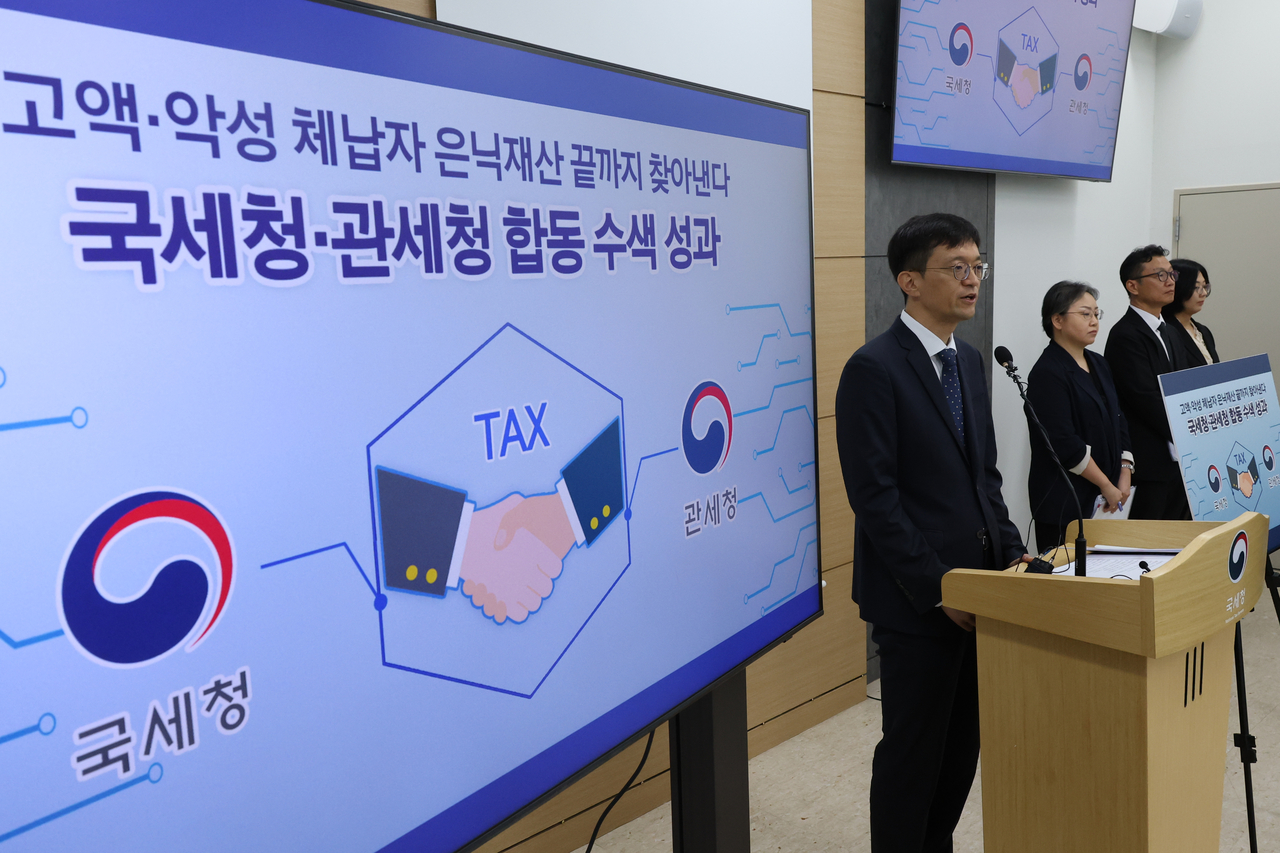
The National Tax Service and the Korea Customs Service announced Thursday that a joint search operation conducted last month against 16 high-value, willful tax delinquents resulted in the seizure of 1.3 billion won ($878,000) in hidden assets.
Among those targeted was a man in his 40s, identified only as A, an electronic cigarette trader who had stuffed more than 1.02 billion won in cash and checks into a travel bag.
He had accumulated 6.4 billion won in unpaid individual consumption tax, value-added tax and other levies after falsely labeling raw materials and underreporting sales, making him a target of the tax authorities' search.
A joint search team raided A's home in Seoul, but his mother refused to open the door for two hours — even after police were called to the scene — forcing the team to break in.
Once inside, the mother accused the team of trespassing and refused to unlock a travel bag found in the master bedroom.
The team seized the bag intact, opened it and found bundles of cash totaling 540 million won and checks worth 480 million won — 1.02 billion won in all.
Targets of the joint operation were delinquents who had failed to pay both national taxes and customs duties while deliberately avoiding their tax debts despite having the means to pay, all while living lavishly.
The NTS shared data on asset-concealment patterns, lifestyle indicators and actual places of residence, while the Korea Customs Service contributed key asset-concealment intelligence including addresses registered under customs identification codes.
Regional tax offices and customs offices conducted detailed data analysis and carried out stakeouts and canvassing to identify targets and search locations. Eight joint search teams of about 10 members each were then assembled and deployed according to the jurisdiction of each delinquent.
A man in his 50s, identified as B, owed 120 million won in national and customs taxes — including unreported capital gains from a land sale — and was selected as a target after investigators found he had traveled abroad 127 times over the past five years, pointing to a lavish lifestyle.
A search of his home in Hwaseong, Gyeonggi Province, turned up five luxury handbags, one high-end bracelet, eight watches and 15 loan certificates worth 500 million won inside a suitcase, all of which were seized and collected in turn.
A man in his 60s identified as C, a mold manufacturer, had left 550 million won in value-added tax, corporate tax and other levies unpaid over an extended period.
The two agencies selected him as a joint search target after determining he was living in a large apartment in Daegu owned by his ex-wife, leading them to suspect he had staged a divorce to evade forced collection.
His ex-wife opened the door just before the team was about to force entry. Inside, investigators found 9 million won in liquid assets stored in a personal safe, along with gold rings and other items totaling 26 million won, all of which were seized.
The ex-wife claimed the jewelry was hers, but the team seized all discovered assets and informed her of the procedure to apply for the seizure to be lifted.
Ha Yu-jeong, director general of the Korea Customs Service's examination bureau, said assets found at a location believed to be a delinquent's place of residence would be released from seizure if a third party could clearly demonstrate ownership under the National Tax Collection Act, but would otherwise be treated as connected to the delinquent and seized.
The NTS and the Korea Customs Service said they plan to make the regular exchange of information on hidden assets and lifestyle patterns of joint national-and-customs-tax delinquents a standing practice, and to continue their coordinated response.
Kang Jong-hun, director general of the NTS's tax collection and legal affairs bureau, said the two agencies had previously cooperated on matters such as refund offsets against delinquent taxes, but that this operation was significant because each agency shared intelligence where it held a comparative advantage, enabling a more precise search. "The success rate for this round of searches was about 80 percent, which was far better than what either agency achieves operating alone," he said.
oskymoon@heraldcorp.com