
Young people burdened with debt are more likely to rush into the job market and end up in precarious employment, according to new research — with economic pressure pushing them to accept unstable work rather than wait for better opportunities.
The Korea Employment Information Service said Sunday the finding comes from a recently published report, "In-Depth Labor Market Analysis Using Employment Panel Data," which for the first time empirically traced the psychological pathway through which youth debt affects labor market entry in South Korea.
Researchers tracked 1,522 university graduates using the Youth Panel Survey 2021 (YP2021), following each participant from graduation through to their first paid job.
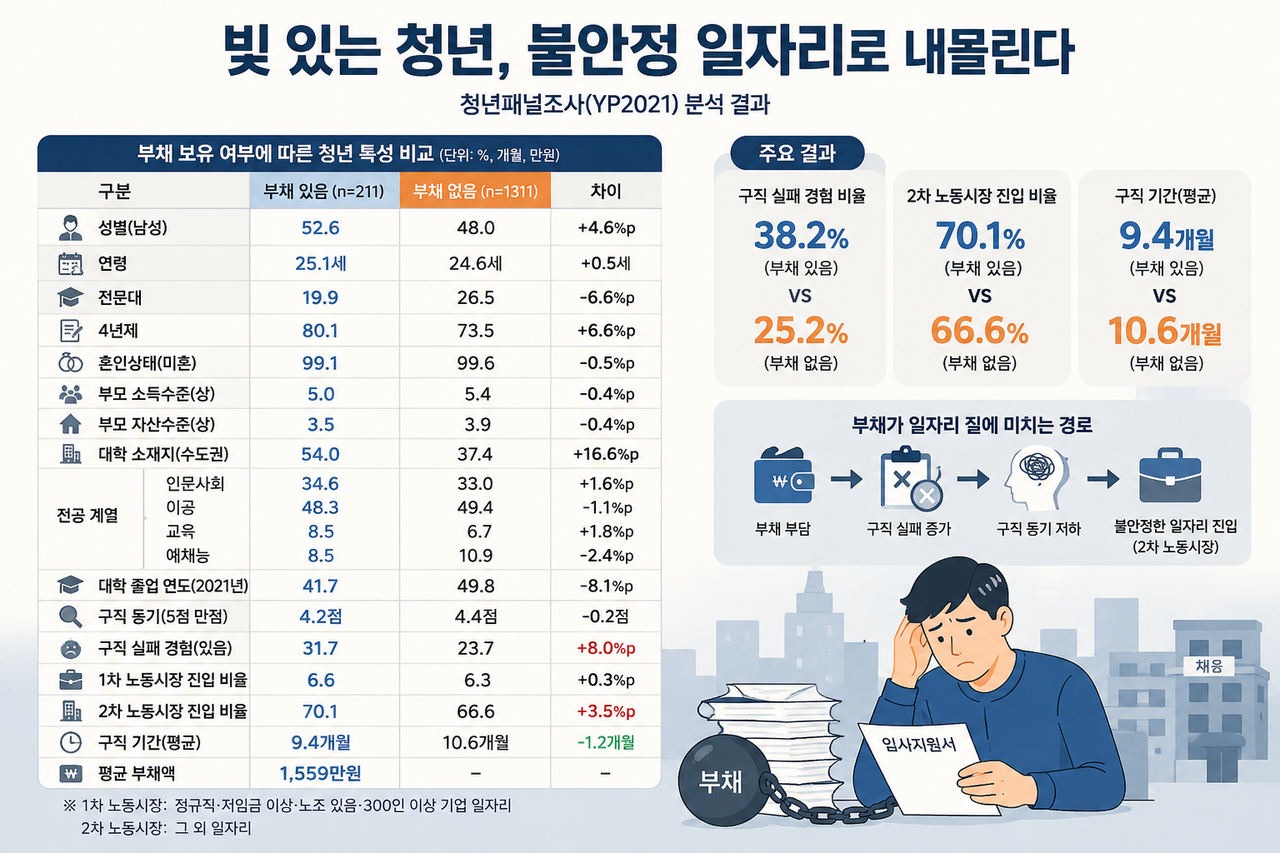
Among graduates who carried debt, the average balance was 15.59 million won ($10,600). Their average job search lasted 9.4 months — 1.2 months shorter than the 10.6-month average for debt-free peers. Finding work faster, however, did not translate into finding more stable work.
The researchers defined the "primary labor market" as regular, above-minimum-wage positions at unionized companies with 300 or more employees, and classified all other jobs as the "secondary labor market." Indebted graduates entered the secondary labor market at a rate of 70.1 percent, compared with 66.6 percent for those without debt.
Indebted graduates also experienced more job-search failures. Among those who ended up in secondary-market jobs, 38.2 percent of indebted graduates had experienced at least one rejection, versus 25.2 percent of debt-free graduates.
The study went beyond correlating debt with employment outcomes. It identified a psychological chain in which debt leads to more frequent job-search failures, which erodes motivation and confidence and ultimately steers graduates toward unstable employment.
Job-search motivation scores averaged 4.2 among indebted graduates, below the 4.4 recorded for those without debt. "The burden of debt can create situations where young people feel compelled to take unstable jobs just to get by, rather than taking the time to search for the work they actually want," the researchers said.
The team recommended introducing a "youth transitional support system" that would cover living expenses, residential costs and job-search costs for six to 12 months after graduation. They also said an integrated support framework linking employment assistance with psychological counseling should be established to address the confidence loss that debt can cause.
The researchers also called for reform of the student loan repayment system. They said the current income threshold for repayment — 18.98 million won per year — is too low and places a heavy burden on graduates in unstable jobs, urging a substantial increase in the threshold to reflect real-world conditions.
fact0514@heraldcorp.com





