National Tax Service collects sales data from 14 platforms including Karrot and Junggo Nara
Used goods excluded from input VAT credit; government cites transparency concerns
National Assembly Research Service calls for clear standards on data use and credit eligibility
![A search for Jeju Island rental listings on Karrot Real Estate. [Karrot capture]](https://wimg.heraldcorp.com/news/cms/2026/09/23/9/news-p.v1.20260213.f41ea465e74f45549e11411414e2afec_P1.png)
The National Tax Service has been collecting sales data from used-goods trading platforms, yet it remains cautious about expanding value-added tax input credits to cover used-goods transactions, citing insufficient transaction transparency.
Questions have been raised about the need to clarify how far the same transaction data can be used for both taxation and tax credits.
According to the National Assembly Research Service's "2026 National Audit Issue Analysis" released Friday, the National Tax Service has been collecting sales brokerage data from 14 platforms — including Junggo Nara and Karrot — since July 2023. However, ordinary used goods are not included among the items eligible for the deemed input VAT credit currently applied to recyclable waste materials.
The deemed input VAT credit system allows businesses to deduct a portion of their purchase price from VAT calculations even when buying goods from individuals who cannot issue tax invoices. The current deduction rate is 3/103 of the acquisition price for recyclable waste and 10/110 for used automobiles. Used-goods retailers that purchase items from private individuals cannot benefit from this special provision.
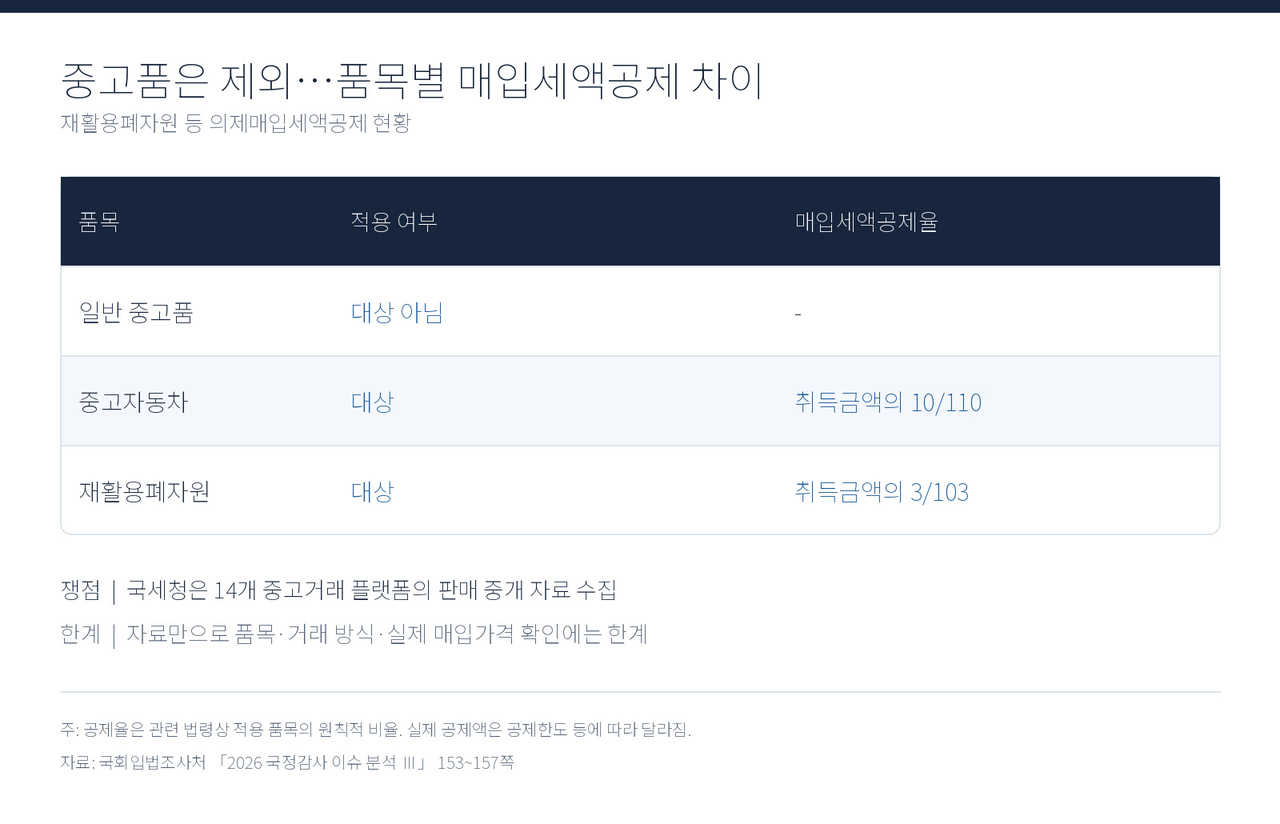
Bills have been introduced in the National Assembly to add used goods and secondhand mobile phones to the list of eligible items, but verifying transactions and the risk of inflated purchase-price claims remain sticking points. The government has expressed concern over transaction transparency, noting that many private deals are conducted in cash and that platform data alone makes it difficult to confirm whether sellers are registered businesses or to verify the items and methods involved in each transaction. The National Tax Service has also said the data it currently collects has limits when it comes to accurately gauging the size of the used-goods market.
On the other hand, some argue there is no reason to uniformly exclude even platform-based transactions from credit eligibility.
The National Assembly Research Service said the government should explain what difference in transaction verification it requires for the two purposes — if it judges that the sales data is sufficient for taxation and income tracking but not for tax credits, it needs to spell out why the standard differs between the two cases.
However, platform sales brokerage data does not by itself prove a business's actual purchase price. A 2023 preliminary feasibility study on expanding the credit to used mobile phones found a benefit-to-cost ratio of 0.648. The fact that data is being collected does not, on its own, establish the case for expanding the credit.
fact0514@heraldcorp.com