South Koreans pay an average of about 5.15 million won a year in insurance premiums, according to the Insurance Development Institute's 2025 figures. This series explores how to make the most of every won you pay.
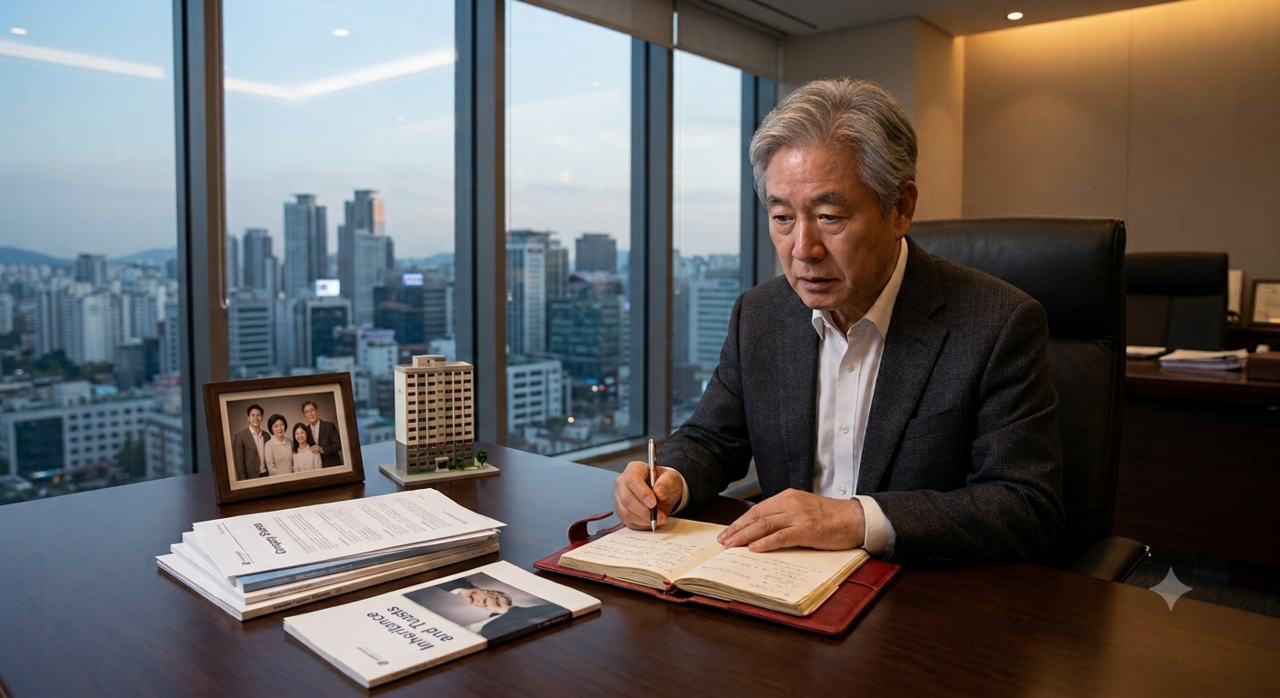
Kang (not his real name, 71), who runs a small and medium-sized enterprise in the greater Seoul area, says his head spins whenever he thinks about passing his assets on to his children — even as sales and profits keep rising. Kang holds a 7.7 billion won stake in his company, representing 87 percent of total shares, along with a 5.5 billion won apartment in Gaepodong, Seoul. He wants to leave the company to his son (42) and the apartment to his daughter (38), but each bequest comes with a nagging condition. For the company, he hopes a professional manager will stay on and run operations after the handover. For the apartment, he wants his daughter to look after his wife (67) once he is gone. Putting those wishes in a will offers no guarantee they will be honored, and consultations with a lawyer and a tax accountant have left him without a clear answer.
Kang's dilemma is far from unusual. Any parent with assets to pass on eventually moves past "who gets what" to a harder question: "on what terms?" There is no guarantee that the recipient will act as the giver intended.
The number of inheritance-division cases that ended up in court reached 3,075 in 2024, surpassing 3,000 for the first time. Of those, 82.7 percent involved disputed assets of 100 million won or less — a reminder that inheritance conflict is not a problem reserved for the wealthy.
A single will is not enough. A will is a powerful instrument for transferring assets, but once the transfer is made, no one is left to ensure the attached conditions are met. What Kang wanted was a mechanism that would keep working after he was gone. To find one, he decided to seek professional advice.
Isn't this ultimately just a question of how to divide the assets?
On the surface, yes. But look closer and it is something different. Kang has three goals: the company continues to grow, his wife is cared for reliably, and his children do not fight. The problem is that these three goals can pull against one another. Hand the company to his son outright and there is no guarantee the professional manager stays. Hand the apartment to his daughter outright and his wife's later years depend entirely on his daughter's goodwill.
Ultimately, this is not a question of dividing assets — it is a question of making his wishes enforceable after he is gone. That is precisely why neither tax calculations nor legal interpretation alone can solve it.
Can't he just write the conditions into a will?
A will is a powerful legal instrument, but it has clear limits. It takes effect the moment the person dies, and once the assets are transferred, its role is finished. After that, no one is responsible for what happens next.
Consider an example. Suppose a will states: "The apartment goes to my daughter, provided she faithfully supports her mother." A few years later, the daughter neglects that duty. Who checks, and how can it be corrected? The same problem applies to a clause saying "keep the professional manager in charge of the company." Writing something down and having it carried out are two different things.
That is where a trust comes in. A trust is a contract under which assets are placed with a reliable financial institution — the trustee — to be managed and distributed according to the owner's specified wishes. The critical difference from a will is that the financial institution continuously monitors whether the contractual conditions are being met and executes them as written. Even after the grantor is gone, the contract lives on and operates.
![[Created using Gemini]](https://wimg.heraldcorp.com/news/cms/2026/07/26/news-p.v1.20260725.a2371dee04814e879cca8647280eb8aa_P1.png)
How do you write the company stake into the contract?
Start with Kang's company stake. One strength of a trust is that it can separate the two rights embedded in shares: voting rights — the power to participate in corporate decisions — and beneficial rights, meaning the right to receive dividends and other financial returns.
The contract could state: "67 percent of the shares pass to my son, but for 20 years after my death, management authority remains with the company, and my son holds only the beneficial rights." The son becomes the owner while being unable to immediately disrupt operations, giving the company time to run stably under professional management.
One important caveat: the Financial Investment Services and Capital Markets Act caps the voting rights a trust company may exercise at 15 percent of a company's total issued shares. The contract must therefore spell out precisely how those voting rights are to be exercised. Placing shares in a trust does not automatically protect management control — that protection must be written in. Before signing, it is also worth checking whether the company's articles of incorporation require board approval for share transfers, and whether share certificates have actually been issued. Many small and medium-sized enterprises have never issued certificates, so that process must be completed before a trust can be established.
For the professional manager, the contract could read: "20 percent of the shares are bequeathed, distributed in 5 percent increments every five years over 20 years." The structure prevents the manager from receiving the full stake and walking away, and makes staying on increasingly rewarding over time.
What if the professional manager refuses the shares?
If the manager declines, the shares revert to Kang's estate. But the reason for the refusal matters more than the refusal itself. A 20 percent stake amounts to roughly 1.7 billion won in assets, which means the recipient would face a substantial gift tax bill. Even an attractive offer can give someone pause when the tax burden is that heavy.
An alternative in that situation is an executive severance package. It is commonly assumed that executive severance pay is capped at twice the standard formula, but that figure is simply the ceiling the tax code recognizes as retirement income. The actual payout is governed by the company's articles of incorporation. By amending those articles so that the severance multiplier rises with years of service — for instance, granting a chief executive who has served more than 15 years a multiplier of four — the company can create a strong incentive for long-term commitment. The portion above the tax-recognized ceiling is subject to income tax, but from the professional manager's perspective, it opens a path to meaningful compensation without putting up personal funds.
![[Created using Gemini]](https://wimg.heraldcorp.com/news/cms/2026/07/26/news-p.v1.20260725.71f7f78b2b9648c6af5483475923e467_P1.png)
A promise alone is not enough. The company must demonstrate that it is actually setting aside the money to pay that severance — only then does the commitment carry credibility. The instrument commonly used for this is a corporate-owned whole-life insurance policy, with the company as the policyholder. Regular premium payments build toward a target reserve, and if the chief executive dies unexpectedly in the meantime, the death benefit provides funds to cover unpaid severance and survivor compensation.
What about the apartment going to the daughter?
A real estate trust contract can state: "The Gaepodong apartment passes to my daughter, but if she fails to fulfill her duty to support her mother, the apartment reverts to her mother."
The key is to define "support" in numbers. Phrases like "care for her sincerely" or "look after her well" cannot be objectively verified. In practice, contracts specify measurable standards — for example, a monthly living allowance of 3 million won, submission of records for medical and pharmacy expenses, and periodic check-in calls from the trust company. Compliance is monitored either by the mother herself reporting any shortfall or by the trust company conducting regular reviews.
No publicly known case in South Korea has yet resulted in assets being clawed back for failure to meet conditions — the system is still relatively new. In overseas trust practice, however, there are precedents for stripping beneficial rights when conditions go unmet. Writing the conditions clearly from the outset is essential to prevent gaps from emerging later.
Is there anything else to prepare for the daughter?
Even with a trust in place, inheritance tax is still due in full. The Gaepodong apartment is currently valued at 5.5 billion won. Assuming annual appreciation of 4 percent, it would exceed 8 billion won in 10 years. The inheritance tax on that amount alone would come to about 2.94 billion won.
The problem is timing. Inheritance tax must be paid in cash within six months of the last day of the month in which the deceased died. If the daughter does not have that much money on hand, she would have to sell the inherited apartment in a hurry or take out a loan.
That is why estate planning and tax-funding planning must go hand in hand. Life insurance is the primary tool. A life insurance policy pays out the agreed benefit immediately upon a qualifying event, even if the policy was taken out only recently — meaning it can provide advance cover for an inheritance tax bill that could arrive at any time.
The structure of the policy matters enormously. Even with the same insurance product, the tax treatment depends on who paid the premiums. If the daughter is the policyholder, pays the premiums from her own income, names her father Kang as the insured, and designates herself as the beneficiary, the death benefit is in principle excluded from the taxable estate — because she funded the policy herself and receives the proceeds herself. If Kang pays the premiums on her behalf, however, the benefit is included in the estate and becomes subject to tax.
To use this structure, the daughter must have income sufficient to cover the premiums, and it is advisable to keep clear records of premium payments to avoid complications later.
![[Created using Gemini]](https://wimg.heraldcorp.com/news/cms/2026/07/26/news-p.v1.20260725.e1cb154f330f44fd9f13f9e50a43495a_P1.png)
What if other family members say the arrangement is unfair?
Placing assets in a trust does not extinguish the legal rights of family members. The law guarantees spouses and children a minimum inheritance share known as the "legal reserve of inheritance." If assets are concentrated in one child, other family members can file a claim to recover their share, and courts look at how assets actually changed hands rather than at the trust structure itself. A trust cannot be used as a device to circumvent the legal reserve.
For that reason, specialists calculate at the planning stage how large the legal reserve exposure might be, taking into account the full estate and any prior gifts. They then arrange for readily available cash — typically through whole-life insurance — to settle any claim that arises. A civil law amendment that took effect in February this year introduced a principle that legal reserve claims be settled in cash rather than in kind, such as a fractional share of real estate. Now that disputes can be resolved with money rather than forcing co-ownership of an apartment, having cash prepared in advance has become even more important.
Is this relevant even for people without large estates?
This is not a concern reserved for the wealthy. As noted earlier, more than 80 percent of inheritance disputes that reach the courts involve assets of 100 million won or less. Conflict stems not from the size of an estate but from a lack of communication within the family.
There is no legally mandated minimum amount for a trust. Individual financial institutions may set their own internal thresholds, and fees do apply — typically 0.6 to 1.2 percent of the assets placed in trust at signing, plus an annual management fee of 0.4 to 1.2 percent. For those who find that burdensome, lower-barrier products exist. An "inheritance peace-of-mind trust," which holds only cash and serves as a simple substitute for a will, carries no contract fee. A "lifetime peace-of-mind trust," designed to ensure that a designated person can receive medical and care expenses on the account holder's behalf in the event of dementia or prolonged illness, is also available.
The process is simpler than most people expect. It typically involves three consultations. The first session covers the client's asset situation and wishes, and produces a draft contract. The second session reviews whether the draft reflects those wishes accurately and outlines the fee structure. The third session involves signing, submitting documents, and — if necessary — completing the transfer of real estate title. As long as the grantor is alive, the terms can be amended or the trust dissolved at any time.
When wealth passes from one generation to the next, more than money changes hands — so do the intentions behind it. If a trust is the blueprint that captures those intentions, insurance is the funding that brings the blueprint to life. Inheritance is not a problem to be dealt with after death; it is a matter of family stewardship that begins now.
psj@heraldcorp.com