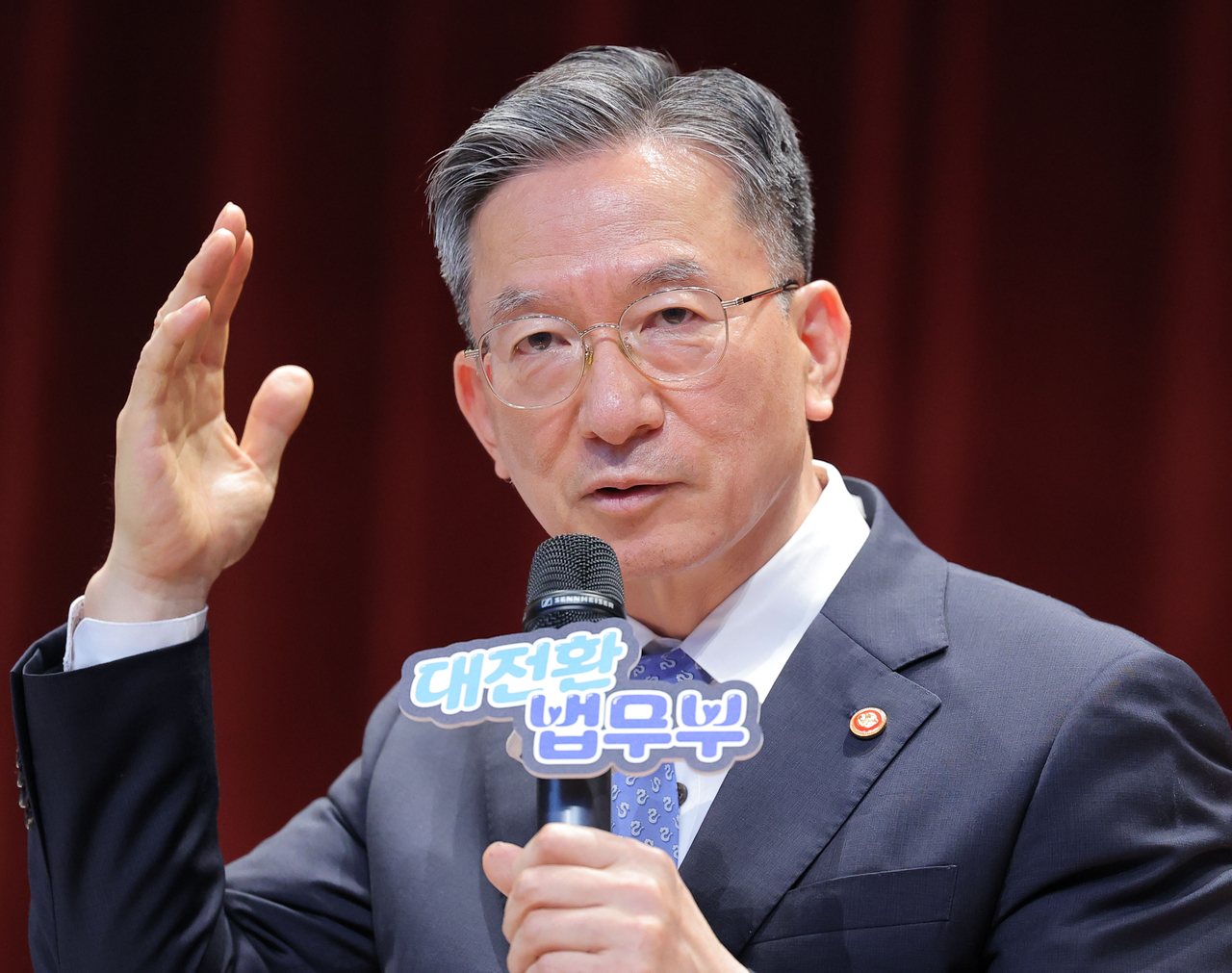
Justice Minister Jeong Seong-ho's decision to submit his resignation to President Lee Jae Myung has sparked a range of interpretations inside and outside the Democratic Party of Korea. With the Aug. 17 party leadership convention already heating up into a fierce contest among candidates, the Democratic Party is working to prevent the resignation from shifting the internal balance of power.
Before attending a plenary session of the National Assembly's Legislation and Judiciary Committee on Monday, Jeong met briefly with reporters and shrugged off questions about the controversy, saying it was "not appropriate to raise such matters" while the president was abroad "working for the national interest."
According to political sources, Jeong recently conveyed through Cheong Wa Dae aides his wish to leave the ministry and return to the party, but President Lee discouraged him from resigning. In a recent interview with Yonhap, Jeong said he had "nothing more to do" at the Justice Ministry and "no will to continue."
A five-term Assembly member, Jeong was appointed as the inaugural justice minister of the Lee Jae Myung administration last July. He and President Lee were classmates at the Judicial Research and Training Institute, and Jeong is widely regarded within the party as the leading figure of the pro-Lee faction. While he has broadly shared the Democratic Party's position on separating investigative and prosecutorial functions as part of prosecutors reform, he has kept his distance from the party's push for the complete abolition of prosecutors' investigative powers.
The Democratic Party has refrained from issuing an official statement on Jeong's resignation bid, but its unease is plain to see. On Friday, the party formally adopted the complete abolition of supplementary investigative powers as its official position and announced it would push for passage of a related amendment to the Code of Criminal Procedure at a plenary session of the Assembly this week.
Against that backdrop, some in political circles have raised concerns that the minister's sudden resignation bid signals that the ruling party, government and presidential office are no longer moving as one, and that prosecutors reform risks being seen as driven by the party's hard-line base rather than a coherent policy agenda.
Park Ji-won, the oldest serving lawmaker in the party, addressed the matter on Facebook, saying he understood Jeong's "loyalty" but that "the resignation must be rejected." Park noted that the launch of a new serious crimes investigation agency and a separate prosecution office was "just around the corner," adding: "If Minister Jeong does not shoulder the burden of prosecutors reform, who else will protect President Lee and ensure his success?"
Rep. Choi Min-hee, who is running for a seat on the party's supreme council, appeared on YTN Radio's Jang Seong-cheol's News Myeongdang on Monday and kept her remarks brief. "The minister has worked so hard this past year. That is all I want to say," she said.
The Rebuilding Korea Party, which has pushed for more aggressive prosecutors reform, kept up its sharp criticism of Jeong. Senior spokesperson Park Byeong-eon said in a statement that the resignation bid had confirmed that Jeong "had in fact been working to preserve the existing prosecutorial organization by using the retention of supplementary investigative powers as leverage, contrary to the main policy direction of the government and ruling party." Park added that President Lee "should reprimand Minister Jeong for insulting the National Assembly."
bigroot@heraldcorp.com