
![Mapo Prestige Xi apartment complex in Yeomni-dong, Mapo-gu. [Naver Real Estate]](https://wimg.heraldcorp.com/news/cms/2026/07/28/news-p.v1.20260728.192f42a023b74e489c479b3d096ca730_P1.jpg)
Record-high transactions continue to emerge in Seoul's Mapo-gu, but a sharp price divide is forming between the district's eastern neighborhoods — Ahyeon, Gongdeok, Yeomni and Sinsu-dong — and its western areas, including Mangwon, Seongsan and Sangam-dong. This year, deals in the eastern zone have been closing at around 100 million won per pyeong (3.3 square meters), prompting the real estate industry to draw a clear line between "East Mapo" and "West Mapo."
According to the Ministry of Land, Infrastructure and Transport's actual transaction price disclosure system, a 59-square-meter unit at E-Pyeonhansesang Mapo River Park in Yonggang-dong sold for 2.4 billion won on July 3, setting a new record high for the complex. The unit's total supply area is roughly 25 pyeong, putting the per-pyeong price close to 100 million won.
The complex was completed in 2016, making it about a decade old — far from a newly built apartment. Analysts say the price reflects a market shift in which locational value — transit access and proximity to business districts — is now being priced in more fully, outweighing any premium typically reserved for brand-new units.
Several transactions at around 100 million won per pyeong have followed in Mapo-gu this year amid a broader rise in apartment prices. A 59-square-meter unit on the 12th floor of Mapo Prestige Xi in Yeomni-dong was the first in the district to cross the 100-million-won-per-pyeong threshold, trading at 2.4 billion won on March 22. An 84-square-meter unit at Mapo Xi Hillstate Rachels in Gongdeok-dong changed hands for 3.13 billion won on April 13.
The 100-million-won-per-pyeong mark is widely regarded in the premium apartment market as a symbolic threshold for entry into top-tier neighborhoods. The benchmark was set in October 2019, when an 84-square-meter unit at Acro River Park in Banpo-dong, Seocho-gu, sold for 3.4 billion won — ushering in what the industry called the "100-million-won-per-pyeong era" in the Gangnam area.
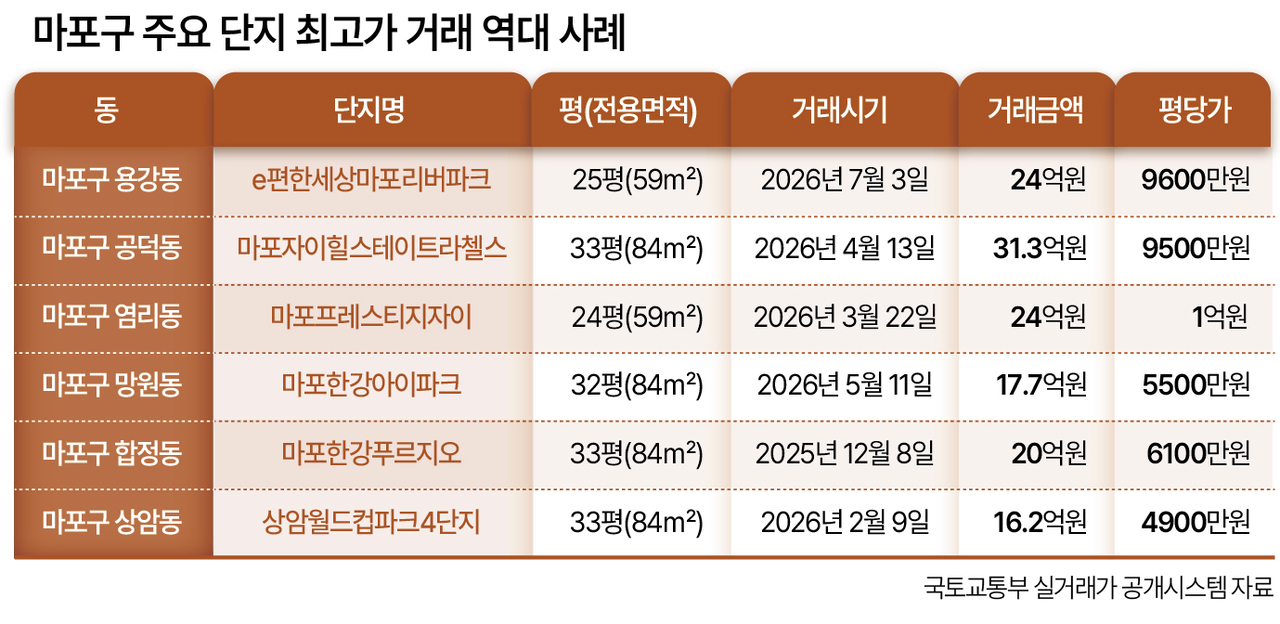
However, the complexes commanding prices near 100 million won per pyeong in Mapo-gu are concentrated almost entirely in the eastern corridor — the neighborhoods of Ahyeon, Yeomni, Gongdeok, Dohwa, Daeheung, Sinsu, Yonggang and Seogang-dong. Large-scale new and near-new complexes such as Mapo Prestige Xi and Mapo Grand Xi are also clustered in this area.
"East Mapo is convenient for reaching the central business districts of Gwanghwamun and Jongno, as well as Yeouido, via Seoul Subway Line 5 and Mapo-daero," said the head of a licensed real estate agency in Ahyeon-dong. "The concentration of office buildings and commercial facilities along Mapo-daero is drawing high-income end-users to the area."
In contrast, the neighborhoods typically classified as West Mapo — Sangam, Seongsan, Mangwon, Yeonnam, Seogyo and Hapjeong-dong — have seen far more modest price levels. The most recently built apartment of note in the area is Mapo Hangang I'Park in Mangwon-dong, completed in 2018. An 84-square-meter unit there sold for 1.77 billion won in May, translating to a per-pyeong price in the 50-million-won range — roughly half that of major East Mapo complexes.
"The East Mapo and West Mapo distinction has roots in the electoral boundaries of the Mapo-gap and Mapo-eul constituencies," said the head of another agency in Mangwon-dong. "Accumulated differences in living zones, transit networks and housing types have now translated into a real price gap in the housing market."
Experts point to the higher proportion of villas and multi-family low-rise housing in West Mapo neighborhoods such as Mangwon, Seongsan and Sangam-dong, along with limited supply of large new apartment complexes, as the main drivers of the price gap. East Mapo has seen a wave of large new apartment complexes following the near-completion of redevelopment projects led by the Ahyeon New Town initiative, while West Mapo has lagged behind in the pace of urban renewal.
"Within the same Mapo district, areas with more new apartments will inevitably stand out in terms of value," said Kim Hak-ryeol, head of Smart Tube, a real estate research firm. "East Mapo has already completed much of its redevelopment and has many new apartments, so the market tends to perceive it as a relatively higher-tier area. West Mapo could also attract market attention once redevelopment activity there gains momentum."
quq@heraldcorp.com





