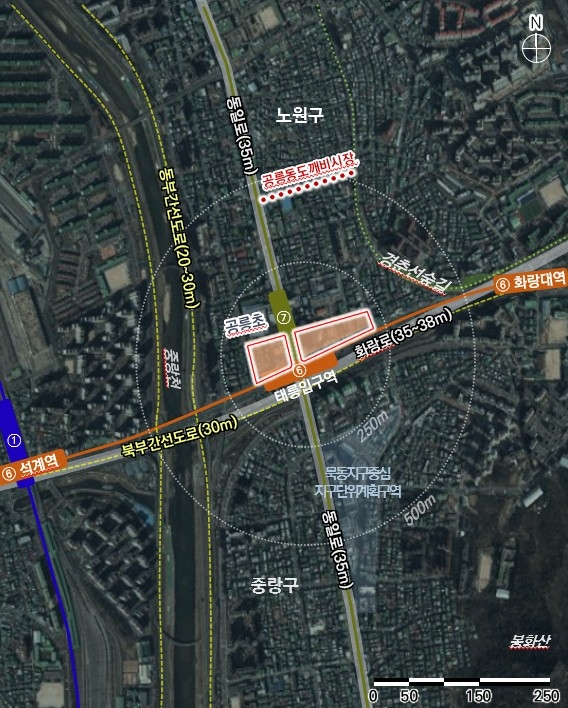
Nowon-gu said a revitalization project around Taereung Entrance Station will move into full swing after the Seoul Metropolitan Government's 13th Joint Urban and Architecture Committee approved, with modifications, a proposed change to the district unit plan for the area on Wednesday.
The revised plan includes the designation of a special planning zone, sweeping deregulation and the introduction of youth-focused incentives — measures expected to accelerate the creation of a flagship youth hub for Seoul's northeastern corridor.
The target site — centered on 670 Gongneung-dong and covering 35,733 square meters — sits within 3 kilometers of eight universities and is already home to a youth culture street, youth-run shops and other youth-oriented infrastructure. Despite its prime location as a transfer station for subway lines 6 and 7 and its commercial zoning, development has long stalled due to rigid lot plans and a tangle of regulations.
The centerpiece of the district unit plan overhaul is the designation of a special planning zone, which lays the groundwork for large-scale integrated development in the commercial area. The district will designate one densely residential parcel as a special planning zone to strengthen the mixed-use character of the commercial district and encourage private-led integrated development. The zone will operate for three years from the date of the official designation notice, and integrated development projects will be permitted to build up to 100 meters. Recognizing that large-scale integrated development can be difficult in practice, the plan also allows phased implementation, giving landowners the flexibility to develop on their own terms. The district said it will provide active administrative support once private development picks up in earnest.
For general development sites outside the special planning zone, the district has significantly overhauled development standards to give private developers greater autonomy — scrapping regulations on maximum development scale and mandatory joint development, and relaxing the base floor-area ratio to as high as 800 percentage points. The changes are intended to inject vitality into the stagnant commercial area and spur private investment and self-directed development.
Drawing on the area's concentration of youth infrastructure, the district will introduce a new "youth-specific use floor-area ratio incentive." Developments that incorporate youth-oriented uses — such as startup spaces, cultural facilities and education — will be eligible for a floor-area ratio bonus of up to 80 percentage points. The initiative is expected to lay the foundation for a mixed-use "live-work-play" environment by expanding spaces that support youth entrepreneurship and economic activity while also encouraging youth residential supply.
The district plans to re-publish the proposed district unit plan change for public review, incorporating the committee's modification conditions, before issuing the official "Taereung Entrance Station District Unit Plan Zone Decision (Change)" notice. Details of the re-publication and the final notice will be available on the Seoul Metropolitan Government's Urban Space Portal and the Nowon-gu website, and related documents may also be reviewed at the Urban Management Division of Nowon-gu Office.
"This district unit plan overhaul has laid the foundation for creative private development through the designation of a special planning zone and bold regulatory reform," Nowon-gu District Mayor Seo Jun-o said. "We will develop Taereung Entrance Station into a flagship youth hub for the northeastern corridor — a place where young people can work, live and enjoy life — and build Nowon into a future economic city."
seouldream01@heraldcorp.com