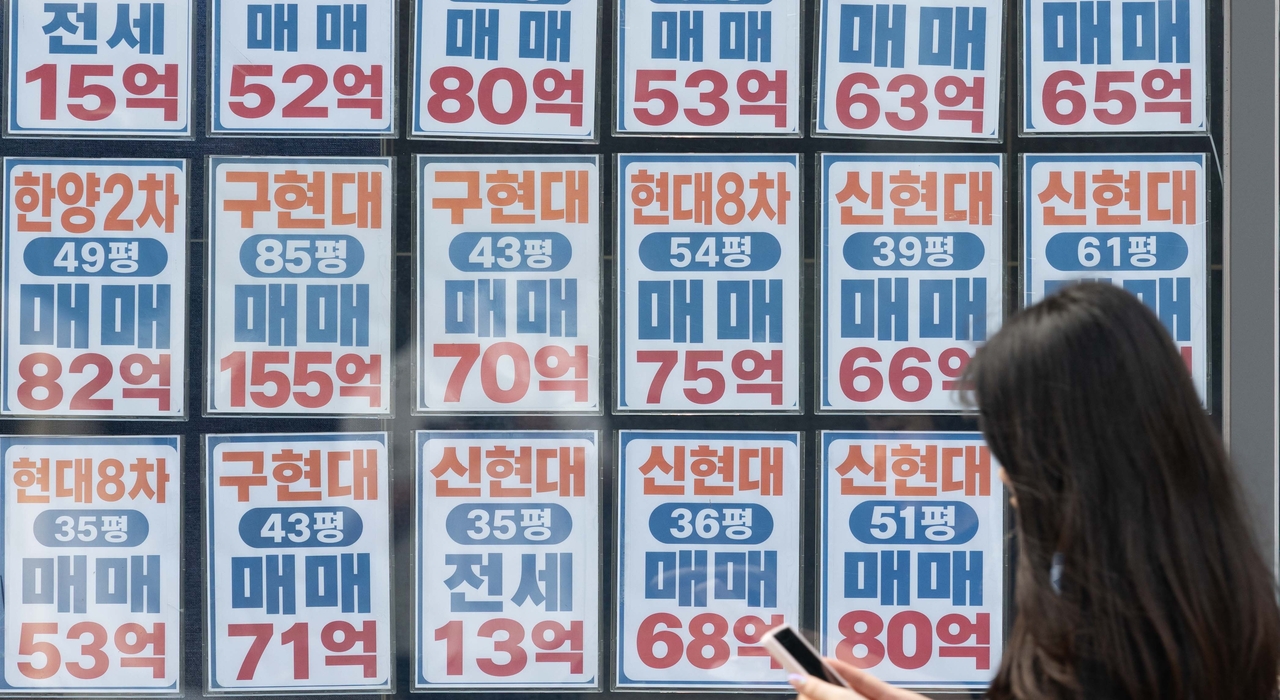
The government is reviewing a plan to abolish the ownership requirement under the long-term holding special deduction — a capital gains tax relief measure — and cap the deductible amount in the 1 billion won ($682,000) range. Should the proposal take effect, capital gains tax burdens on ultra-high-end homes in key Seoul districts could rise to two to five times the current level. While the impact would be minimal for properties with a market price up to the mid-3 billion won range — assuming 10 years of residency — owners of homes valued at 4 billion won or more would bear the brunt of the increase.
Related ministries and the real estate industry said Wednesday the government is reviewing measures to scale back the long-term holding special deduction benefit for single-home sellers as part of a tax reform package it plans to announce soon. The leading option under discussion would eliminate the ownership-based deduction component — which currently allows up to 40 percent relief for meeting the ownership requirement and another 40 percent for the residency requirement, for a combined maximum of 80 percent — and cap the total deductible amount in the 1 billion won range. However, the government is understood to be leaning toward a compensatory measure that would preserve the full 80 percent deduction for those who have actually lived in the home for 10 years or more.
Apgujeong Hyundai: 350 million to 1.54 billion won; Hannam the Hill: 670 million to 3.15 billion won
If the proposed overhaul of the long-term holding special deduction takes effect, capital gains tax bills on ultra-high-end complexes valued at 4 billion won or more would rise by hundreds of millions to tens of billions of won.
In a simulation commissioned from Ko Yu-bin, head tax accountant at Sabyeok Tax Accounting, a single-home owner who bought an 84-square-meter unit at Banpo Xi in Banpo-dong, Seocho-gu, through pre-sale at 1.18 billion won, held and lived in it from March 2009 to the present, and sold it at 4.83 billion won — based on KB's general market price — would currently owe 212.78 million won in capital gains tax.
Under the government's proposed 1 billion won deduction cap, however, that tax bill would jump to 789.1 million won — roughly four times the current amount. If the cap were set at 1.5 billion won instead, the tax would rise to 541.6 million won.
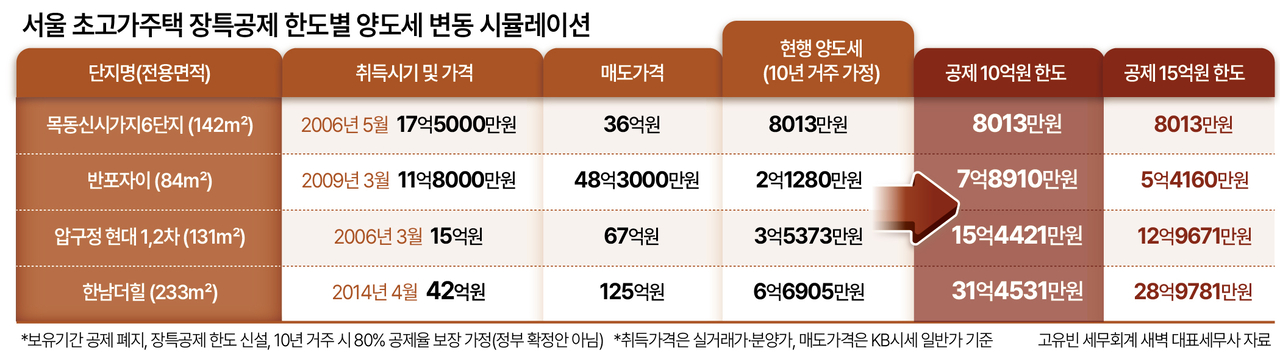
For a single-home owner who bought a 131-square-meter unit at Hyundai 1·2 in Apgujeong-dong, Gangnam-gu — currently valued at 6.7 billion won — for 1.5 billion won in March 2006 and has held and lived there for 20 years, the capital gains tax would surge from the current 353.73 million won to 1.54 billion won under a 1 billion won cap, or 1.3 billion won under a 1.5 billion won cap.
At Hannam the Hill in Hannam-dong, Yongsan-gu — one of Seoul's most prominent ultra-high-end residential addresses — an owner who bought a unit for 4.2 billion won in 2014 and meets the residency requirement currently faces a capital gains tax bill of 669.05 million won. Under a 1 billion won deduction cap, that figure would soar to 3.15 billion won. Even under a 1.5 billion won cap, the tax would surge to 2.9 billion won.
By contrast, a single-home owner who bought a 142-square-meter unit at Mok-dong Sinsiganji Complex 6 in Mok-dong, Yangcheon-gu — currently valued at 3.6 billion won — for 1.75 billion won in May 2006, lived there and then sold it would face the same capital gains tax of 80.13 million won even after a deduction cap is introduced. This is because after subtracting the 1.2 billion won threshold for the single-household capital gains tax exemption, the maximum 80 percent residency-based long-term holding deduction applied to the gains above that threshold produces a deductible amount below 1 billion won.
"Complexes like Banpo Xi, Apgujeong Hyundai and Hannam the Hill would hit the deduction ceiling, causing their tax burdens to spike to roughly 2.5 to 4.7 times the current level," Ko said. "The more expensive the property, the larger the multiplier." He added that "guaranteeing an 80 percent deduction for those who have lived in the home for 10 years or more would spare owners with capital gains of around 1.2 billion won from a major hit," but cautioned that "even in such cases, those who have lived there for fewer than 10 years would see their overall deduction rate fall as the residency-period deduction is abolished, resulting in a heavier tax burden."
NTS chief calls deduction 'excessively regressive'; experts warn reform runs counter to system's purpose
The government's push to restructure the long-term holding special deduction so that tax burdens rise steeply for properties valued above 4 billion to 5 billion won reflects its determination to rein in what it sees as excessive tax benefits concentrated among ultra-high-end homeowners.
National Tax Service Commissioner Lim Gwang-hyeon wrote on his X (formerly Twitter) account on Sunday that "the current long-term holding special deduction is excessively regressive because it allows up to 80 percent of taxable capital gains to be deducted with no ceiling for those who have held and lived in a property for 10 years," adding that "there have even been cases where more than 20 billion won was deducted through the long-term holding special deduction on the sale of a single home in Gangnam-gu." Kim Yong-beom, the Cheong Wa Dae policy chief, also said in a radio interview on Monday that "constructive proposals — including setting a cap on the long-term holding special deduction — came out of the forum, and we are considering ways to appropriately reflect them in policy."
Among experts, however, there are concerns that abolishing the ownership requirement and imposing a deduction ceiling would run counter to the original purpose of the long-term holding special deduction, which was designed to curb speculative demand and account for inflation. The worry is that single-home owners who have lived in their properties for decades may increasingly choose to hold rather than sell in the face of a heavier capital gains tax burden, deepening the supply freeze in the real estate market.
Park Hap-su, an adjunct professor at Konkuk University's Graduate School of Real Estate, said the long-term holding special deduction "was introduced on the principle that taxing natural price appreciation driven by inflation would infringe on property rights, and that such gains should therefore be deductible — so eliminating the ownership requirement entirely runs counter to that purpose." He added that "even if the deduction structure were adjusted — say, from the current maximum of 40 percent for ownership and 40 percent for residency to 20 percent for ownership and 60 percent for residency — outright abolition of the ownership requirement should be approached with great caution."
Park went on to say that "single-home owners should fundamentally be regarded as end-users, not speculators, regardless of the property's price," and that "if the reform direction of abolishing the ownership requirement becomes reality, selling would mean being unable to afford a comparable home, so there would be no reason to sell unless you are an older homeowner downsizing."
hwshin@heraldcorp.com