![Kim Young-hoon, minister of Employment and Labor (third from left), and Jang Ji-yeon, chairperson of the labor-management-government task force on strengthening retirement pension functions (fourth from left), pose for a photo after announcing the task force's joint declaration at Kensington Hotel in Yeouido, Seoul, on Feb. 6. [Yonhap]](https://wimg.heraldcorp.com/news/cms/2026/07/29/rcv.YNA.20260206.PYH2026020602950001300_P1.jpg)
A new option is coming for how retirement pensions are managed in South Korea.
The government is pushing to amend legislation this year to introduce a fund-based retirement pension system. Under the new model, contributions from multiple workplaces would be pooled into a single fund and managed professionally — an alternative to the current contract-based system, in which companies individually contract with banks, securities firms or insurers to manage their reserves.
So who would manage your retirement pension under a fund-based system, and what would change?
Reserves scattered by company to be pooled into one fund
According to the Ministry of Employment and Labor on Wednesday, labor, management and government reached a broad agreement in principle on Feb. 6 through a joint declaration of the labor-management-government task force on strengthening retirement pension functions, backing the introduction of a fund-based retirement pension system and the mandatory external reserve of retirement benefits. It marked the first time labor and management had aligned on the direction of a pension system overhaul since the retirement pension regime was introduced in 2005.
The government is working through a working group — involving related ministries, labor and management representatives, and experts — to finalize the detailed design of the system ahead of amending the Act on the Guarantee of Workers' Retirement Benefits this year. Key issues under discussion include the governance structure and management framework for trustee corporations, the National Pension Service's potential role, and the mandatory external reserve of retirement benefits.
The government expects that pooling contributions from multiple workplaces into a single fund for professional management will enable long-term and diversified investment through economies of scale, ultimately improving returns.
The current system centers on the contract-based model, in which companies individually contract with financial institutions such as banks, securities firms and insurers. Total reserves held by South Korea's 43 retirement pension providers — securities firms, banks and insurers — reached 553.88 trillion won ($378 billion) in the second quarter of this year, up about 45 trillion won from the previous quarter's 508.73 trillion won.
Under the fund-based model, contributions from multiple workplaces are pooled into a single fund and managed over the long term by a professional management organization, similar to how the national pension operates. The existing contract-based system would not be abolished but would run in parallel. Workplaces could choose either the fund-based or contract-based model, or operate both simultaneously.
"The core of the fund-based model is pooling contributions from multiple workplaces collectively to achieve economies of scale and enable long-term investment and professional asset allocation," a Ministry of Employment and Labor official said. The joint declaration also explicitly states that "the fund-based model is not a replacement for the existing contract-based system but will operate alongside it."
The trustee corporation is key — what sets the financial institution, coalition and public types apart?
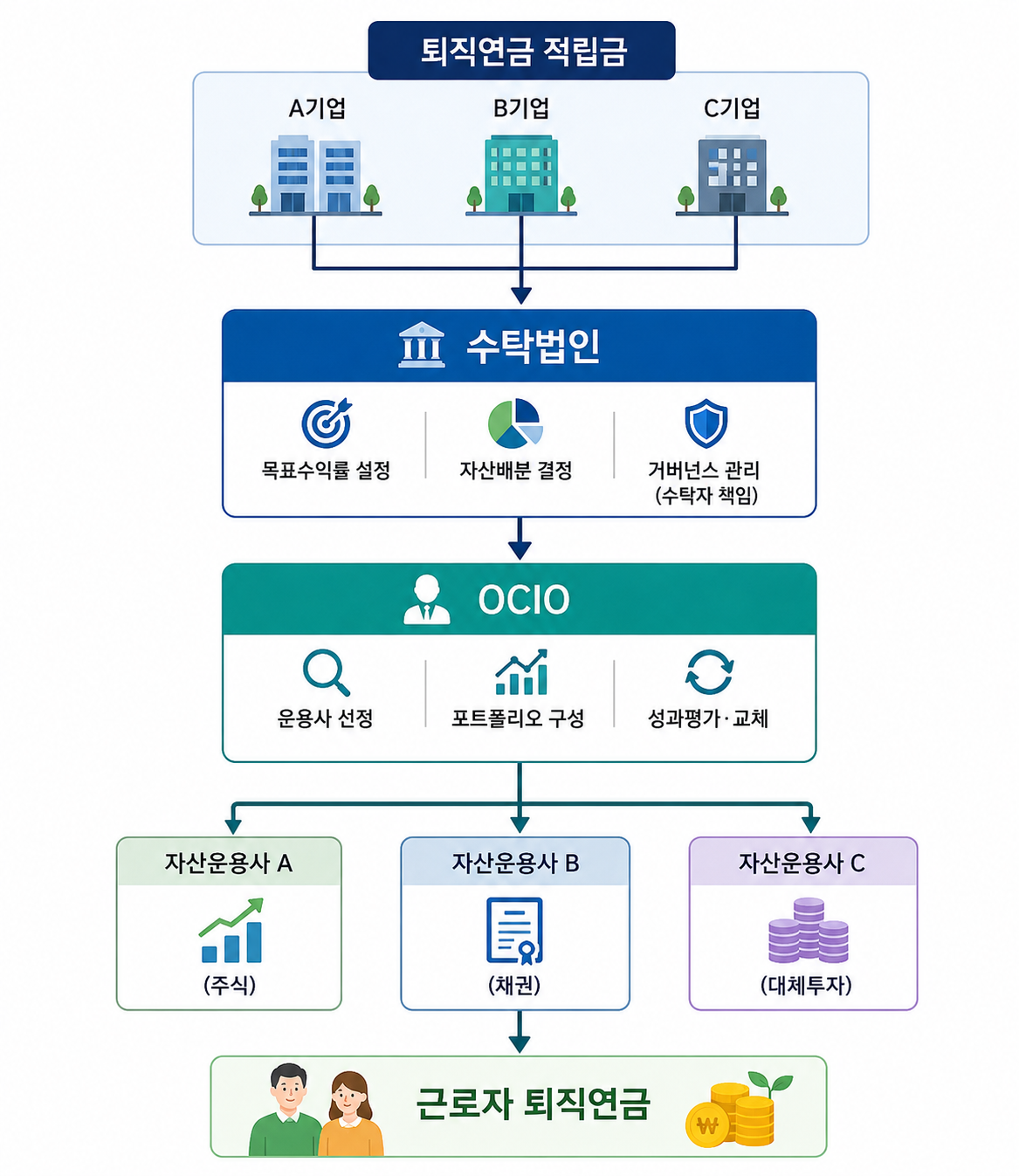
The fund-based retirement pension system pools contributions from multiple workplaces into a single fund for professional management. The key players are the trustee corporation, which serves as the control tower for fund management; the outsourced chief investment officer, or OCIO, which executes the actual investment strategy; and individual asset management firms that handle specific asset classes.
The trustee corporation acts as the final decision-making body, approving the investment policy statement through its fund management committee, selecting and evaluating the OCIO, and setting the overall management direction — including target returns and acceptable risk levels.
The OCIO is the professional management organization that carries out the investment strategy set by the trustee corporation. Securities firms or asset managers are likely candidates for the role. The OCIO oversees the overall portfolio and selects specialized managers for each asset class.
In their joint declaration, labor, management and government defined "establishing fiduciary responsibility with the subscriber's interests as the top priority" as the core of the fund-based retirement pension system, and called for a dedicated fund management body with investment expertise to be established within the trustee corporation, separate from its board of directors.
The three parties have already agreed to introduce three types of trustee corporations: a financial institution type, a coalition type and a public institution type. The working group is currently discussing the detailed rules governing how each type would be established and operated.
Under the financial institution type, banks, securities firms, insurers and other financial companies would establish separate trustee corporations to manage pooled contributions from multiple workplaces. To prevent conflicts of interest, the trustee corporation would be kept separate from the financial institution, and independent directors with no ties to the financial institution would hold a majority of board seats — with at least 30 percent, or a minimum of two directors, drawn from candidates recommended by subscribers.
The coalition type involves multiple companies jointly establishing a trustee corporation. While industry-based trustee corporations were considered, it is more likely that such entities would be formed around conglomerates and their affiliates — such as Samsung, Hyundai Motor and SK Group. The board would be required to have equal representation from labor and management, which is why labor groups favor this model. However, because the board structure gives labor and management equal footing even after a company bears the cost of establishing the corporation, it is not an attractive option for employers — leading some to question whether coalition-type trustee corporations would actually be formed in practice.
The public institution type is modeled on an expansion of the Small and Medium Enterprise Retirement Pension Fund, known as "Pureunssiaat," currently operated by the Korea Workers' Compensation and Welfare Service. Introduced in 2022 as South Korea's first public fund-based retirement pension, Pureunssiaat pools contributions from small and medium-sized enterprises into a single fund for professional management. Eligibility has been expanded from workplaces with up to 30 full-time employees to those with fewer than 50, and starting in January next year it will extend to workplaces with fewer than 100 employees. An individual retirement pension account under Pureunssiaat has also been introduced, allowing the self-employed, platform workers, civil servants and anyone else in work to join the fund-based retirement pension system.
The biggest question surrounding the public institution type is whether the National Pension Service will participate. The National Pension Service has expressed its intention to join as a public institution-type trustee corporation, but no decision has been reached.
Once a trustee corporation sets the principles for strategic asset allocation through an investment policy statement, the OCIO takes charge of executing investments, selecting managers and overseeing performance. Some observers expect the National Pension Service to enter the retirement pension market as an OCIO rather than as a trustee corporation.
The OCIO selects specialized managers for each asset class — including overseas equities, bonds and alternative investments — and replaces underperforming ones. "If the trustee corporation is the organization that formulates the investment strategy, the OCIO is the professional management body that actually executes it," a Ministry of Employment and Labor official said.
Who manages it, who decides — and legislation targeted for this year
The introduction of a fund-based retirement pension system would not automatically convert existing subscribers' pensions to the new model. The decision to adopt the fund-based system rests with individual workplaces, not employees, and switching pension systems requires going through labor-management procedures — including soliciting employee opinions and obtaining consent from employee representatives.
If a workplace opts for the fund-based model, it would contract with an appropriate trustee corporation — whether of the financial institution, coalition or public institution type. Workplaces currently running a contract-based retirement pension could also switch to the fund-based model or operate both systems in parallel, subject to labor-management consultation.
The introduction of the fund-based system and the mandatory external reserve of retirement benefits are being discussed together but are separate issues. Mandatory external reserves would expand the number of retirement pension subscribers and the scale of reserves, helping the fund-based system take root — but the government says the fund-based system itself can be introduced even without mandatory external reserves.
This is an ongoing series that explains useful policy information in plain terms, examining the background behind proposed policies and what changes mean — and outlining who can use them, when and how.
fact0514@heraldcorp.com