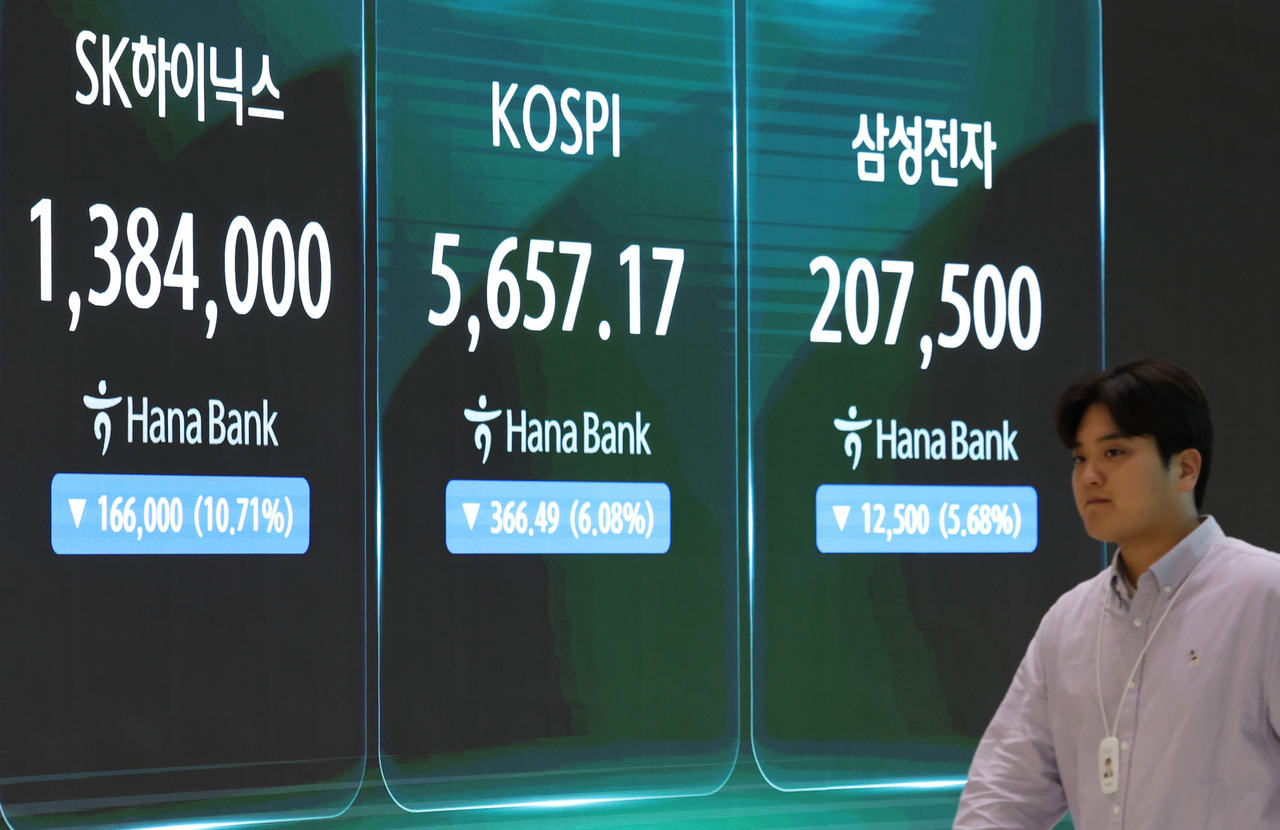
The Kospi's 30 percent collapse in July was not the product of a single shock. China's advancing semiconductor industry cracked the AI chip rally, a wave of foreign selling dragged the index lower, and a market structure in which Samsung Electronics and SK Hynix together account for more than half of total market capitalization amplified every move downward — pushing the monthly decline past levels last seen during the Asian financial crisis and the global financial crisis.
According to Korea Exchange, the Kospi fell 28.94 percent in July, sliding from 8,476.48 at the end of June to 6,023.66 on Tuesday. Measured from the all-time closing high of 9,114.55 set on June 22, the index has dropped 33.91 percent in just over a month. Over the same period, total Kospi market capitalization shrank from 7,449.59 trillion won ($5.08 trillion) to 4,993.3 trillion won — a decline of 2,456.3 trillion won, or 32.97 percent. The monthly drop surpassed both the 27.25 percent fall recorded in October 1997 during the Asian financial crisis and the 23.13 percent decline in October 2008 during the global financial crisis, marking the steepest monthly loss since 1990.
Foreign investors were at the center of the rout. They net sold 17.91 trillion won worth of shares on the Kospi and Kosdaq markets this month, offloading semiconductor stocks that had led the AI rally. On Tuesday alone, foreigners net sold 4.97 trillion won on the Kospi, sending the index down 10.84 percent. Panic selling was severe enough to trigger both a sell-side sidecar and a circuit breaker in succession, and the index briefly broke below the 6,000 level during trading. Retail investors and institutions net bought 4.33 trillion won and 630 billion won, respectively, in an attempt to cushion the fall, but could not absorb the volume of foreign selling.
What ignited the foreign selloff was the pace of China's push toward semiconductor self-sufficiency. News that a Chinese government-backed company had begun producing immersion deep-ultraviolet lithography equipment fueled fears that the supply chain could expand to include China's largest DRAM maker, CXMT, and SMIC. Concerns deepened as reports circulated about CXMT expanding production capacity and the possibility of an initial public offering by Yangtze Memory Technologies, raising fears that China could build an end-to-end independent semiconductor supply chain spanning design, equipment, production and memory chips. Even though analysts noted that Chinese DUV equipment still lags ASML's products in performance and reliability, investors moved quickly to price in the prospect of a future surge in memory supply. As confidence in the AI memory supercycle — premised on a supply shortage — began to waver, semiconductor stocks tumbled in the United States, with Nvidia, Micron and SanDisk all falling sharply, while the shock spread across Asia to Japan's Kioxia and Tokyo Electron and to Taiwan's TSMC and MediaTek.
The selloff also exposed how the domestic market's heavy dependence on semiconductors has become a structural vulnerability. As capital flowed into Samsung Electronics and SK Hynix during the AI rally, the two stocks drove the index higher — but in a correction, that same concentration amplified the decline.
As of Tuesday, Samsung Electronics and SK Hynix carried market capitalizations of 1,286.18 trillion won and 1,104.69 trillion won, respectively, for a combined 2,390.87 trillion won — equal to 50.02 percent of the entire Kospi. When the two dominant semiconductor stocks wobbled, the broader index had little choice but to follow.
"The combined weighting of Samsung Electronics and SK Hynix within the KOSPI 200 has expanded to 60.7 percent, significantly weakening the diversification effect," said Yoon Yeo-sam, a researcher at Meritz Securities. "Of the 2,358.8-point decline in the Kospi from its peak, the semiconductor sector accounted for 1,892 points — or 80.2 percent of the total drop."
Market analysts view the correction as the result of a broader breakdown in the investment thesis surrounding AI semiconductors, rather than a single China-related shock. The confluence of China's chipmakers closing the technology gap, doubts about the sustainability of hyperscaler capital expenditure, and fears that the memory cycle has peaked has led the market to question whether the semiconductor upcycle has already crested.
"The market is simultaneously pricing in doubts about the sustainability of hyperscaler investment, the rise of Chinese chipmakers, and concerns that earnings forecasts have peaked," said Lee Young-won, a researcher at Heungkuk Securities. "While Chinese DUV equipment is unlikely to enable advanced semiconductor production in the near term, China's potential to build an independent semiconductor supply chain is a key issue that must be monitored over the long term."
Even record-breaking earnings from chipmakers failed to meet market expectations. SK Hynix on Wednesday posted second-quarter sales of 79.32 trillion won and operating profit of 60.54 trillion won — both all-time quarterly highs. Operating profit surged 557.2 percent year-on-year, surpassing the company's full-year operating profit for last year in a single quarter, yet it fell short of the market consensus of 63.15 trillion won, marking an earnings miss. Attention has now shifted away from the results themselves toward the second-half outlook — HBM demand, the broader memory cycle and the speed of China's capacity expansion.
Analysts say any future rebound will ultimately hinge on whether foreign investors return as net buyers. Historical patterns from past sharp selloffs show that the index has tended to enter a recovery phase only after foreigners turned to net purchasing.
"During the dot-com bubble, foreign selling continued even as share prices fell, deepening the losses," said Lee Gyeong-su, a researcher at Hana Securities. "By contrast, during the China shock and the Dubai shock, foreigners bought domestic shares as part of a rebalancing move while retail investors sold once prices recovered to their purchase levels — and the index rebounded afterward."
hajun825@heraldcorp.com