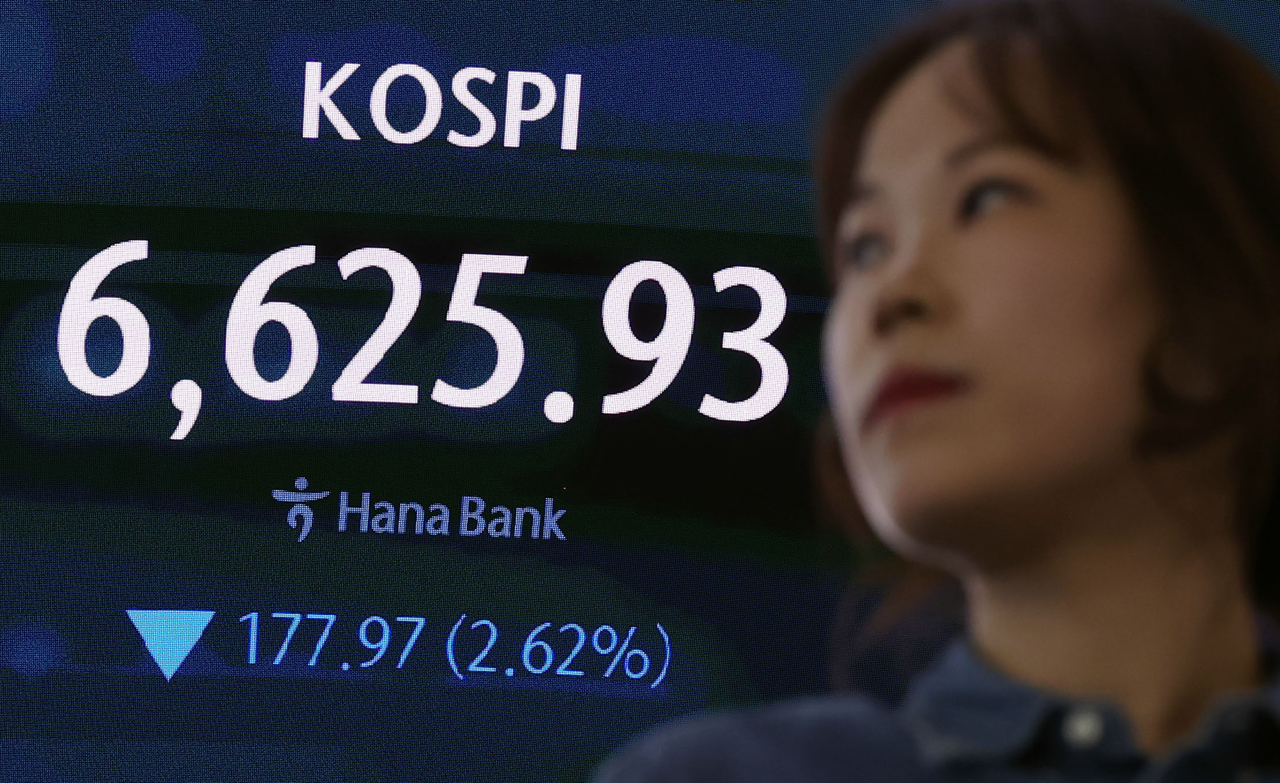
![The Kospi is displayed at the dealing room of Hana Bank's headquarters in Seoul on Wednesday. The index briefly rose 1 to 2 percent in early trading before reversing course and falling below the 6,000 mark. [Yonhap]](https://wimg.heraldcorp.com/news/cms/2026/07/29/rcv.YNA.20260729.PYH2026072908640001300_P1.jpg)
South Korean stocks plunged more than 12 percent intraday on Wednesday, led by double-digit losses in semiconductor heavyweights Samsung Electronics and SK hynix. SK hynix tumbled more than 18 percent during the session despite reporting record quarterly earnings that surpassed market expectations, while Samsung Electronics fell below the 200,000-won mark, accelerating the broader Kospi decline.
According to Korea Exchange, the Kospi slid as low as 5,262.77 as of 1:32 p.m., down 760.89 points, or 12.63 percent, from the previous session. A sell-side sidecar was triggered in the morning following a sharp drop in Kospi 200 futures, and at 12:32 p.m. the Kospi fell to 5,532.33 — a decline of 8.16 percent — prompting a sell-side circuit breaker. Trading halted for 20 minutes before resuming at 12:52 p.m., but selling pressure continued and the index set a fresh intraday low.
SK hynix disclosed Wednesday that it posted consolidated sales of 30.21 trillion won ($20.6 billion) and operating profit of 11.23 trillion won in the second quarter — both all-time highs on a quarterly basis. Operating profit exceeded the market consensus. The company said growth in sales of high-value products, particularly HBM, drove the results.
The strong earnings did little to support the share price. SK hynix was trading at 1.262 million won at the same time, down 288,000 won, or 18.58 percent, from the previous session. The stock touched an intraday low of 1.259 million won, with the decline widening to 18.77 percent.
Samsung Electronics also fell, trading at 192,400 won, down 27,600 won, or 12.55 percent, from the previous close. The stock dropped as low as 192,000 won intraday, extending its loss to 12.73 percent. It was the first time the share price had fallen below 200,000 won during trading since April 13.
The sharp selloff in large-cap semiconductor stocks amplified the Kospi's decline. When the circuit breaker was triggered, the index stood at 5,532.33, down 8.16 percent. Selling continued after trading resumed, and the benchmark fell to 5,262.77 — a drop of 12.63 percent — by 1:32 p.m., roughly 270 points below the level at which the circuit breaker had been activated.
Wednesday's circuit breaker marked the first time sell-side circuit breakers had been triggered on two consecutive trading days on the Kospi since the mechanism was introduced. So far this year, the Kospi has seen 20 buy-side sidecars, 24 sell-side sidecars and nine sell-side circuit breakers, reflecting extreme market volatility.

kacew@heraldcorp.com