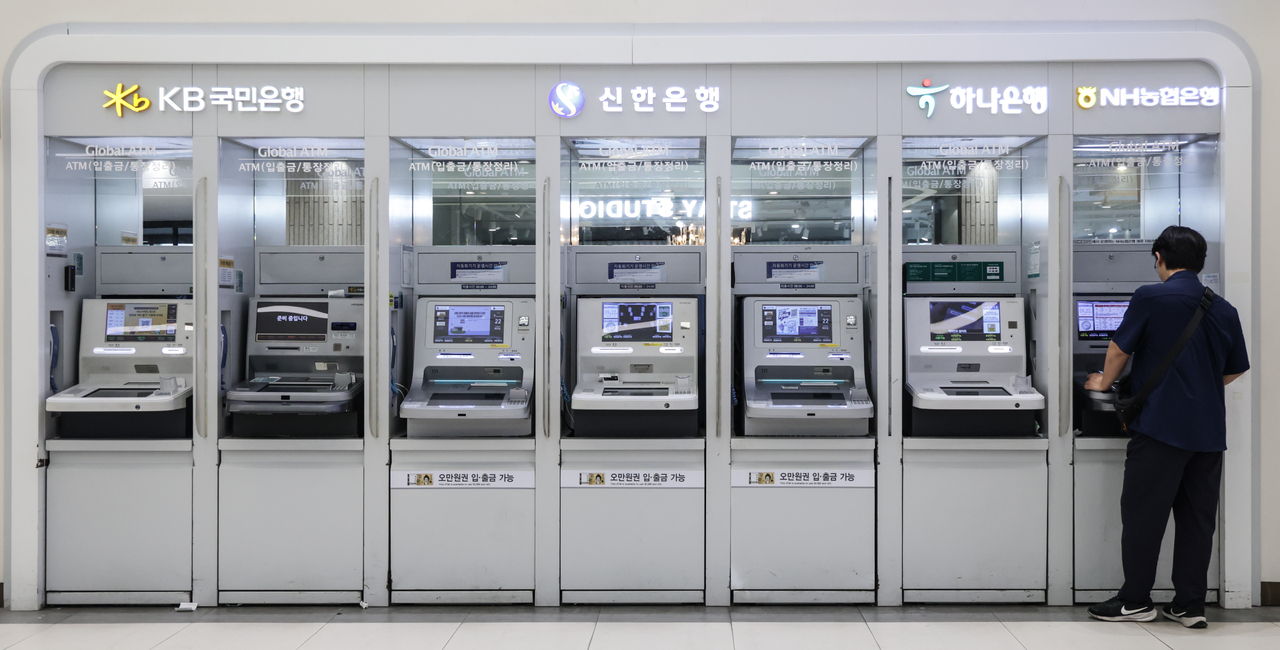
![The Kospi is displayed at the dealing room of Hana Bank's headquarters in Seoul on Friday. As of 9:03 a.m., the index stood at 6,371.64, up 778.08 points, or 13.91 percent, from Thursday. It opened up 64.23 points, or 1.15 percent, at 5,657.79 and quickly reclaimed the 6,000 level, recovering to the 6,300 range in early trading. [Yonhap]](https://wimg.heraldcorp.com/news/cms/2026/07/31/rcv.YNA.20260731.PYH2026073104620001300_P1.jpg)
The Kospi swung more than 800 points intraday on Friday, recording the second-largest intraday range of the year. As of 9:30 a.m., the gap between the session high and low stood at 811.62 points — second only to Wednesday's 965.8-point swing. With the index lurching by hundreds of points daily throughout the month, July's average daily intraday range hit 468.2 points, the highest of the year.
According to Korea Exchange, the Kospi's average daily intraday range — the difference between the intraday high and low — came to 468.2 points for July (July 1 through Thursday). That is up 10.9 percent from June's 422.0 points and 52.7 percent from May's 306.6 points, the widest monthly average so far this year.
The daily intraday range measures the gap between the highest and lowest prices reached during a session. A wider range means investors experience greater price swings in real time, and trades executed on the same day can produce vastly different returns depending on timing. Unlike the VKOSPI — which reflects expected market volatility over the next 30 days based on KOSPI 200 options prices — this measure captures actual price movement during trading hours.
The surge in volatility did not emerge suddenly in July. The average daily intraday range first crossed 300 points in May, widened to the 400-point range in June, and reached 468.2 points in July, a year-to-date high. The expansion was not simply a byproduct of a rising index. The intraday range relative to the index level was also the widest of the year: the ratio of the average daily intraday range to the monthly average closing level hit 6.67 percent in July, the highest reading of the year.
Swings exceeding 500 points occurred repeatedly this month. Wednesday's intraday range stretched to 965.8 points, while July 3 (758.2 points), July 13 (745.6 points), July 8 (605.5 points) and July 7 (565.3 points) all saw moves of more than 500 points.
As the Kospi tumbled 32.6 percent from 8,303.41 on July 1 to 5,593.56 on Thursday, the index repeatedly plunged 5 to 10 percent in a single session before sharply rebounding. The extreme intraday swings meant that returns on any given day varied widely depending on when investors bought or sold.
Options markets suggest elevated volatility may persist for now. The VKOSPI, which reflects expected market volatility over the next 30 days based on KOSPI 200 options prices, stood at 86.18 as of Thursday. While that is below the all-time high of 96.94 set last month, it remains historically elevated.
There are also signs that extreme volatility is beginning to ease. Kwon Sun-ho, a researcher at Daishin Securities, said the VKOSPI's decline even as the market sold off sharply suggests investors are less worried about further steep drops than before. "Deleveraging activity is slowing and short-term trading is declining, which means the sharp volatility driven by supply-and-demand imbalances is also gradually easing," he said.
Attention is also turning to whether stabilization measures by financial authorities and the industry will take hold. Starting Friday, the minimum deposit requirement for single-stock leveraged products rose from 10 million won ($6,940) to 30 million won, and asset managers began voluntarily spreading rebalancing trades throughout the session rather than concentrating them at the close. Lee Jae-won, a researcher at Yuanta Securities Korea, said a reduction in single-stock leveraged trading could ease the concentration of order flow into large-cap stocks. "It should also help lower market volatility in the short term," he said.

kacew@heraldcorp.com