Semiconductor base effect to weigh on next year's profit growth
Investors should seek firms with improving margins, free cash flow despite won strength
For the Kospi next year, what will matter is not how fast profits grow but how high they actually are. With earnings having surged this year — led by the semiconductor sector — a base effect is expected to drag down profit growth rates in 2027, prompting analysts to call for stock selection based on operating profit margins and free cash flow. A curated list of 16 Kospi picks meeting those criteria was also unveiled.
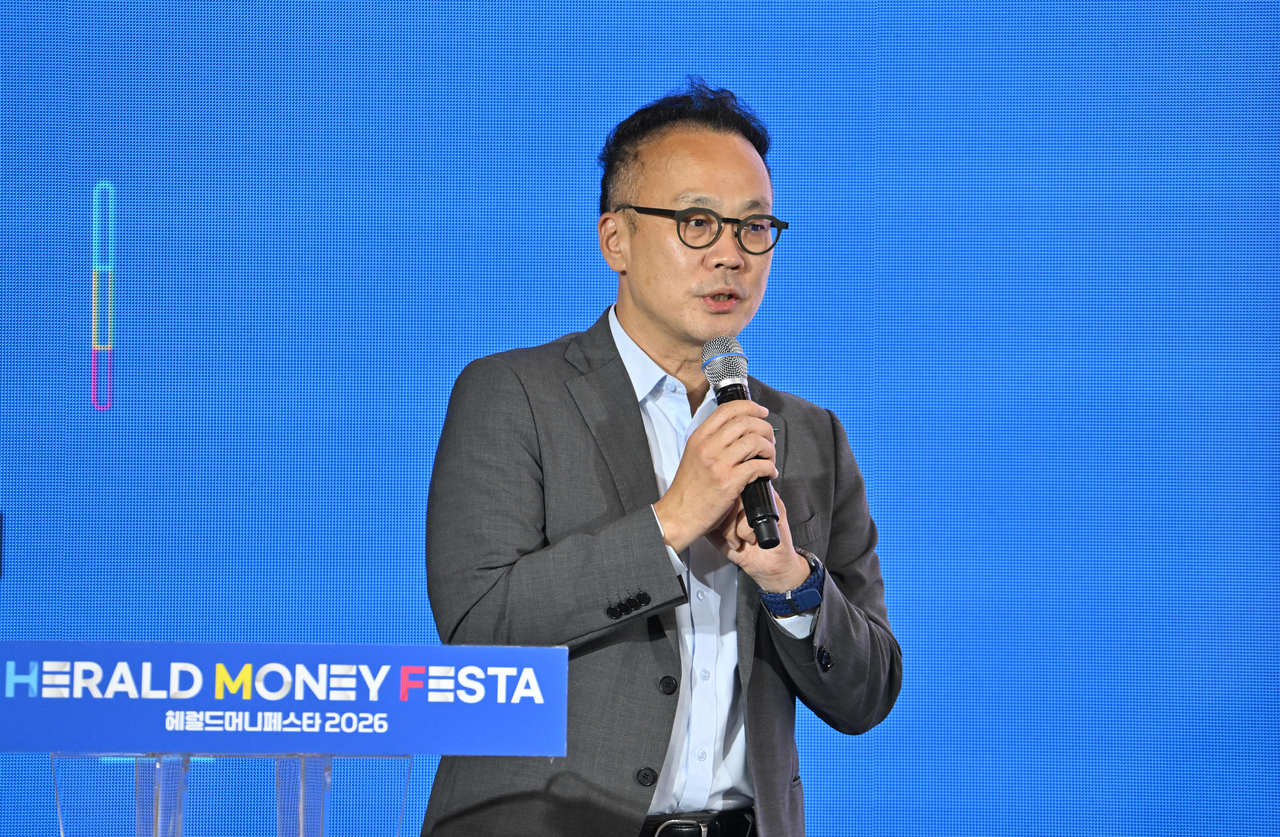
Lee Jae-man, head of global investment analysis at Hana Securities, said at the Herald Money Festa 2026, held Friday at Dongdaemun Design Plaza in Jung-gu, Seoul, that "in an era of 5 percent interest rates, choosing the right individual companies matters just as much as picking the right sector."
The expected slowdown in profit growth next year reflects how sharply earnings rose this year. Hana Securities forecast that the Kospi's net profit growth rate would fall from 271.5 percent this year to 30.6 percent in 2027. The semiconductor sector alone is projected to post net profit growth of 607.8 percent this year, making it virtually impossible to sustain that pace into next year.
As profit growth slows, corporate profitability could become the key factor separating winners from losers in the stock market. The Kospi's discount rate climbed from 15 percent in June to 21 percent in September this year. Lee said that as earnings growth begins to decelerate, whether a company can improve its operating profit margin will be a critical variable in determining share price divergence. "The Kospi has already seen its discount rate spike, reflecting higher global oil prices and market interest rates," he said. "Particularly in the early phase of slowing profit growth, whether operating profit margins are rising will be a key variable driving stock-by-stock divergence."
When high interest rates persist, share prices can diverge even among companies in the same sector depending on their profitability. Lee pointed to the US stock market in the second half of 1999, when the Federal Reserve was raising its benchmark interest rate. As the Fed's rate hikes and rising market rates proceeded simultaneously, share prices diverged within leading sectors — including semiconductors, software, industrials and financials. Applied Materials, Oracle, GE and Citigroup outperformed, while other companies in the same sectors lagged.
"The variable that drove that divergence was return on equity," Lee said. "Applied Materials, Oracle and Citigroup, which posted strong share price gains, were all in the group that saw significant ROE improvement." GE was also found to have maintained a high level of ROE during that period.
For the Korean market, Lee's strategy is to use operating profit margins and free cash flow to identify such profitability differences. The approach involves screening for companies whose third-quarter operating profit margin exceeds that of the second quarter — even after conservatively adjusting for won strength — and that are expected to see further margin improvement in 2027 alongside rising free cash flow.
Lee also said investors need to account for the drag on corporate profit margins from the recent won appreciation. The won-dollar exchange rate has fallen 12 percent over the past three months. According to Hana Securities, when the won-dollar rate has dropped more than 10 percent over a three-month period since 2015, the Kospi's projected operating profit margin has declined by an average of 0.30 percentage point from the prior month. "Given the sharp and rapid won appreciation in recent months, an adjustment to operating profit margin estimates is necessary," Lee said.
With third-quarter earnings season approaching, Lee said investors should watch closely how next year's profit estimates are revised. "Sectors that see their 2027 earnings estimates raised in October will post different fourth-quarter returns than those that see estimates cut," he said. An analysis of Kospi sectors from 2023 to 2025 confirmed that sectors whose next-year earnings estimates were revised upward during the October third-quarter reporting period delivered relatively higher fourth-quarter share price returns than those that saw downward revisions.
Sectors identified as having both high projected profit growth next year and recently rising earnings estimates include chemicals, secondary batteries, power equipment and semiconductors. Hana Securities forecast 2027 net profit growth of 138.0 percent for chemicals, 129.1 percent for secondary batteries, 36.4 percent for power equipment and 35.6 percent for semiconductors, against an overall Kospi forecast of 30.6 percent. Earnings estimates for those four sectors have been revised upward by 3.5 percent, 5.1 percent, 0.8 percent and 1.5 percent, respectively, over the past four weeks.
The 16 Kospi stocks selected under these criteria are Samsung Electronics, Hanwha Aerospace, Samsung SDI, Hyosung Heavy Industries, HD Hyundai Electric, Korea Electric Power Corporation, Samsung SDS, Hyundai Glovis, APR, Korean Air, Isupetasys, DB HiTek, OCI Holdings, Shinsegae, Hansol Chemical and Kepco Plant Service & Engineering. These picks were chosen not simply for high projected profit growth next year, but through a combined assessment of third-quarter operating profit margins adjusted for won strength, 2027 operating profit margin forecasts and expected free cash flow growth.
Lee drew wide attention among investors in May when he flagged the moment SK hynix's market cap surpassed Samsung Electronics' as a signal that the bull market was ending. In that report, he identified the market cap flip as a sign that the earnings-driven rally was running out of steam — and when the overtaking actually occurred in June, the call was widely revisited across the market.

kacew@heraldcorp.com