The Bank of Korea has said that if semiconductor-led economic growth lifts the country's potential growth rate, the neutral interest rate could rise as well — a prospect that raises the possibility of borrowing costs staying elevated for an extended period as South Korea enters a full-fledged rate-hiking cycle.
In a written response to the office of People Power Party lawmaker Kwon Young-se, the Bank of Korea said it does not disclose a specific neutral rate figure, citing the high uncertainty involved in estimating an unobservable variable and the wide variation across methodologies. The central bank added that monetary policy is best determined by weighing not only the neutral rate but also inflation, growth trends and financial stability conditions. It nonetheless said that based on internal and external research, the current benchmark interest rate of 2.75 percent "is assessed to fall within the estimated range of the neutral rate."
The Bank of Korea cited five research findings, which collectively placed the neutral rate in a range of 1.8 percent to 3.3 percent.
The neutral rate refers to the theoretical interest rate at which the economy can grow steadily without pushing inflation either up or down. It serves as a compass for monetary policy.
Markets are increasingly expecting the neutral rate to move higher. A sustained semiconductor-driven expansion, if it proves structural rather than cyclical, could push up the potential growth rate. The government has already set a target of raising the potential growth rate to 3 percent in its second-half 2026 economic growth strategy.
The potential growth rate measures the maximum pace at which an economy can expand when all its resources are fully utilized. A decline signals weakening fundamentals and growth capacity; a rise signals the opposite. The potential growth rate and the neutral rate typically move in the same direction.
Asked how the neutral rate might change if the government's 3 percent potential growth rate target were met, the Bank of Korea said "a rise in the potential growth rate acts as upward pressure on the neutral rate," but declined to give a specific figure, adding that "it is difficult to state a uniform magnitude — results vary across studies depending on the estimation horizon and methodology."
Domestic and international institutions have long forecast that the potential growth rate would continue to decline, driven primarily by an aging population. More recently, however, the view that an AI-centered "knowledge revolution" could reverse that trend and lift the potential growth rate has been gaining traction.
A higher neutral rate would push up both lending and deposit rates. Some two decades ago, when the potential growth rate stood at 5 to 6 percent, deposit rates were around 4 to 5 percent. According to data the Bank of Korea provided to the office of People Power Party lawmaker Lee Jong-wook, a 0.25 percentage point rise in mortgage rates would increase the annual interest burden on all borrowers by 1.8 trillion won ($1.25 billion).
The key question going forward is whether the semiconductor-driven economic momentum proves to be a temporary surge or a structural growth trend. In a recent report, the Bank of Korea said the current semiconductor upcycle "is rooted in structural demand growth driven by the spread of AI, beyond short-term supply-and-demand factors, making it highly likely that its magnitude and duration will exceed past cycles."
The Bank of Korea's advance estimate for second-quarter real GDP showed growth of 0.6 percent from the previous quarter — three times its own forecast of 0.2 percent — and analysts say annual growth of 3 percent now appears well within reach. Real gross domestic income rose 3.6 percent quarter-on-quarter, outpacing real GDP growth by roughly sixfold. Real GDI adds the real trade gain or loss from changes in the terms of trade to real GDP, providing a measure of the actual purchasing power felt by households. On a year-on-year basis, real GDI surged 15.6 percent, the fastest pace since the first quarter of 1988, when it rose 16.4 percent — a gap of more than 38 years.
The figures reflect a sharp surge in semiconductor prices that has caused income to outpace output by a wide margin. A Bank of Korea official said the degree to which real GDI is outstripping real GDP "is normally seen only in oil-producing or commodity-exporting countries," adding that "semiconductors are essentially playing the role of crude oil."
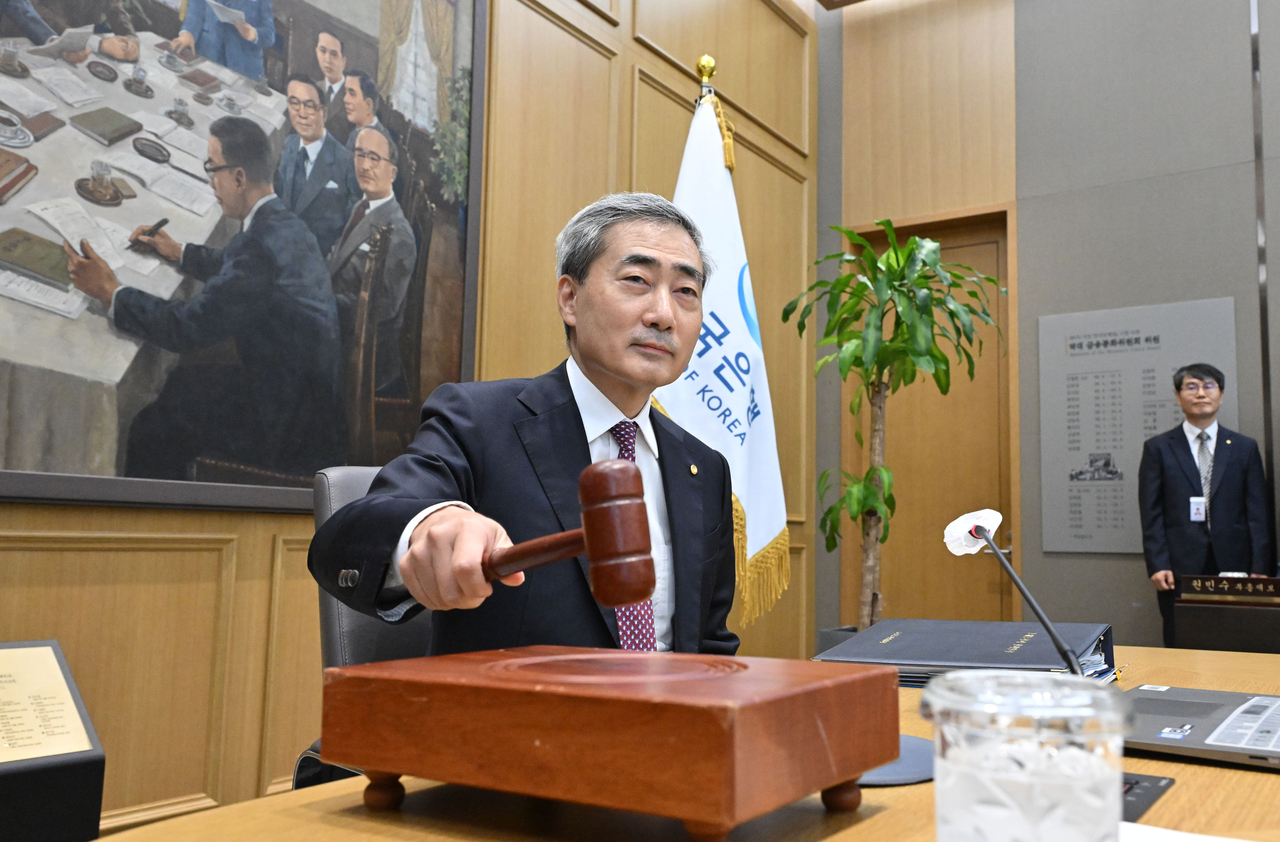
Attention is now turning to the Bank of Korea's revised economic outlook, due at the Monetary Policy Board meeting on Aug. 27. At the May meeting, the central bank raised its growth forecast for this year by 0.6 percentage points, from 2 percent to 2.6 percent. Markets are now expecting a forecast in the 3 percent range, with close attention on just how high the new figure will be. At a press briefing following the monetary policy decision on Monday, Gov. Shin said "all components of GDP — exports, investment and consumption — are showing considerable strength," and signaled that the 2.6 percent growth forecast issued in May "is too low and will be revised upward in August."
The Monetary Policy Board will also decide on the benchmark interest rate at the same meeting. With second-quarter GDP growth coming in well above expectations, a further consecutive rate increase would become more likely if July's core inflation reading also comes in elevated.

kimstar@heraldcorp.com